
Why Most Beginners Get Position Size Wrong
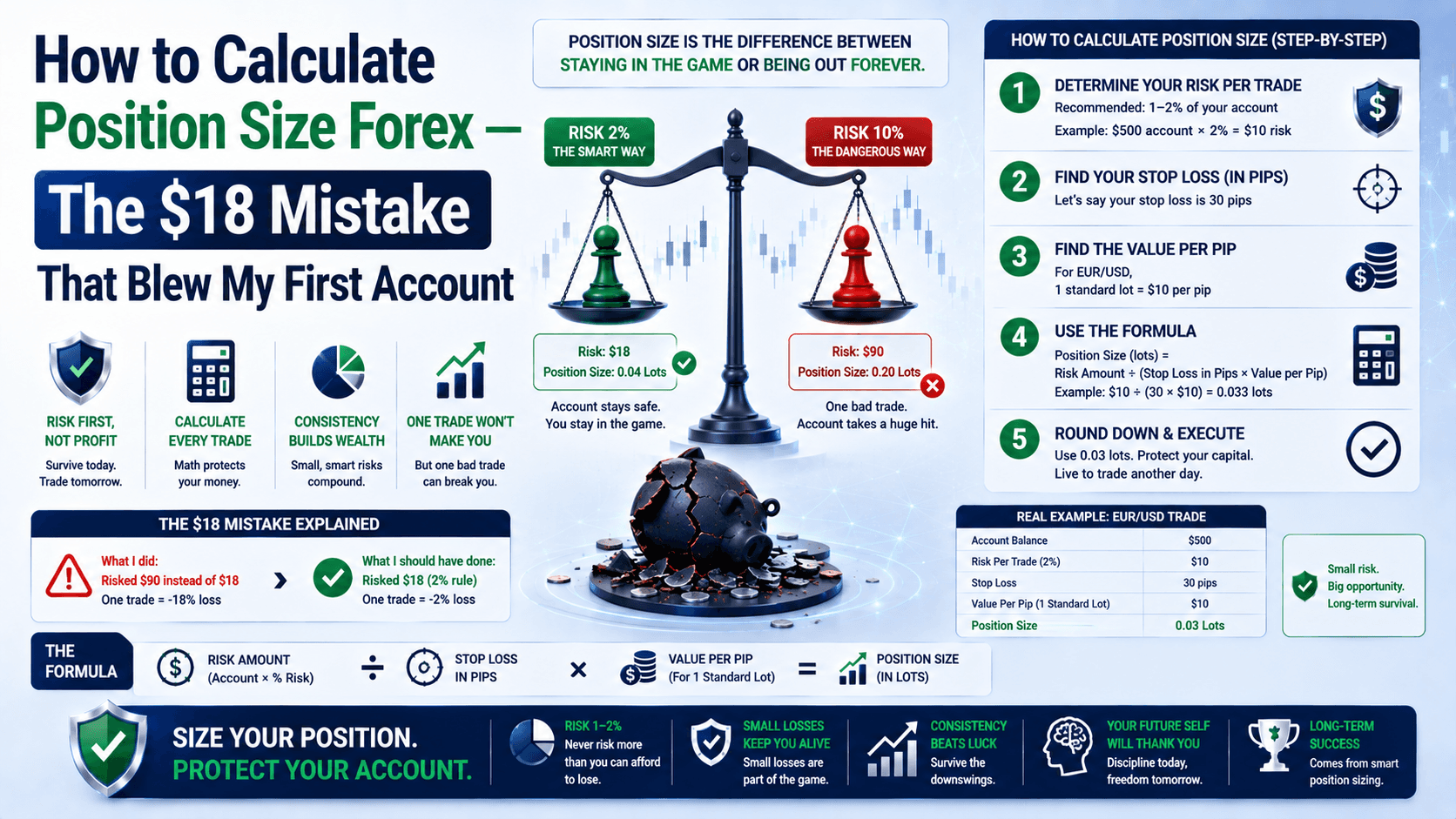
Here's a story that might sound familiar. I opened my first forex account with $500. I saw a "sure thing" setup on EUR/USD at 1.0850. The price was about to break resistance, or so I thought. I bought 1 standard lot — $100,000 worth of currency. My account was $500. The trade went against me by 20 pips. That's $200 loss. My account was down 40% in one trade. It took me months to understand what happened: I had no idea how to calculate position size forex.
The worst part? I knew about stop losses. I just didn't know how to connect them to the size of my trade. That's the gap most beginners face. You know you should use a stop loss. But you don't know how to use it to calculate the right lot size. Let me show you exactly how to fix this — with real numbers you can use today.
How to Calculate Position Size Forex: The Simple Formula
The formula is straightforward. You don't need a finance degree. You need three numbers:
- Account balance — Total money in your trading account
- Risk percentage — How much of your account you're willing to lose on one trade
- Stop loss distance — How many pips between your entry and your stop loss
Here's the formula:
Position Size (in lots) = (Account Balance × Risk %) ÷ (Stop Loss in pips × Pip Value per lot)
Let me walk you through a real example. Say you have a $2,000 account. You want to risk 1% per trade — that's $20. Your stop loss is 20 pips away. For EUR/USD, 1 standard lot (100,000 units) has a pip value of $10.
Position size = ($2,000 × 0.01) ÷ (20 × $10) = $20 ÷ $200 = 0.1 lots
That's 0.1 standard lots, or 1 mini lot. If your stop gets hit, you lose $20 — exactly 1% of your account. No surprises. No blown accounts. That's how to calculate position size forex correctly.
Why Risk Percentage Matters More Than Win Rate
Most beginners obsess over win rate. "I want to win 80% of my trades!" They forget that even a 60% win rate can lose money if you risk too much on each trade. Let me show you why.

Imagine two traders. Both have $5,000 accounts. Both have a 60% win rate and a 1:1 risk-reward ratio. But Trader A risks 2% per trade. Trader B risks 10% per trade.
| Metric | Trader A (2% risk) | Trader B (10% risk) |
|---|---|---|
| Account | $5,000 | $5,000 |
| Risk per trade | $100 | $500 |
| Win rate | 60% | 60% |
| After 10 trades (6 wins, 4 losses) | $5,200 (+$200) | $5,000 ($0 net) |
| After 5 consecutive losses | $4,500 (down 10%) | $2,500 (down 50%) |
See what happens? Trader B has a 50% drawdown after just 5 losses. To recover from a 50% loss, you need a 100% gain. That's nearly impossible. Trader A recovers easily. That's why understanding how to calculate position size forex is the single most important risk management skill you can learn.
Common Mistakes When Calculating Position Size
Here are the three mistakes I see most often — and how to avoid them:
Mistake 1: Using the Wrong Pip Value
Pip value changes depending on the currency pair and lot size. For EUR/USD, 1 pip on a standard lot is $10. For USD/JPY, it's different. Always check your broker's pip value calculator before entering a trade.
Mistake 2: Ignoring the Spread
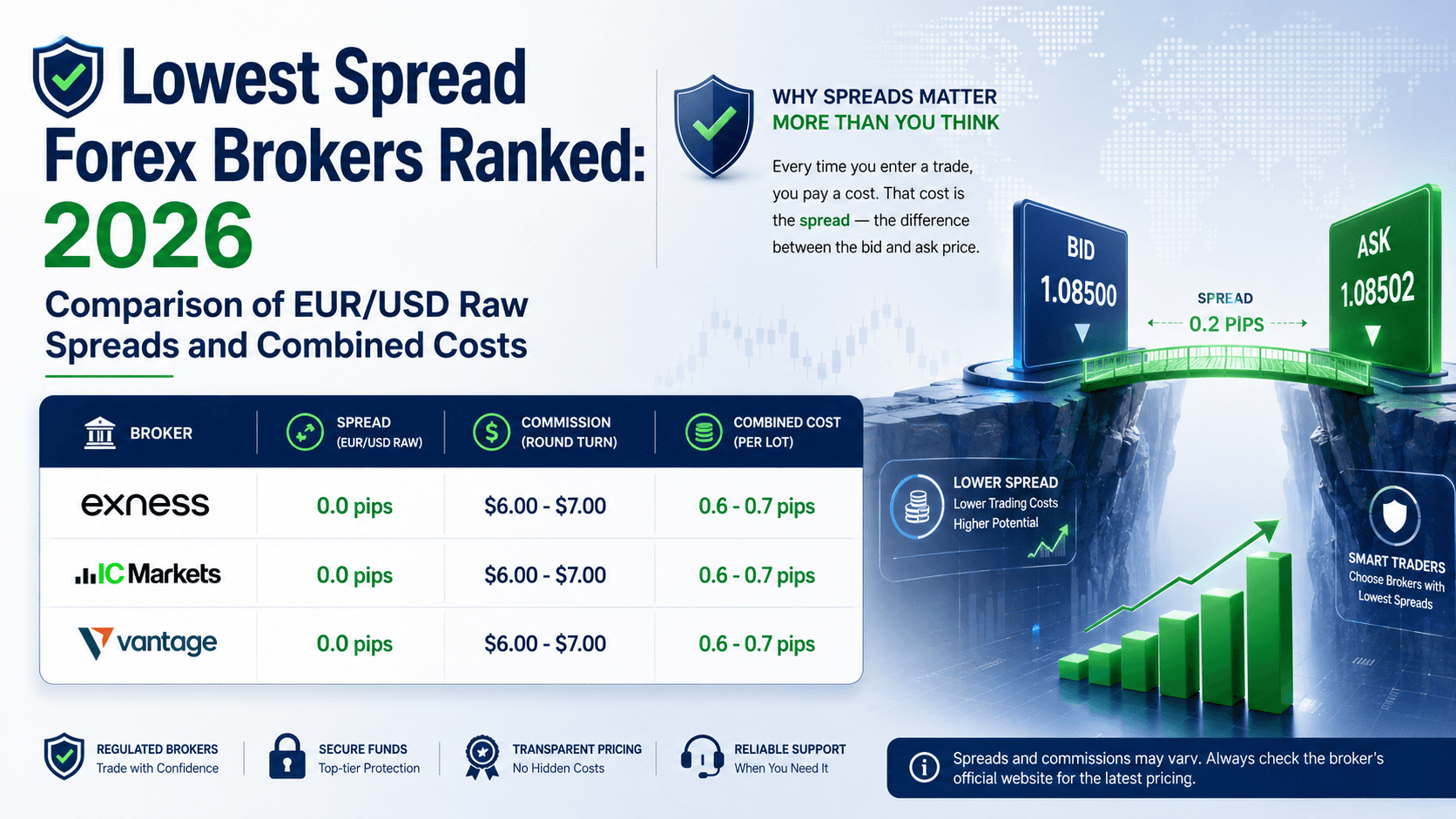
The spread is the difference between the bid and ask price. If you enter a trade and the spread is 2 pips, you're already down 2 pips before the market moves. Factor this into your stop loss distance. If your stop is 20 pips away and the spread is 2 pips, your effective risk is 22 pips.
Mistake 3: Changing Risk Percentage Based on "Feeling"
I see beginners risk 1% on a "safe" trade and 5% on a "sure thing." This is gambling, not trading. The market doesn't care how confident you feel. Stick to a fixed percentage. That's the discipline that makes how to calculate position size forex work for you.
How to Calculate Position Size Forex for Small Accounts
If you have a small account — say $500 or less — you need to be extra careful. Here's the problem: 1% of $500 is $5. If your stop loss is 20 pips on EUR/USD, and 1 pip on a standard lot is $10, then 20 pips × $10 = $200. You can't even trade 0.01 lots (which would risk $2 per pip).
The solution? Use a broker that offers micro lots (0.01 lots = 1,000 units). With a micro lot, 1 pip on EUR/USD is worth $0.10. So 20 pips × $0.10 = $2. That's within your 1% risk limit ($5).
Here's the calculation for a $500 account with 1% risk and a 20-pip stop on EUR/USD:
Position size = ($500 × 0.01) ÷ (20 × $0.10) = $5 ÷ $2 = 2.5 micro lots (0.025 lots)
Most brokers don't allow fractional micro lots. So round down to 0.02 lots. Your actual risk becomes $4 (0.8% of $500). That's fine. Always round down, never up.
FAQ
How do I calculate position size forex without a calculator?
Use the formula: (Account Balance × Risk %) ÷ (Stop Loss in pips × Pip Value per lot). For EUR/USD with a standard lot, pip value is $10. For a mini lot, it's $1. For a micro lot, it's $0.10.

What is the best risk percentage for forex trading?
Most professional traders risk 1-2% per trade. Beginners should start at 1%. Never exceed 3% unless you have a proven, profitable system and a large account.
Can I calculate position size forex for multiple trades at once?
Yes. Add up the risk from all open positions. If you have two trades open, each risking 1% of your account, your total risk is 2%. Make sure total risk never exceeds your maximum (usually 5-6%).
Do I need to calculate position size for every trade?
Yes. Every single trade. It takes 30 seconds. Skipping this step is how accounts get blown. Make it a non-negotiable part of your routine.
📝 Quick Recap
- Position size = (Account × Risk %) ÷ (Stop loss pips × Pip value)
- Risk 1-2% per trade — never more
- Always factor in the spread
- Use micro lots for small accounts
- Round down, never up
Your Quick Win
Open your trading platform right now. Look at your account balance. Pick a currency pair — EUR/USD is easiest. Set a hypothetical stop loss 20 pips away. Calculate your position size using the formula above. Write it down. Do this for 5 different pairs. By the time you're done, you'll know how to calculate position size forex without thinking. That's the skill that saves your account.