
Let's get something straight.
You're not a bad trader. You're an untrained one when it comes to managing your impulses.
There's a massive difference.
A bad trader keeps making the same mistakes and blames the market. An untrained trader makes mistakes, learns from them, and gets better.
The fact that you're here, reading this, learning? That already puts you ahead of 80% of people who call themselves "traders."
Now let's make sure you stay ahead.
I've been trading for over a decade. I've blown accounts. I've taken trades that made zero sense — clicking "buy" on EUR/USD at 1.0850 because I saw a green candle and panicked I was missing out. Sound familiar?
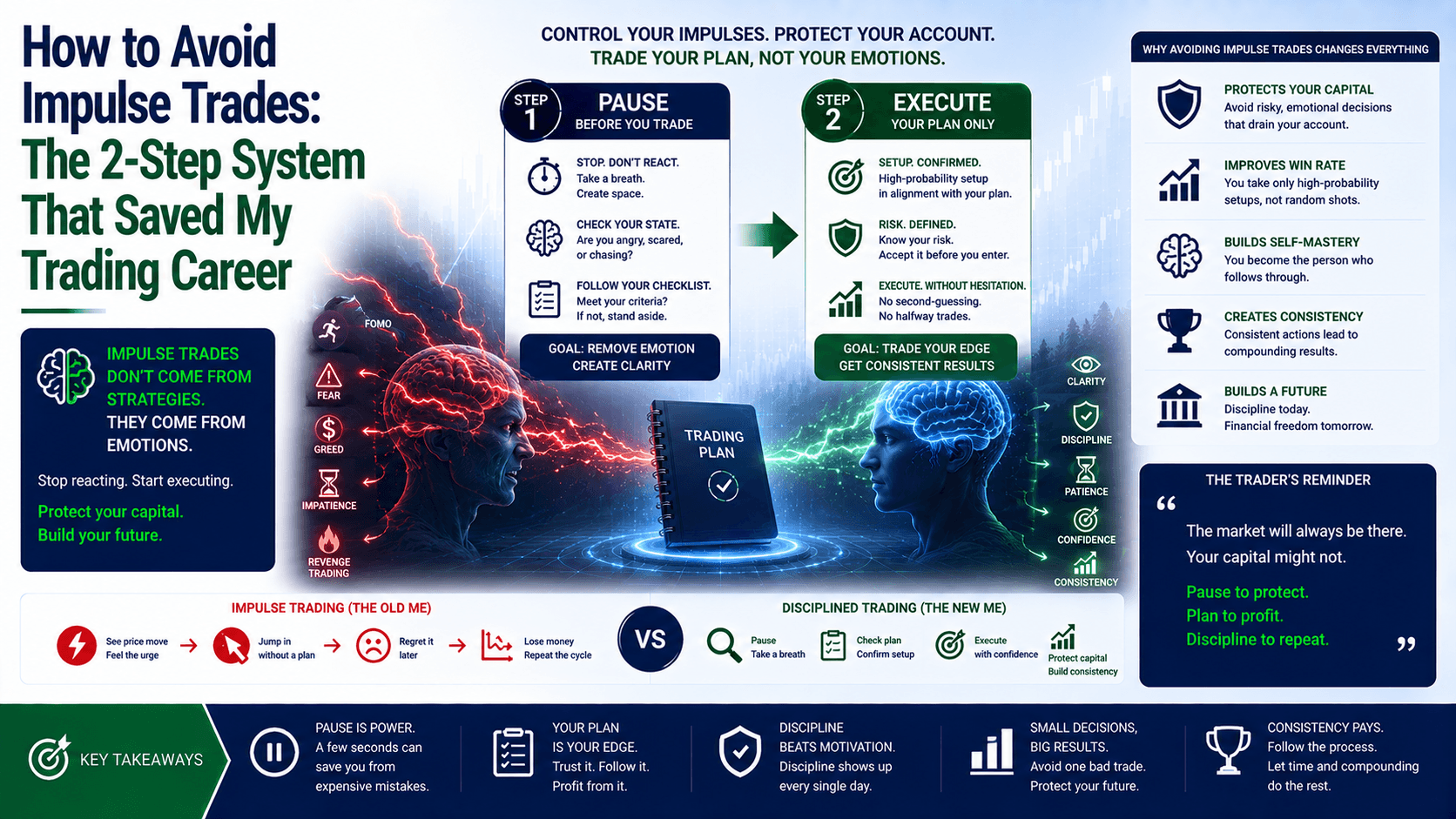
Here's the truth: how to avoid impulse trades isn't about finding the perfect strategy. It's about rewiring your brain to pause before you click.
And it's simpler than you think.
Why Willpower Alone Won't Stop Impulse Trades
Most traders think they can "just be more disciplined."
Then the market opens. Gold drops $5 in 2 minutes. Your heart races. You buy the dip at $2,345 without checking support. Price drops another $10. You're down $100 on 0.1 lots in 30 seconds.
Willpower didn't help. Your biology took over.
Impulse trading isn't a strategy problem — it's a mental state problem. Your brain's amygdala (the fear center) hijacks your prefrontal cortex (the rational part) when it senses urgency or loss.
The solution isn't to fight your brain. It's to interrupt the pattern before the impulse becomes a trade.
| Approach | What Happens | Result |
|---|---|---|
| Willpower only | You resist for a while, then snap | Blown account within 3 months |
| System + Routine | You interrupt impulses before they become trades | Consistent execution, fewer losses |
| No system, just "try harder" | Same mistakes, more frustration | Quit trading or keep losing |
The 2-Step System to Eliminate Impulse Trades
I use two tactics every single day. They've saved my account more times than I can count.
Step 1: The Pre-Trade Routine That Rewires Your Brain
Before you open your chart, do this:
- Write down exactly what you're trading today — which pairs, which strategies
- Write down why you follow this strategy — "It gives me 2:1 risk-reward when I follow the rules"
- Write down what you will NOT do — "No trades outside my setup. No chasing breakouts."
- Write down what you'll do instead — "If no setup forms, I'll close the chart and walk away."
Here's the key: put this list on a physical piece of paper next to your monitor. Not a digital note. A real piece of paper.
When you feel the urge to trade, look at that paper. Read it out loud.
This takes 5 minutes. It's non-negotiable.
Step 2: Commentate Every Price Move
This is the game-changer.
While you're watching the chart, talk to yourself out loud. Describe what price is doing:
- "EUR/USD is at 1.0845. It's bouncing off the 1.0830 support. No setup yet."
- "Gold is at $2,350. It just broke below the moving average. I'm waiting for a retest before considering a short."
- "No setup forming. I'm staying out. If price reaches 1.0860, I might look for a rejection candle."
Why does this work? Because your brain can't simultaneously talk through analysis and act on impulse. The commentary keeps your rational mind engaged.
When you stop talking, that's when the impulse sneaks in.
| Scenario | Without Commentary | With Commentary |
|---|---|---|
| Price drops fast | You buy the dip impulsively | You say "Price is dropping. No setup yet. I wait." |
| Price breaks out | You chase the breakout | You say "Breakout happening. I wait for retest." |
| No movement | You force a trade out of boredom | You say "No setup. I close the chart." |
The Wrong Way vs. The Right Way
Let me show you how this plays out in real life.

The Wrong Way:
It's Tuesday morning. EUR/USD is at 1.0840. You see a big green candle. FOMO hits. You buy at 1.0842 without checking anything. Price drops to 1.0835. You panic sell at 1.0836. You lose $6 on 0.1 lots. But the real damage? You're now tilted. You take another bad trade. Then another. By lunch, you're down $40.
The Right Way:
Same scenario. You do your pre-trade routine. You write down your rules. You start commentating: "Green candle at 1.0840. This could be a breakout. I wait for a retest to 1.0835 and a rejection candle. If it holds, I enter at 1.0837 with a stop at 1.0825. Target 1.0860."
Price retests 1.0835. It holds. You enter. Price reaches 1.0860. You make $23 on 0.1 lots.
Same market. Same setup. Different result.
The difference? You interrupted the impulse.
Why This System Works (The Neuroscience)
Your brain has two systems:
- System 1: Fast, automatic, emotional. This is where impulse trades come from.
- System 2: Slow, deliberate, rational. This is where good trades come from.
Commentating forces you into System 2. You can't be emotional and analytical at the same time. The act of speaking out loud activates your prefrontal cortex and calms your amygdala.
It's like having a coach sitting next to you, telling you what to do. Except that coach is you.
What to Do When You Still Take an Impulse Trade
It happens. Even to me.
When it does, don't beat yourself up. Do this:
- Close the chart immediately. Walk away for 10 minutes.
- Write down what happened. What triggered it? What were you feeling? What did you skip?
- Identify the gap. Did you skip your pre-trade routine? Did you stop commentating?
- Reset. Do your pre-trade routine again before you touch the charts.
The goal isn't perfection. It's progress. Each time you catch an impulse before it becomes a trade, you're rewiring your brain.
FAQ
How long does it take to stop impulse trading?
Most traders see results within 2-3 weeks of consistent practice. But the habit needs to be maintained. Even experienced traders can slip if they stop their routine.

Can I use these techniques for crypto trading?
Yes. The principles work for any market — forex, crypto, stocks, or commodities. The key is the mental state, not the asset.
What if I'm too impulsive to stick with a routine?
Start smaller. Just do the pre-trade routine for 3 days. Then add commentary. Build the habit gradually. Even 5 minutes of preparation is better than none.
Do I need to commentate all day?
No. Only when you're actively watching the chart. If no setups are forming, take a break. Come back when the market gets interesting.
Quick Recap
- Impulse trades come from your emotional brain, not your rational one
- Willpower alone won't work — you need a system
- Do a 5-minute pre-trade routine before every session
- Commentate every price move to stay rational
- When you slip, write down what happened and reset
- Consistency beats intensity — do it every day
Your Quick Win (Do This Today)
Open your notepad right now. Write down 3 things:
- The one setup you're trading today
- The one rule you will not break
- What you'll do if no setup forms
Put this paper next to your monitor. Before you trade, read it out loud.
That's it. That's the start.
Now it's your turn.