
You're Doing It Wrong (And I Know Because I Did It Too)
Let me guess. You found a "sure thing" setup on EUR/USD. The chart looked perfect. You went all in — maybe 5%, maybe 10% of your account. And then price did what price always does: it went against you. Suddenly, you're down $500 on a $2,000 account. Your heart's racing. You're staring at the screen, praying for a reversal that never comes.
Sound familiar?
I blew my first account doing exactly this. I turned $5,000 into $1,200 in three weeks. My wife asked where the money went. I told her it was "invested in education." She said, "You could've taken an actual class for less." She wasn't wrong.
The thing is, how much to risk per trade beginner is the single most important question you'll ever answer as a trader. Get it right, and you survive long enough to learn. Get it wrong, and you're out before you even understand what happened.
The 1% Rule — Your New Religion
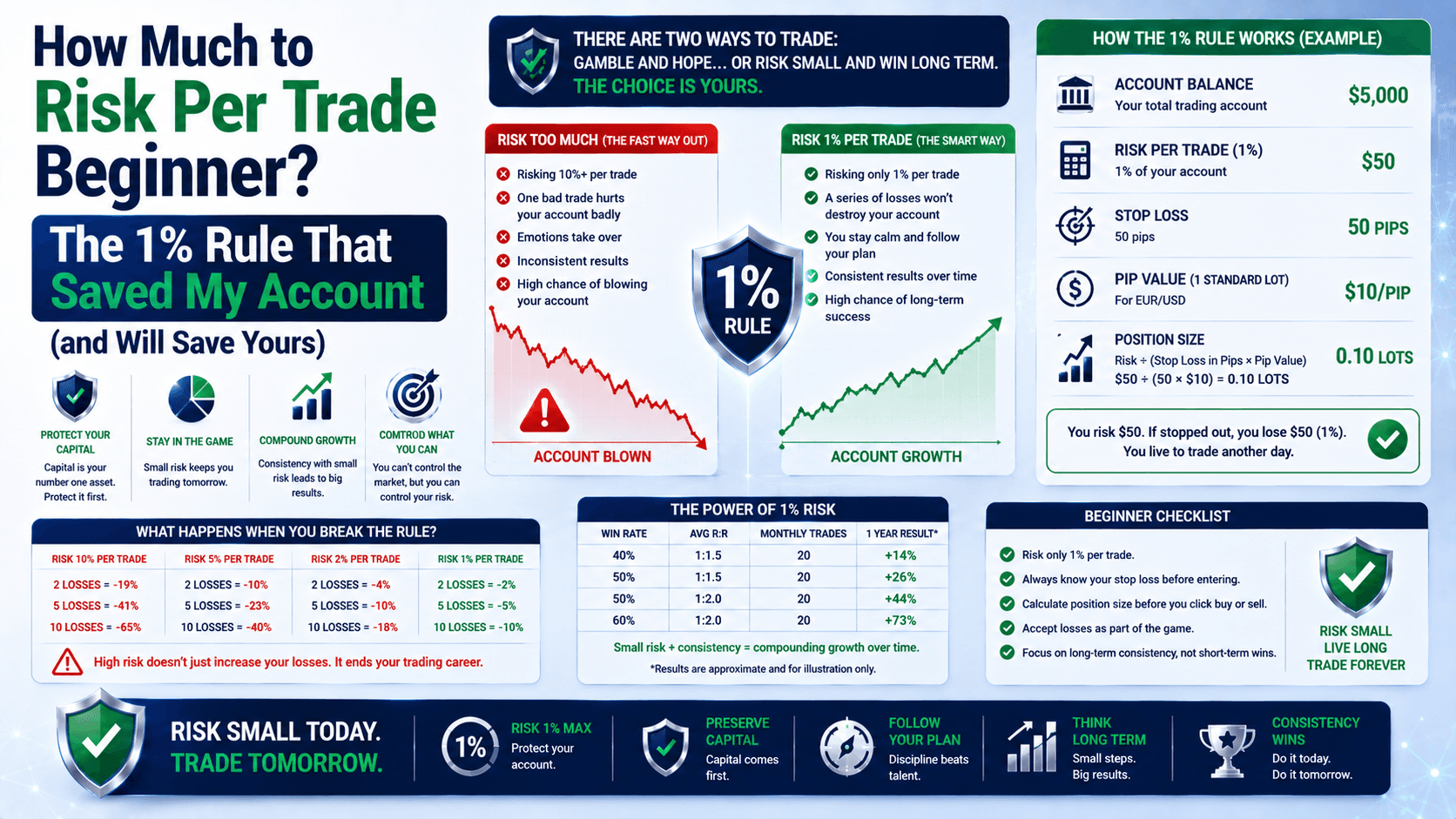
Here's the rule that changed everything for me: Never risk more than 1% of your account on a single trade.
I don't care if you think you found the trade of the century. I don't care if your analysis is so perfect it could make Warren Buffett jealous. Stick to 1%.
Let me show you why with real numbers.
You have a $5,000 account. Risking 1% means your maximum loss per trade is $50.
Now, let's say you take a trade on EUR/USD at 1.0850 with a 50-pip stop loss. On a standard lot (100,000 units), each pip is worth $10. So 50 pips × $10 = $500 risk. That's 10% of your account — way too much.
Here's how to fix it:
- Drop to 0.1 lots: Each pip is worth $1. 50 pips × $1 = $50 risk. That's exactly 1%.
- Or tighten your stop to 25 pips on 0.1 lots: 25 pips × $1 = $25 risk. That's 0.5%.
See how the math works? You're not guessing. You're calculating.
What Happens If You Ignore This?
Let's run the numbers on the wrong way:
| Risk Per Trade | Account Size | Loss Per Trade | Trades to Lose 50% |
|---|---|---|---|
| 10% | $5,000 | $500 | 5 trades |
| 5% | $5,000 | $250 | 10 trades |
| 2% | $5,000 | $100 | 25 trades |
| 1% | $5,000 | $50 | 50 trades |
At 10% risk, five bad trades and you're down 50%. At 1%, you can lose 50 trades in a row and still have over 60% of your account left. That's the difference between surviving and blowing up.
How to Calculate Your Position Size (The Simple Formula)
Here's the formula that saved my trading life. Write it down:

Position Size = (Account Balance × Risk %) ÷ (Stop Loss in Pips × Pip Value)
Let's break it down with a real example:
- Account: $10,000
- Risk: 1% = $100
- Stop loss: 50 pips
- Pip value on 0.1 lots: $1
Calculation: $100 ÷ (50 × $1) = 2. So you trade 0.2 lots.
That's it. That's all you should be trading. Not 1 lot. Not 5 lots. 0.2 lots.
Pro tip: Most brokers have a position size calculator built into their platform. Use it. Every single time.
The Wrong Way vs. The Right Way
The Wrong Way:
You see Gold (XAU/USD) at $2,350. You're convinced it's going to $2,400. You buy 1 lot (100 ounces). Your stop is 20 pips away. That's $2,000 risk on a $10,000 account — 20%. One bad move and you're down 20% in minutes.
The Right Way:
Same setup. Same conviction. But this time, you calculate first.
- Account: $10,000
- Risk: 1% = $100
- Stop: 20 pips
- Pip value on 0.1 lots: $10
- Position size: $100 ÷ (20 × $10) = 0.05 lots
You buy 0.05 lots. If price hits your stop, you lose $100 — not $2,000. You're still in the game. You can trade tomorrow.
Common Beginner Mistakes (And How to Avoid Them)
Mistake #1: Moving Your Stop Loss
You set your stop at 1.0800. Price drops to 1.0805. You think, "It'll come back." You move your stop to 1.0780. Price drops to 1.0775. Now you're down 75 pips instead of 50. Your $50 loss just became $75.
Fix: Set your stop before you enter. Never change it. Treat it like a contract.
Mistake #2: Revenge Trading After a Loss
You lose $50 on your first trade. You're angry. You take another trade — this time with 2% risk. You lose again. Now you're down $150. You take a third trade with 5% risk. You lose that too. Your $50 loss just became $400.
Fix: After a loss, walk away. Close the charts. Go for a walk. Come back tomorrow.
Mistake #3: Risking Too Much on "High Probability" Setups
You see a perfect setup. Everything lines up. You think, "This one is different. I'll risk 3%."
It's never different. The market doesn't care about your analysis.
Fix: Every trade gets the same risk. 1%. No exceptions.
FAQ
Is 2% risk per trade safe for beginners?
It's the upper limit for experienced traders. For beginners, start at 0.5% to 1%. Your goal is survival, not speed. You can increase risk once you're consistently profitable.

How much money do I need to start forex trading with proper risk management?
With a $500 account and 1% risk, you're risking $5 per trade. That's enough to trade 0.01 lots on most pairs. Start with a demo account until you can consistently risk 1% without emotional stress.
What if my stop loss is too tight and I get stopped out often?
Your stop loss should be based on market structure, not a fixed number. Use the Average True Range (ATR) indicator to set stops that account for current volatility. A 20-pip stop on a quiet day might be fine. On a news day, you might need 40 pips.
Can I risk more if my win rate is high?
No. Even a 70% win rate means you lose 3 out of 10 trades. A few bad trades at high risk can wipe out weeks of gains. Keep risk consistent and let your edge play out over time.
📝 Quick Recap
- Risk 1% of your account per trade — no exceptions
- Calculate position size using the formula: (Account × Risk %) ÷ (Stop in pips × Pip value)
- Never move your stop loss once set
- After a loss, walk away — no revenge trading
- Every trade gets the same risk percentage
Your Quick Win (Do This Today)
Open your trading platform right now. Find the position size calculator. Enter your account balance, your risk percentage (start with 1%), and a 50-pip stop loss. What lot size does it give you?
Write that number down. That's your maximum position size for your next trade.
Now open a demo account. Place a trade with that exact lot size. Watch what happens. If you feel any stress, cut the risk to 0.5%. Your goal is to make trading boring — because boring is profitable.