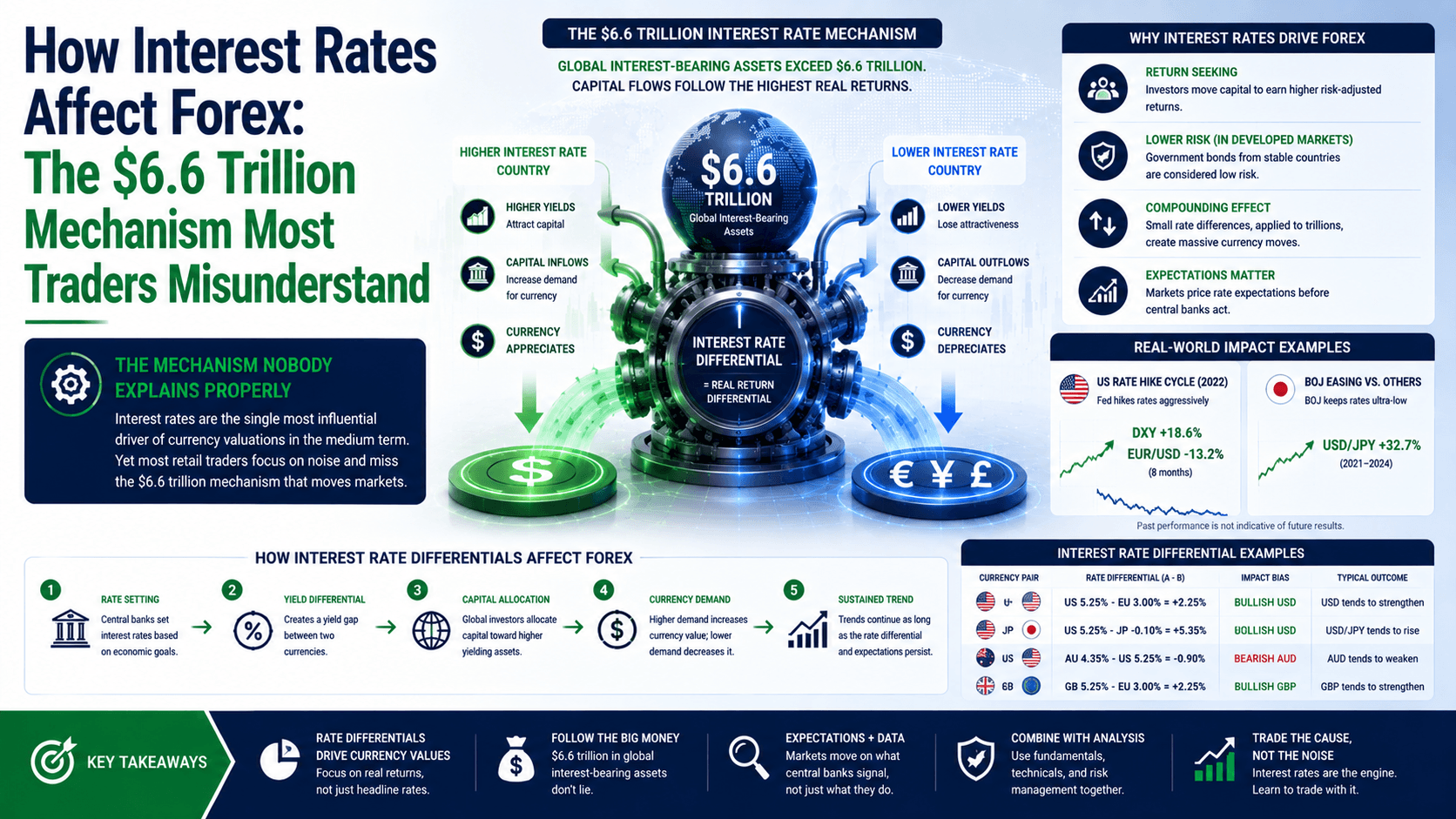

The Mechanism Nobody Explains Properly
Interest rates are the single most influential driver of currency valuations in the medium term. Yet most retail traders treat them as background noise — something to glance at between candlestick patterns and RSI readings.
That's a costly mistake.
Here's the reality: when the Federal Reserve shifts its rate by 25 basis points, it can trigger a $100 billion repositioning in currency markets within hours. The EUR/USD pair alone moves an average of 80-120 pips on major rate decision days. On a standard 0.1 lot, that's $80-$120 in profit or loss — in a single session.
Understanding how interest rates affect forex isn't optional. It's the difference between trading with the current and fighting against it.
The Core Logic: Capital Follows Yield
The mechanism behind how interest rates affect forex is surprisingly straightforward. It's not about magic or complex algorithms. It's about where money earns the best return.
When a country raises its interest rate, its government bonds and savings accounts become more attractive to global investors. A US Treasury bond yielding 5% is more appealing than a German Bund yielding 2.5%. To buy those US bonds, international investors must first purchase US dollars. That increased demand pushes the dollar higher.
The reverse is equally true. A rate cut reduces the yield on a country's assets. Investors sell, convert back to their home currency, and the currency weakens.
Data from the Bank for International Settlements confirms that interest rate differentials explain approximately 70% of medium-term currency movements among G10 pairs. The remaining 30% comes from risk sentiment, trade flows, and geopolitical events.
The Interest Rate Cycle: Expansion vs. Contraction
Central banks don't change rates randomly. They follow a predictable cycle tied to the broader economy.
| Economic Phase | Central Bank Action | Expected Currency Impact |
|---|---|---|
| Strong growth, rising inflation | Rate hike | Currency appreciates |
| Moderate growth, stable inflation | Rate hold | Currency stable or trend-dependent |
| Weak growth, falling inflation | Rate cut | Currency depreciates |
| Recession, deflation risk | Aggressive rate cuts | Sharp currency depreciation |
Consider the US economy in 2023-2024. Inflation peaked at 9.1% in June 2022. The Federal Reserve responded with 11 rate hikes, taking the federal funds rate from near zero to 5.5%. The US Dollar Index (DXY) surged from 95 to 107 during this period — a 12.6% gain.
Now contrast that with the Eurozone. The European Central Bank raised rates later and more slowly. EUR/USD dropped from 1.1500 to below 1.0500 — a loss of nearly 1,000 pips for anyone long the euro.
This is how interest rates affect forex in practice. Not in theory. In real, measurable price movement.
The Inflation Connection: Why Central Banks Act
Inflation is the trigger that forces central banks to act. A common misconception is that central banks target low inflation for its own sake. The real reason is more practical: high inflation erodes purchasing power, destabilizes business planning, and ultimately weakens a currency's role as a store of value.

The Federal Reserve targets 2% inflation, measured by the Personal Consumption Expenditures (PCE) Price Index. When PCE runs above 2%, markets price in rate hikes. When it falls below, rate cuts become more likely.
Here's the data that matters:
- US CPI (Consumer Price Index): Released monthly. A 0.2% miss above expectations can move EUR/USD 30-50 pips within minutes.
- US Non-Farm Payrolls: Strong employment gives the Fed room to hike. Weak data pressures them to cut.
- Retail Sales: Consumer spending drives 70% of US GDP. Strong sales = inflationary pressure = rate hikes.
A concrete example: On June 13, 2023, US CPI came in at 4.0% versus expectations of 4.1%. The slight miss signaled that inflation was cooling faster than expected. Markets immediately repriced rate cut expectations. EUR/USD jumped from 1.0780 to 1.0860 — 80 pips in under an hour. On a 0.5 lot, that's $400.
Market Expectations vs. Reality: The Surprise Factor
Here's where most traders get it wrong. The market doesn't react to the rate decision itself. It reacts to how that decision compares to expectations.
If the market expects a 25 basis point hike and gets exactly that, the currency barely moves. But if the market expects a hold and gets a hike — or vice versa — the reaction can be explosive.
| Market Expectation | Actual Decision | Typical Currency Reaction |
|---|---|---|
| Rate hike | Rate hike | Minimal movement (already priced in) |
| Rate hold | Rate hold | Minimal movement |
| Rate hold | Rate hike | Sharp appreciation (surprise) |
| Rate hike | Rate hold | Sharp depreciation (disappointment) |
| Rate cut | Rate cut | Minimal movement |
| Rate hold | Rate cut | Sharp depreciation (surprise) |
The July 2008 Reserve Bank of New Zealand decision illustrates this perfectly. The market expected a hold at 8.25%. Instead, the RBNZ cut to 8.00%. NZD/USD dropped from 0.7497 to 0.7414 — 83 pips in under 10 minutes. Traders who were short one standard lot made $830 in minutes.
The lesson: don't trade the decision. Trade the surprise relative to consensus.
Interest Rate Differentials: The Trader's Edge
An interest rate differential is simply the difference between two countries' interest rates. This is the foundation of the carry trade and a key input for medium-term directional bias.
As of early 2025, the Federal Reserve rate stands at 4.50%, while the European Central Bank rate is 3.25%. The differential is 125 basis points in favor of the USD. This means, all else being equal, capital should flow toward USD-denominated assets.
But the expected future differential matters more than the current one. Markets price in forward rates using futures contracts. If the market expects the Fed to cut 100 bps over the next year while the ECB cuts only 50 bps, the differential narrows. That narrowing weakens the USD against the EUR.
This is why implied rates — derived from futures markets — are more useful than current rates for forecasting. They tell you what the market has already priced in. Your job is to find where the market is wrong.
A Practical Framework for Trading Rate Decisions
Here's a step-by-step approach used by institutional traders:
- Monitor the economic calendar for central bank meetings (FOMC, ECB, BOE, BOJ, RBA, RBNZ). These are scheduled in advance.
- Track consensus expectations using sources like Bloomberg, Reuters, or the CME FedWatch Tool. Know what the market expects.
- Watch for guidance shifts in the weeks before the meeting. Central bank speeches, minutes, and economic data releases all provide clues.
- Identify the surprise scenario. What would cause the biggest move? A hawkish surprise (rate hike when hold was expected) or a dovish surprise (rate cut when hold was expected)?
- Plan both directions. Have a long and short plan with specific entry, stop loss, and target levels. The market can move violently in either direction.
- Wait for the release. Don't trade before the announcement unless you have a strong edge. The spread widens, and liquidity drops.
- Let the initial spike settle. The first 1-2 minutes can be chaotic. Wait for the first 5-minute candle to close, then enter in the direction of the trend.
A real-world example: Ahead of the September 2024 FOMC meeting, the consensus was a 25 bps cut. The CME FedWatch Tool showed a 65% probability of 25 bps and 35% of 50 bps. The actual decision was 50 bps. The surprise triggered a sharp USD sell-off. EUR/USD rallied from 1.1020 to 1.1150 — 130 pips — within 30 minutes. Traders positioned for the surprise made $1,300 on a standard lot.
Common Mistakes Retail Traders Make
After a decade of watching traders navigate rate decisions, I've identified three recurring errors:

Mistake #1: Trading the decision, not the expectation. Most traders buy the currency before the announcement, hoping for a hike. When the hike comes as expected, the currency doesn't move. They sit in a losing trade as the market sells the news. The fix: wait for the surprise.
Mistake #2: Ignoring the forward guidance. The rate decision is only half the story. The accompanying statement and press conference reveal the central bank's future bias. A rate hike with dovish language (signaling future cuts) can actually weaken the currency. Read the full statement.
Mistake #3: Overleveraging on news. Rate decisions are high-volatility events. Spreads can widen to 10-20 pips during the first minute. Slippage is common. Using 50:1 leverage on a news trade is a recipe for a margin call. Reduce position size by 50% for news trades.
FAQ
How do interest rates affect forex prices in the short term?
In the short term, interest rate decisions and the surprise factor relative to market expectations drive immediate price movement. A surprise hike typically causes sharp appreciation within minutes. The effect can last from hours to days depending on the magnitude of the surprise and accompanying guidance.
What is the relationship between inflation and interest rates in forex?
Inflation is the primary driver of interest rate decisions. Rising inflation forces central banks to hike rates, which strengthens the currency. Falling inflation allows rate cuts, which weakens the currency. Traders monitor inflation data (CPI, PCE) to predict future rate changes.
Can you trade forex based on interest rate differentials alone?
Interest rate differentials provide a strong directional bias but should not be used alone. Combine them with technical analysis — support/resistance levels, trend lines, and candlestick patterns — for entry and exit timing. The differential tells you where the market might go; technicals tell you when to enter.
How do I track central bank interest rate decisions?
Use an economic calendar (Forex Factory, Investing.com) that lists all central bank meetings. For the Fed, use the CME FedWatch Tool for real-time probability estimates. For other central banks, check Bloomberg or Reuters for consensus forecasts. Set alerts 15 minutes before the announcement.
Quick Recap
- Interest rates drive currency values by influencing capital flows toward higher yields
- Market expectations matter more than the actual decision — trade the surprise
- Inflation data (CPI, PCE) is the leading indicator for future rate changes
- Interest rate differentials provide medium-term directional bias
- Always combine fundamental analysis with technical confirmation for entry timing
Quick Win
Open your economic calendar right now. Find the next FOMC meeting date. Go to the CME FedWatch Tool and check the current probability of a rate hike, hold, or cut. Write down the consensus expectation. Now ask yourself: what would be the surprise scenario? That's your trading opportunity. Mark your calendar and prepare your plan.