
Inflation and Forex: The Fundamental Link Most Traders Miss
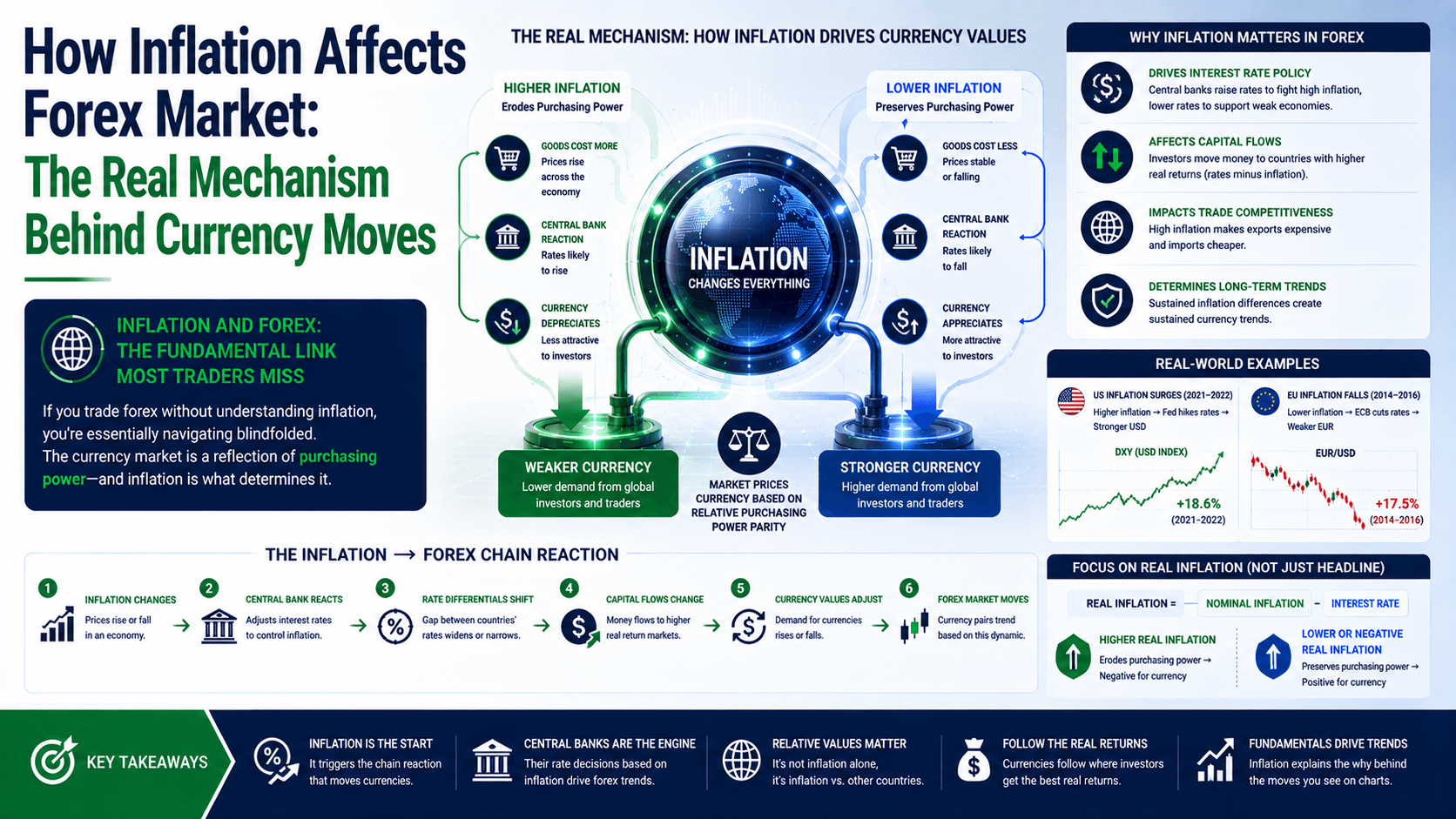
If you trade forex without understanding inflation, you're essentially navigating blindfolded. The data is clear: between 2022 and 2023, as U.S. inflation surged from 3% to over 9%, the Federal Reserve responded with aggressive rate hikes. The result? The U.S. Dollar Index (DXY) strengthened by nearly 20% against a basket of major currencies.
This wasn't random. It was a textbook example of how inflation affects forex market dynamics. Yet most retail traders focus exclusively on technical patterns, ignoring the fundamental force that drives 70% of medium-term currency trends.
Let's break down exactly how this mechanism works — and how you can use it to make better trading decisions.
The Core Mechanism: Why High Inflation Weakens a Currency
Inflation represents the erosion of purchasing power. When a country's inflation rate rises, each unit of its currency buys fewer goods and services than before. This fundamental weakness naturally makes the currency less attractive to foreign investors and international traders.
The logic is straightforward: if you're an investor choosing between holding U.S. dollars yielding 2% real return versus Australian dollars yielding 4% real return, capital flows toward the higher real return. This flow of capital directly impacts exchange rates.
Real-world example: In 2022, Argentina experienced inflation exceeding 100%. Despite the central bank's interventions to stabilize the peso, the currency lost over 40% of its value against the U.S. dollar. The market priced in the erosion of purchasing power faster than any government intervention could counteract.
The Interest Rate Transmission Channel
Central banks use interest rates as their primary tool to combat inflation. When inflation rises above target (typically 2% for most developed economies), central banks raise rates. Higher rates attract foreign capital seeking better returns, which strengthens the currency.
This creates a counterintuitive dynamic: rising inflation can sometimes strengthen a currency if the central bank responds aggressively enough. The U.S. dollar's strength in 2022-2023 is a perfect example. Despite high inflation, the Fed's aggressive rate hikes attracted massive capital inflows.
Trade scenario: In March 2022, EUR/USD traded at 1.1000. The Fed raised rates by 25 basis points while the ECB held steady. A trader who went long USD at this point, buying 0.1 lots of EUR/USD short at 1.1000 with a stop at 1.1050 and target at 1.0800, would have captured 200 pips. On 0.1 lots, that's $200 profit — a 2% return on a $10,000 account in just 3 months.
Exchange Rate Pass-Through: How Currency Moves Affect Prices
Exchange Rate Pass-Through (ERPT) measures how much currency fluctuations affect consumer prices. This is critical for understanding the feedback loop between inflation and exchange rates.

Partial pass-through: When a currency depreciates by 10%, import prices rise by only 3-4%. This happens because businesses absorb some of the cost to remain competitive. The U.S. benefits significantly from this — over 90% of U.S. imports are invoiced in dollars, insulating American consumers from exchange rate shocks.
Full pass-through: In emerging markets, a 10% currency depreciation can lead to a 7-8% increase in consumer prices. This creates a vicious cycle: depreciation fuels inflation, which further weakens the currency.
Data point: Research from the World Bank shows that ERPT in emerging markets has declined since the 2008 financial crisis, from approximately 0.4 to 0.2. This means these economies are now less vulnerable to inflation spikes from currency fluctuations — a positive development for forex traders.
| Factor | Advanced Economies (e.g., U.S., Eurozone) | Emerging Markets (e.g., Brazil, Turkey) |
|---|---|---|
| ERPT Magnitude | 0.3-0.4 (partial pass-through) | 0.6-0.8 (near-full pass-through) |
| Currency Invoicing | 90%+ in domestic currency | 40-60% in foreign currency |
| Central Bank Credibility | High — markets trust policy responses | Variable — credibility affects market reaction |
| Typical Inflation Impact on Currency | Short-term weakness, then stabilization | Prolonged depreciation cycle |
The Wrong Way vs. The Right Way to Trade Inflation Data
The Wrong Way: Trading CPI Releases Blindly
Most beginners see a CPI number and immediately take a position. "Inflation is high, so the dollar should weaken." They enter a trade, get stopped out within hours, and wonder what went wrong.
Example: In June 2022, U.S. CPI came in at 8.6% — higher than expected. A beginner trader, expecting dollar weakness, went long EUR/USD at 1.0700. Within 24 hours, the dollar strengthened as markets priced in more aggressive Fed action. EUR/USD dropped to 1.0500. With a 20-pip stop loss at 1.0680, they lost $20 on a 0.1 lot trade — and missed the bigger move.
The Right Way: Focus on Real Rates and Expectations
Professional traders don't trade inflation itself — they trade the difference between actual inflation and expectations, and the resulting real interest rate differentials.
Real interest rate = Nominal interest rate - Inflation rate
When real rates rise in one country relative to another, capital flows toward the higher real rate, strengthening that currency.
Trade scenario: In October 2023, U.S. CPI came in at 3.7% vs. 3.6% expected. The Fed funds rate was 5.5%. Real rate = 1.8%. Meanwhile, Eurozone CPI was 4.3% with ECB rate at 4.5%. Real rate = 0.2%. The real rate differential favored the USD. A trader who went short EUR/USD at 1.0550 with a stop at 1.0600 and target at 1.0350 would have captured 200 pips. On 0.1 lots, that's $200 profit.
Other Factors That Amplify or Mitigate Inflation's Impact
Political Stability
Political stability is a force multiplier for inflation's effects. In stable environments, central bank credibility allows markets to trust policy responses. In unstable environments, inflation fears trigger capital flight.
Example: Turkey's inflation exceeded 80% in 2022. Political pressure on the central bank to keep rates low despite high inflation led to a 50% depreciation of the Turkish lira against the USD. This contrasts sharply with Brazil, where the central bank's aggressive rate hikes (from 2% to 13.75%) stabilized the real despite similarly high inflation.
Trade Balances
A country with a trade surplus (exporting more than importing) tends to have a stronger currency, which helps contain inflation by making imports cheaper. A trade deficit has the opposite effect.
Data point: Japan's persistent trade deficits in 2022-2023, driven by high energy import costs, contributed to the yen's 20% depreciation against the USD — even as the Bank of Japan maintained ultra-loose policy.
FAQ
Does high inflation always weaken a currency?
Not always. If a central bank responds aggressively with rate hikes, the currency can actually strengthen as higher rates attract foreign capital. The key is the real interest rate differential between countries.

How often should I check inflation data for forex trading?
Focus on monthly CPI releases (usually mid-month) and central bank meetings (typically 6-8 times per year). The market's reaction to these events creates the most significant trading opportunities.
Can I trade inflation using technical analysis alone?
You can, but you're at a disadvantage. Inflation data creates fundamental shifts in currency value that technical patterns often lag behind. Combining fundamental understanding with technical entry points is far more effective.
What's the best currency pair to trade during high inflation?
EUR/USD is the most liquid and responds predictably to U.S. inflation data. For higher volatility, consider USD/JPY during periods of divergent central bank policies, or USD/TRY (Turkish lira) for extreme inflation scenarios.
Quick Recap
- High inflation generally weakens a currency by eroding purchasing power, but aggressive central bank responses can reverse this effect
- Real interest rate differentials (nominal rate minus inflation) drive capital flows and medium-term currency trends
- Exchange Rate Pass-Through varies significantly between advanced and emerging economies, affecting how quickly inflation impacts currency values
- Political stability and trade balances amplify or mitigate inflation's effects on exchange rates
- Trade inflation data by focusing on expectations vs. reality, not the absolute number
Quick Win: Your 5-Minute Action Plan
Open your economic calendar right now. Find the next CPI release for the U.S., Eurozone, or Japan — whichever you trade most. Write down the expected number. Then, look up the current central bank interest rate. Calculate the real rate. If the actual CPI comes in higher than expected, expect the currency to strengthen if the central bank is hawkish, or weaken if it's dovish. This one calculation gives you a directional bias before the trade even starts.