
Hedging vs Stop Loss — The Question Nobody Answers Honestly
You've been there. You set a stop loss on EUR/USD at 1.0850. Price drops to 1.0848, triggers your stop, then bounces straight to 1.0920. You just lost $20 on a 0.1 lot trade — and missed a $70 profit.
That's when someone whispers: "Why not just hedge instead?"
So which is better — hedging or stop loss? The short answer: it depends on your personality, your strategy, and how much time you can watch the charts.
Let me break this down with real numbers, real scenarios, and zero BS. By the end, you'll know exactly which approach fits your trading style.
How Stop Losses Actually Work (And Where They Fail)
A stop loss is an order that automatically closes your trade at a predetermined price. You buy EUR/USD at 1.0850, set your stop at 1.0820 — if price drops 30 pips, you're out with a $30 loss on 0.1 lots.
The good: It's mechanical. You set it and forget it. No emotions, no overthinking. Your risk is fixed before you even enter the trade.
The bad: Three things can screw you:
- Variable spreads: During news events, spreads can widen from 1 pip to 5 pips. Your 30-pip stop becomes a 34-pip stop in reality.
- Market spikes: A sudden 20-pip spike on low liquidity can trigger your stop and reverse immediately. You get stopped out by noise, not by being wrong.
- Interbank market gaps: Between session closes (especially after New York), spreads blow out. Your stop can get hit at a worse price than expected.
Real example: You're long GBP/USD at 1.2650, stop at 1.2620 (30 pips). During the Sydney open, spreads widen to 8 pips. Price dips to 1.2625 on low volume, but with the spread, your stop triggers at 1.2617. You lose 33 pips instead of 30 — and price never even reached 1.2620 on the actual bid.
What Is Hedging in Forex? (Simple Explanation)
Hedging means opening a position in the opposite direction of your current trade. You're long 0.1 lots of EUR/USD at 1.0850. Price drops to 1.0820. Instead of taking the loss, you open a short position of 0.1 lots at 1.0820.
Now you're flat — the loss on your long is exactly offset by the profit on your short. You've paused the trade. No loss taken yet.
The key difference: With a stop loss, the market decides when you close. With hedging, you decide when to close the losing side.
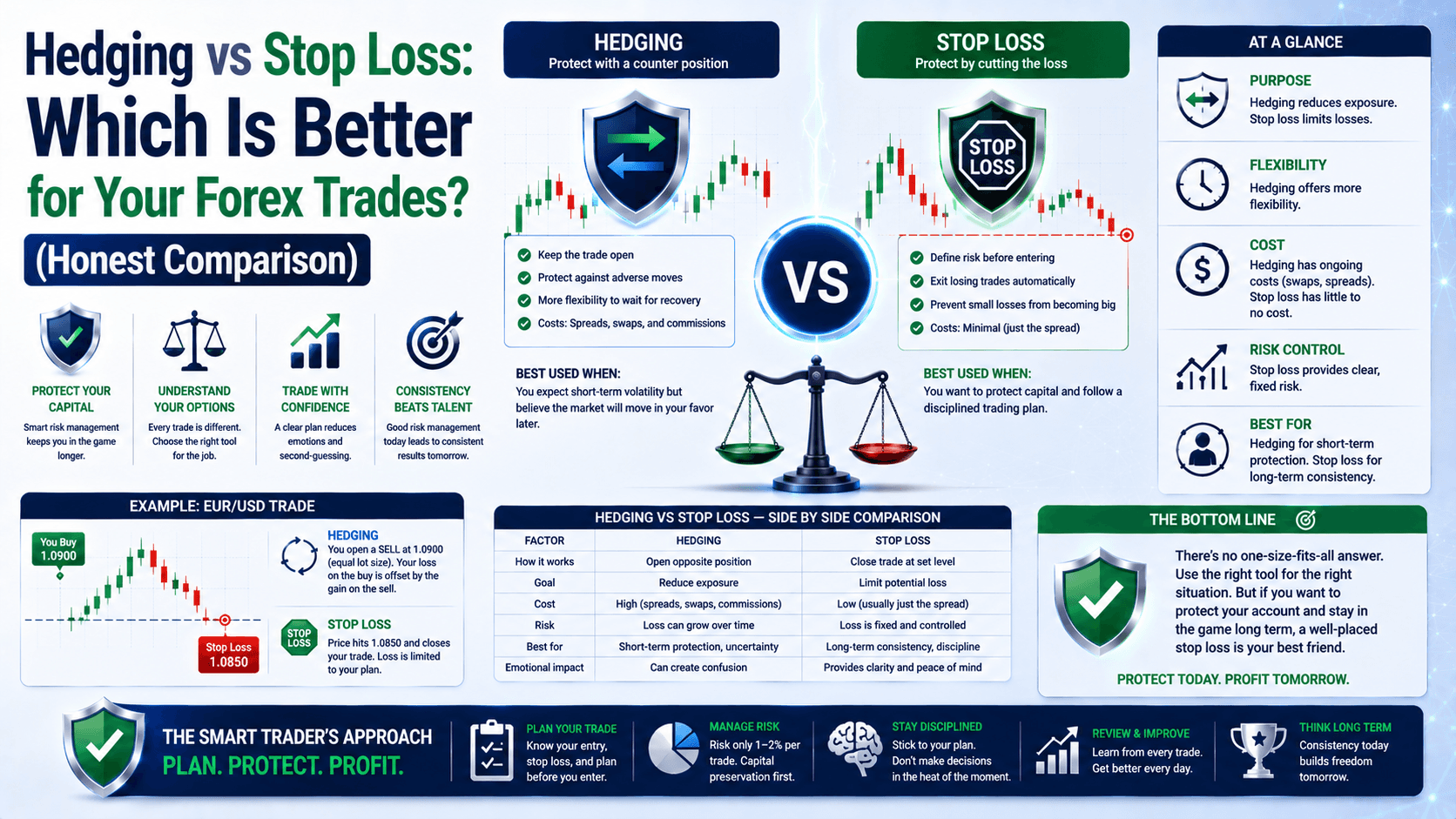
Hedging vs Stop Loss — Side-by-Side Comparison
| Factor | Stop Loss | Hedging |
|---|---|---|
| Risk control | Fixed — you know exactly what you'll lose | Variable — you can adjust the hedge size |
| Psychological impact | Hard — taking a loss feels like failure | Easier — you control when you lose |
| Time commitment | Low — set and forget | High — you need to monitor and manage |
| Protection from spikes | Low — spikes can trigger you out | High — you stay in the trade |
| Swap/interest costs | None (trade is closed) | Can be positive or negative depending on pair |
| Flexibility | Binary — win or lose | Many shades — partial hedges, gradual exits |
| Best for | Disciplined traders, swing traders | Active traders, those who hate getting stopped out |
When Hedging Beats Stop Loss (Real Scenarios)
Scenario 1: The Spike That Would Have Stopped You Out
You're long XAU/USD (Gold) at $2,350. Your stop is at $2,340 — 10 points ($100 on 0.1 lots). A sudden news spike drops Gold to $2,338 for 30 seconds, then it rockets to $2,380.

With a stop loss: You're out at $2,340. Loss: $100. Missed profit: $300.
With hedging: You hedge at $2,340 by going short 0.1 lots. The spike hits, your hedge absorbs the loss. When price recovers, you close the hedge and let the long run. Net result: you're still in the trade.
Scenario 2: Breaking Losses Into Smaller Pieces
Would you rather take one $200 loss, or four $50 losses over two days?
Mathematically, they're the same. Psychologically? Completely different. Hedging lets you roll off losses gradually — close part of the hedge when price moves in your favor, then the rest later.
When Stop Loss Is Still the Better Choice
Let me be honest — hedging isn't for everyone. Here's when a stop loss wins:
- You're a swing trader — You check charts once a day. Hedging requires active management.
- You struggle with discipline — Hedging can become "hope trading" where you never take a loss.
- You have a small account — Hedging uses margin for both positions. A $500 account might not have room.
- You value simplicity — Stop losses are one click. Hedging is a whole system to learn.
How to Use Hedging Properly (Step by Step)
Step 1: Enter your trade normally. EUR/USD at 1.0850, long 0.1 lots. Your plan says if price drops 30 pips, you're wrong.
Step 2: Instead of a stop loss, set an alert at 1.0820. When price hits that level, you manually enter a short position of 0.1 lots.
Step 3: Now you're flat. Your loss on the long is frozen at $30. No additional risk.
Step 4: Wait for clarity. Price bounces? Close the short and let the long run. Price keeps dropping? Close the long and let the short run. Price goes sideways? Close both and take the $30 loss on your terms.
FAQ
Is hedging safer than using a stop loss?
Not necessarily. Hedging protects you from being stopped out by noise, but it can lead to overtrading and higher costs if not managed well. Both methods work — pick the one that fits your personality.

Can I use hedging with a small account?
Yes, but it's harder. A $500 account might only allow 0.01 lot positions. Hedging uses margin for both sides, so check your broker's margin requirements first.
Do professional traders use hedging instead of stop losses?
Some do, especially institutional traders. But most retail traders are better off with stop losses because hedging requires active management and discipline that beginners often lack.
What's the biggest mistake beginners make with hedging?
They never close the hedge. They keep both positions open indefinitely, paying swap fees and never taking a loss. Hedging is a tool to manage risk, not to avoid it.
Quick Recap
- Stop losses are simple, mechanical, and protect you from yourself — but they can be triggered by noise and spikes.
- Hedging gives you control over when you take losses and protects against premature exits — but requires active management and discipline.
- Your choice depends on your time commitment, account size, and personality. There's no "right" answer.
- Test both on a demo account before deciding. The best method is the one you can actually execute consistently.
Your Quick Win (Do This Today)
Open your trading platform right now. Find your last 3 losing trades. For each one, ask yourself: "Would I have preferred to hedge instead of taking that stop loss?" If the answer is yes for 2 out of 3, hedging might be worth exploring. If not, stick with stop losses — they're working for you.