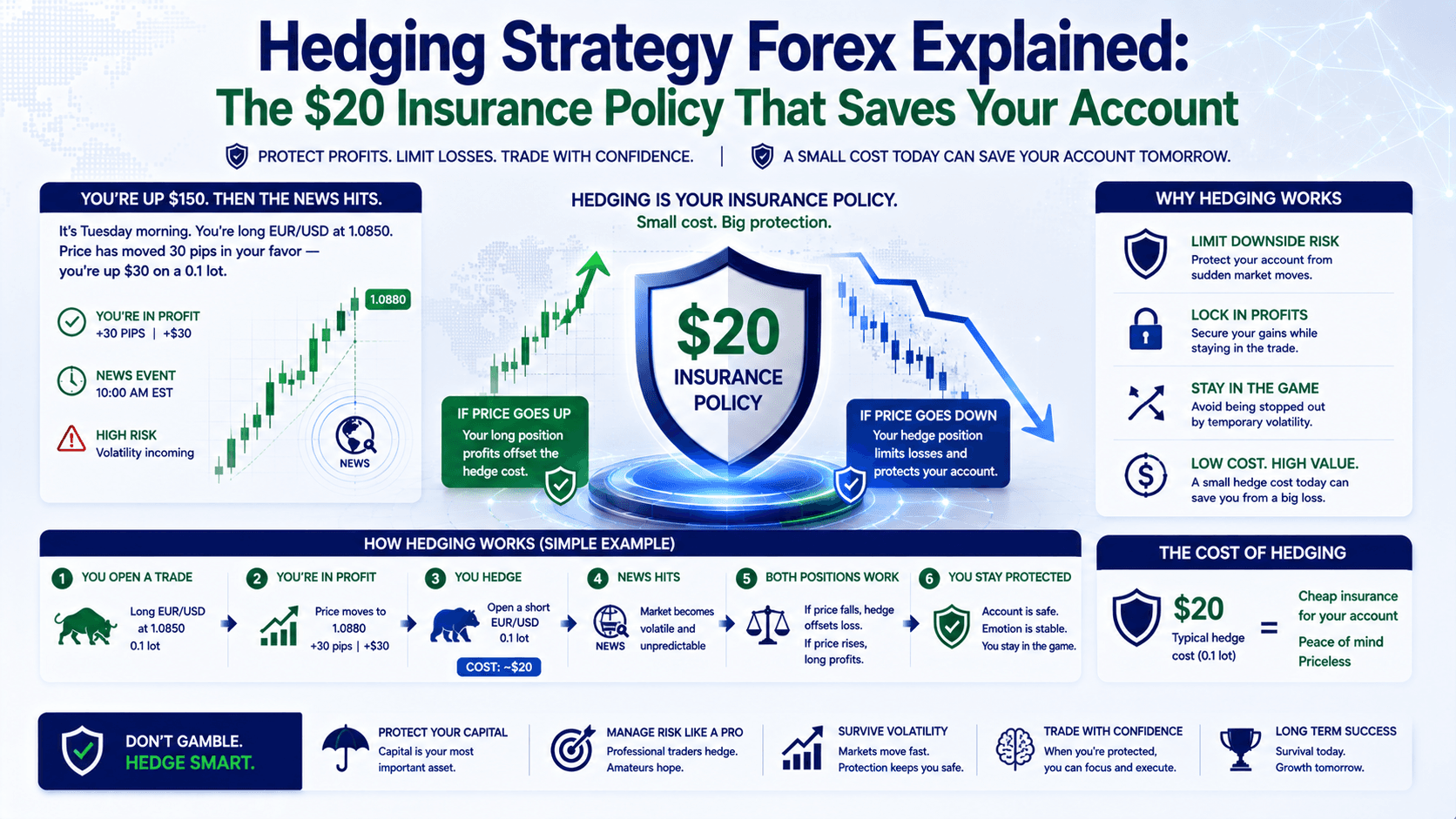

You're Up $150. Then the News Hits.
It's Tuesday morning. You're long EUR/USD at 1.0850. Price has moved 30 pips in your favor — you're up $30 on a 0.1 lot. Feels good.
Then the economic calendar flashes red. ECB rate decision in 2 hours. You've seen this movie before — price whipsaws 50 pips in 3 minutes and your stop gets taken.
What if you could stay in the trade and protect yourself at the same time?
That's exactly what a hedging strategy forex explained in plain English is all about. It's not about making money. It's about not losing it when the market goes crazy.
What Is a Hedging Strategy in Forex? (The Insurance Analogy)
Think of hedging like car insurance. You pay a small premium every month. You hope you never need it. But when someone rear-ends you at a traffic light, you're glad you have it.
In forex, a hedge is a second trade you open that profits if your first trade loses money. The goal is zero net loss during uncertain periods.
Here's the key difference most beginners miss: Hedging is not a profit strategy. It's a protection strategy.
Professional traders don't hedge to make money. They hedge to survive volatile events — news releases, central bank meetings, unexpected geopolitical shocks.
The 3 Most Common Hedging Strategies (With Real Numbers)
1. Direct Hedge — The Perfect Hedge
This is the simplest. You open a buy AND a sell on the same currency pair at the same time.

Example:
- You're long EUR/USD at 1.0850 (0.1 lot)
- ECB meeting in 2 hours — you're nervous
- You open a short EUR/USD at 1.0850 (0.1 lot)
If EUR/USD drops 50 pips to 1.0800:
- Long position loses $50
- Short position gains $50
- Net result: $0
If EUR/USD rises 50 pips to 1.0900:
- Long position gains $50
- Short position loses $50
- Net result: $0
You're flat. No profit, no loss. But here's the catch — you're paying swap fees on both positions every day. So this only works as a temporary shield (hours, not days).
2. Correlated Pair Hedge — The Smart Hedge
Instead of the same pair, you use two pairs that move together. EUR/USD and GBP/USD are positively correlated — they usually go up and down together.
Example:
- You're long EUR/USD at 1.0850 (0.1 lot)
- To hedge, you short GBP/USD at 1.2650 (0.1 lot)
If the dollar strengthens broadly:
- EUR/USD drops 40 pips → you lose $40
- GBP/USD drops 40 pips → you gain $40
- Net result: $0
But here's where it gets interesting. Correlations can break. If a UK-specific event (like Brexit news) hits the pound harder than the euro, your GBP/USD short might lose more than your EUR/USD long gains.
That's the imperfect hedge — you're protected against broad moves but exposed to pair-specific risk.
3. Options Hedge — The Premium Hedge
This is the most flexible. You buy a put option (right to sell) or call option (right to buy) at a specific price. You pay a premium upfront — that's your insurance cost.
Example:
- You're long EUR/USD at 1.0850
- You buy a put option with strike 1.0800, expiring in 1 week
- Premium cost: $20
If EUR/USD drops to 1.0700:
- Your long position loses $150
- Your put option gains $100 (1.0800 - 1.0700 = 100 pips × $1 per pip)
- Net loss: $50 + $20 premium = $70
If EUR/USD rises to 1.0950:
- Your long position gains $100
- Your put option expires worthless
- Net profit: $100 - $20 premium = $80
Notice the difference? With options, you cap your downside while keeping unlimited upside. That's the beauty — but the premium is a guaranteed cost.
Comparison Table: Which Hedge Strategy Is Right for You?
| Strategy | Cost | Protection Level | Best For | Risk |
|---|---|---|---|---|
| Direct Hedge | Swap fees | 100% (temporary) | Short-term news events | Swap costs eat profits |
| Correlated Pair | Spread costs | 70-90% | Broad market moves | Correlation breakdown |
| Options Hedge | Premium | Flexible (capped downside) | Long-term positions | Premium cost guaranteed |
The Wrong Way vs. The Right Way
The Wrong Way: A beginner opens a long EUR/USD position. Price drops 10 pips. Panicking, they open a short position on the same pair. Now they're hedged — but they don't close the hedge when the news passes. Three days later, swap fees have eaten $15. They close both positions and realize they lost money even though price went nowhere.
The Right Way: You plan your hedge BEFORE you need it. You know the ECB decision is at 1:15 PM. You open your long position at 9:00 AM. At 1:00 PM, you open your short hedge. At 1:30 PM, the news drops. Price spikes 20 pips, then settles. You close the hedge. Your long position is still open. Total cost: $2 in swap fees. You stayed in the trade and survived the volatility.
FAQ
Is hedging legal in forex?
Yes, in most countries. Some brokers restrict direct hedging (opening buy and sell on the same pair), but correlated pair hedging and options hedging are widely available. Always check your broker's terms.

Does hedging guarantee profit?
No. Hedging is designed to limit losses, not generate profits. In most cases, a perfect hedge results in zero net profit (minus costs). The goal is survival and risk management, not making money.
How much does hedging cost?
It depends on the strategy. Direct hedges cost swap fees (overnight interest). Options hedges cost a premium (typically $10-$100 per contract). Correlated pair hedges cost the spread on two trades. Always calculate the cost before hedging.
Can I hedge with a small account ($500)?
Yes. Use micro lots (0.01) to keep costs low. A direct hedge on 0.01 lots costs about $0.10 in swap fees per day. Options may be too expensive for small accounts — a $20 premium is 4% of your account.
📝 Quick Recap
- Hedging is insurance — it protects against losses, not makes profits
- 3 main strategies: direct hedge, correlated pair hedge, options hedge
- Costs matter — swap fees, spreads, and premiums add up
- Timing is everything — hedge before the event, close after
- Not for everyone — beginners should master risk management first
Your Quick Win (Do This Today)
Open your demo account. Pick EUR/USD. Open a 0.01 lot long position at current price. Then open a 0.01 lot short position at the same price. Watch the net P&L for 1 hour. See how it stays near zero? That's hedging in action. Now you know exactly how it works — without risking real money.