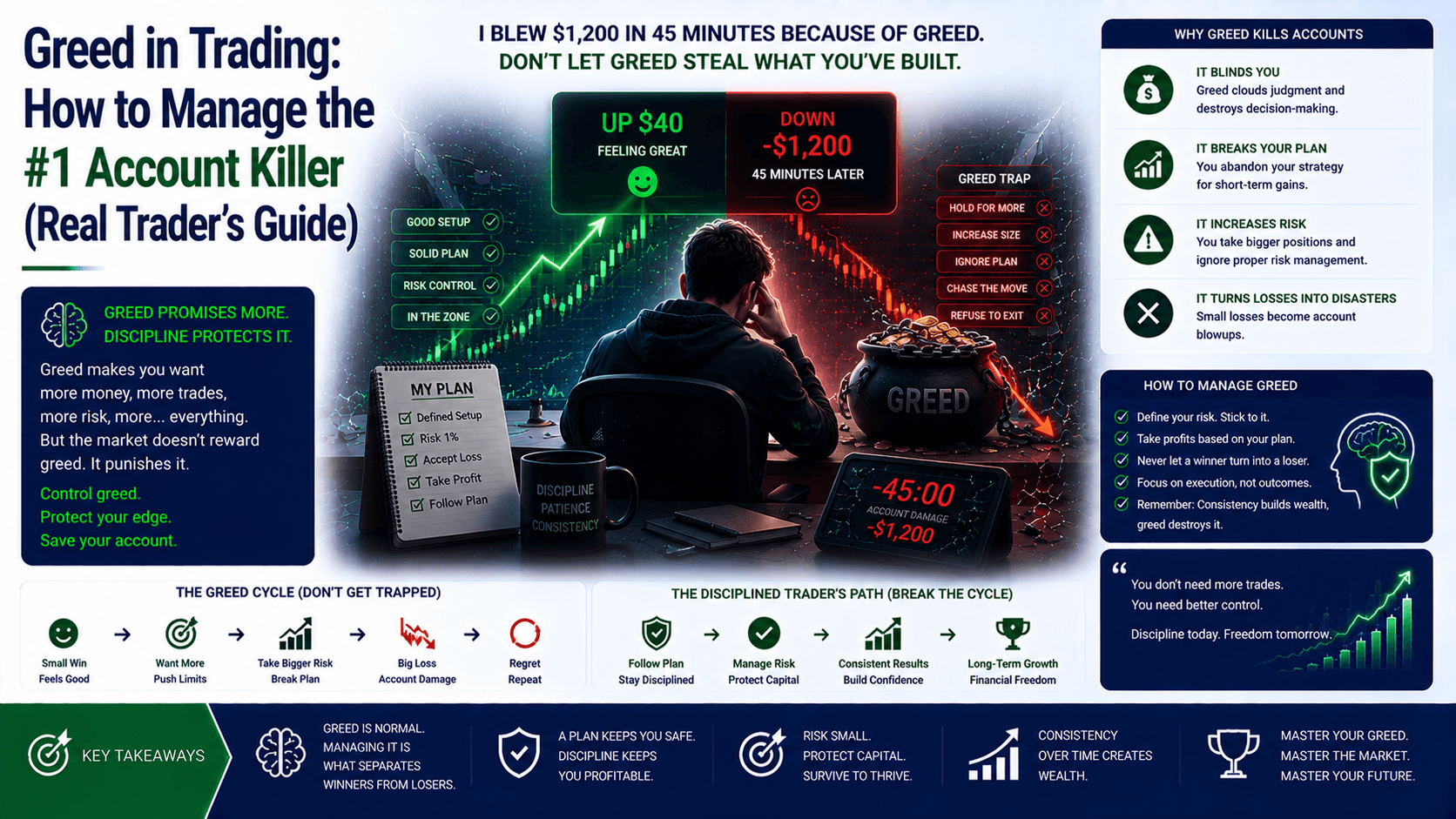

I Blew $1,200 in 45 Minutes Because of Greed
Let me tell you about my worst trading day. It was a Tuesday. Gold was ripping higher, and I was already up $340 on the day. Instead of closing my laptop and calling it a win, I thought: "This is just getting started. I can make more."
I doubled my position size. Then doubled it again. Price turned around 12 pips later. By the time I got stopped out, I'd given back all my profits — plus $860 of my account.
That's greed in trading. And if you've ever felt that pull to "just one more trade" or "let it run a little longer," you're not alone. The question is: how do you manage it before it manages you?
What Does Greed in Trading Actually Look Like?
Most people think greed means being greedy for money. It's deeper than that. Greed in trading shows up in specific, predictable patterns. Here are the three I see most often:
1. Overtrading after a win. You hit a nice profit. Your brain floods with dopamine. Suddenly every setup looks like "the one." You take trades you'd never normally take.
2. Moving your stop loss further away. EUR/USD is at 1.0870. Your stop is at 1.0850. Price dips to 1.0855 and you think: "It's just testing support. Let me move my stop to 1.0830." You just doubled your risk because you couldn't accept being wrong.
3. Holding losers "until it comes back." This is the most expensive form of greed. You refuse to take a small loss because you're convinced the trade will turn around. Days later, you're down 5x what you should have lost.
I'll be honest with you: I've done all three. The third one cost me my first account. Don't let it cost you yours.
The Math of Greed — Why It Always Wins (Until You Stop It)
Here's a scenario every trader has faced. Let's say you have a $2,000 account. You take a trade on GBP/USD at 1.2650 with a 30-pip stop loss. You're trading 0.1 lots, so each pip is worth $1. Your risk is $30 — that's 1.5% of your account. Perfect risk management.

But then greed creeps in. Price moves 20 pips in your favor. You think: "This is working. Let me add another 0.1 lots." Now you're in 0.2 lots. Your stop is still 30 pips away, but from your new entry, it's actually 50 pips. Your total risk just jumped to $80 — 4% of your account.
One 50-pip reversal and you've lost more than double your original plan. That's how greed compounds your risk without you even noticing.
| Scenario | Without Greed | With Greed |
|---|---|---|
| Position size | 0.1 lots | 0.2 lots |
| Stop loss | 30 pips | 50 pips (moved) |
| Risk amount | $30 (1.5%) | $100 (5%) |
| Result if stopped out | Small loss, live to trade | Big loss, mental damage |
The difference isn't luck. It's discipline.
How to Manage Greed in Trading — 3 Practical Strategies
I've been trading for over 10 years. I've tried every technique to manage greed. Here's what actually works.
1. Pre-Define Your "Enough" Number
Before you enter any trade, decide how much profit is "enough" for the day. Write it down. Stick to it. For me, on a $5,000 account, my daily target is $150. Once I hit that, I'm done — even if the chart looks perfect.
Here's why this works: Greed doesn't have a natural stopping point. It always wants more. By setting a hard number, you create a boundary. When you hit it, you close the laptop and walk away. The market will be there tomorrow.
2. Use the "Reverse Stop Loss" Technique
Most traders know about stop losses for losing trades. But you can use the same logic for winning trades. Here's how:
When your trade is up 20 pips, move your stop loss to breakeven (your entry price). Now you can't lose money. When it's up 40 pips, move your stop to lock in 20 pips of profit. This forces you to take gains instead of chasing more.
I learned this the hard way after watching a $700 profit on Gold turn into a $200 loss because I refused to take money off the table.
3. Keep a "Greed Journal"
Your trading journal shouldn't just track entries and exits. Track your emotional state too. After every trade, write down: Was I feeling greedy? Did I take more risk than my plan allowed?
When you see the pattern on paper — "I overtraded after every winning day for 2 weeks" — it becomes real. You can't fix what you don't see.
FAQ
Is greed in trading always bad?
Not entirely. A healthy desire for profit keeps you motivated. The problem is when greed overrides your trading plan and risk management. The key is channeling that drive into discipline, not impulse.

How do I stop myself from overtrading?
Set a maximum number of trades per day before you start. Write it on a sticky note and put it on your monitor. When you hit that number, stop. No exceptions.
Can greed be eliminated completely?
No. Greed is a human emotion. You can't eliminate it, but you can manage it. The goal isn't to feel no greed — it's to have systems in place that prevent greed from making decisions for you.
What's the fastest way to reduce greedy trading?
Lower your position size. When you risk less per trade, the emotional stakes drop. Greed feeds on the feeling that "this trade could change everything." When each trade is just one of many, greed loses its power.
Quick Recap
- Greed shows up as overtrading, moving stops, and holding losers too long
- It compounds your risk silently — one greedy decision can wipe out weeks of gains
- Set a daily profit target and stop when you hit it
- Use trailing stops or "reverse stop losses" to lock in profits
- Track your emotional patterns in a journal
Your Quick Win
Open your trading platform right now. Look at your last 5 trades. For each one, ask yourself: Did I take more risk than planned? Did I hold longer than my strategy said? Did I chase a setup I normally skip?
Write down the answers. Be honest. That's your starting point for managing greed in trading. Trust me — your account will thank you.