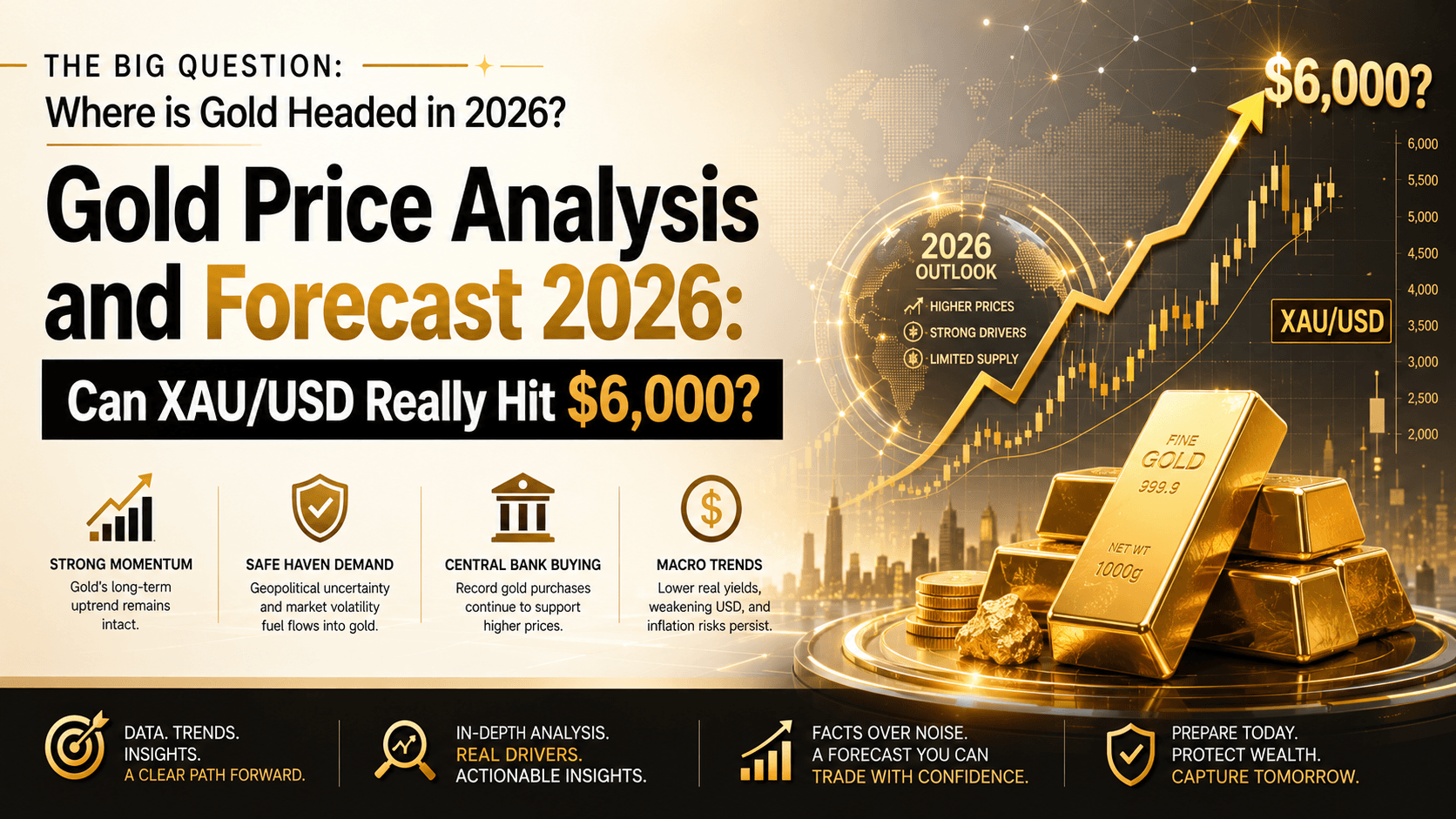

The Big Question: Where is Gold Headed in 2026?
If you've been watching gold (XAU/USD) over the past 18 months, you know something has fundamentally changed. This isn't the same old "safe haven" that spikes during a crisis and fades when things calm down. Gold ended 2025 above $4,000 — a level that seemed unthinkable just two years earlier. Now, in early 2026, the debate has shifted from "will it correct?" to "how much higher can it go?"
Let's break down the gold price analysis and forecast 2026 using the data that actually matters — institutional flows, central bank behavior, and the structural shifts that separate this cycle from every previous gold rally.
What's Driving Gold in 2026? Three Structural Forces
To understand where gold is going, you need to understand why it's already here. The rally isn't speculation — it's a structural repricing driven by three forces that aren't going away.
1. Central Banks Are Buying Like Never Before
This is the biggest story that most retail traders miss. Central banks bought over 1,000 tonnes of gold annually for three consecutive years (2023–2025). That's roughly double the pre-2022 average of 400–500 tonnes per year.
In 2026, J.P. Morgan projects central bank purchases will still average around 755 tonnes — a step down from the peak, but still historically elevated. Why the slight decline? Not because demand is fading, but because at $4,000+/oz, central banks need fewer tonnes to reach their target gold allocation.
Here's a concrete example: If a central bank wants to increase its gold share from 5% to 10% of total reserves, at $4,000/oz they need to buy X tonnes. At $5,000/oz, they need about 20% fewer tonnes to achieve the same notional shift. The buying continues — just in smaller physical quantities.
2. De-dollarization Is Real (And Slow)
The US dollar's share of global reserves has been declining steadily — from around 71% in 2000 to roughly 57% today. Gold is the primary beneficiary. When countries want to reduce USD exposure, they buy gold. It's neutral, has no counterparty risk, and can't be sanctioned.
The People's Bank of China added 27 tonnes to its reserves in 2025 alone. Brazil bought 15 tonnes in September and another 16 tonnes in October. The Bank of Korea has publicly discussed increasing gold holdings. This isn't a trend — it's a structural shift that will take years to play out.
3. Policy Credibility Is Eroding
Gold thrives when trust in central banks and governments is low. In 2026, we have a unique combination: high government debt, uncertain monetary policy, and geopolitical fragmentation. The Fed may cut rates two or three times this year — but the market's real concern is whether policy tools still work in a highly leveraged global system.
When real yields are capped and policy guidance is conditional, gold's opportunity cost is no longer about yield — it's about avoiding variability. Stability becomes a return.
Gold Price Analysis and Forecast 2026: The Numbers
Let's look at what the major institutions are actually projecting. The range is wide — and that's where the opportunity (and risk) lies.
| Institution | 2026 Year-End Target | Bias |
|---|---|---|
| J.P. Morgan | $5,000 – $6,300 | Bullish |
| Goldman Sachs | $5,400 | Bullish |
| UBS | $6,000 (base) / $7,200 (upside) | Very Bullish |
| Deutsche Bank | $6,000 | Bullish |
| Wells Fargo | $6,300 | Bullish |
| Bank of America | $5,000 | Neutral |
| HSBC | Mid $4,000s | Bearish |
| Commerzbank | High $4,000s | Slightly Bearish |
| Capital Economics | $3,500 | Very Bearish |
Notice something? The bullish targets cluster between $5,000 and $6,300. The bearish targets sit in the mid-to-high $4,000s. The chasm is real — and it reflects genuine disagreement about whether gold's rally is sustainable or speculative.
The Bull Case: Why Gold Could Hit $6,000+
The bulls have a compelling argument. Let's walk through their logic step by step.

Demand Is Structural, Not Speculative
J.P. Morgan projects investor and central bank demand will average around 585 tonnes per quarter in 2026. Here's how that breaks down:
- Central banks: ~190 tonnes per quarter
- Bar and coin demand: ~330 tonnes per quarter
- ETF and futures: ~275 tonnes annualized (front-loaded)
Using J.P. Morgan's own model — which explains about 70% of quarterly gold price changes — 585 tonnes per quarter implies continued upward pressure. Every 100 tonnes above the 350-tonne baseline is worth roughly a 2% quarterly price increase.
The "Gold Share" Argument
Gold currently represents about 2.8% of total global investor assets under management (AUM). Historically, during major bull markets, this share has risen to 4–5%. If gold's share of AUM moves from 2.8% to just 4%, that's roughly $1.2 trillion in new demand — enough to push prices significantly higher.
And here's the kicker: J.P. Morgan estimates that if just 0.5% of foreign holdings of US assets were diversified into gold, it would create enough demand to drive prices to $6,000/oz. That's not a fantasy — it's a realistic scenario given de-dollarization trends.
Geopolitical Premium Is Permanent
Geopolitical tensions are no longer "shock events" — they're persistent features of the macro landscape. Trade fragmentation, US-Iran tensions, and political uncertainty create a permanent risk premium embedded in gold pricing. Investors aren't panicking; they're hedging possibility.
The Bear Case: Why Gold Could Correct Sharply
The bears aren't wrong — they're just betting on a different set of outcomes. Let's look at their arguments objectively.
Gold Is Overbought
After a 55% rally in 2025 and continued gains in early 2026, gold is technically extended. Capital Economics projects a decline to $3,500/oz by year-end, arguing that "prices can fall almost as quickly as they rise." Their reference: gold fell by a third within one year of the 1980 peak.
However, this comparison has flaws. In 1980, central banks were selling gold. Today, they're accumulating at record rates. The macro backdrop is fundamentally different.
The Consensus Is Lower Than You Think
A Financial Times survey of 11 analysts found a consensus forecast of just $4,610 for 2026. S&P Global's consensus was even lower at $4,241.82. These numbers suggest that the bullish headlines are louder than the actual analyst community.
Why the gap? Many analysts believe that absent fresh shocks, gold's risk premium could fade. If geopolitical tensions ease or inflation moderates, safe-haven demand could evaporate quickly.
HSBC's Warning: Lessons from 1980
HSBC's James Steel warns that changes in the political landscape — such as tariff dispute resolutions, fiscal consolidation, or rapprochement between the US and China — could have a negative impact on gold. The 1980 bull market ended when Reagan and Thatcher brought economic rejuvenation and geopolitical wins.
Could a similar shift happen in 2026? It's possible — and that's the risk.
Technical Levels That Matter Right Now
For traders, the narrative is important — but price is what pays. Here are the key levels to watch on XAU/USD.
| Level | Type | What It Means |
|---|---|---|
| $4,200 – $4,300 | Weekly Support | Below this, the bullish structure breaks down |
| $4,250 – $4,350 | Daily Support Zone | Re-accumulation zone — buy pullbacks here |
| $4,550 – $4,600 | Near-Term Resistance | Acceptance above this confirms continuation |
| $4,700 – $4,900 | Bullish Target Zone | First leg of the next rally |
| $5,000 | Psychological Resistance | Major milestone — expect volatility here |
| $5,200 – $6,000 | Extended Targets | Requires momentum acceleration |
The weekly chart shows a clean bullish trend with no structural breakdown. Daily pullbacks continue to resemble re-accumulation, not distribution. As long as price holds above $4,300, the path of least resistance is higher.
Scenario Framework: Three Paths for Gold in 2026
Instead of a single forecast, let's look at three realistic scenarios — and what needs to happen for each.
Bullish Continuation (Probability: 45%)
Conditions: Real yields remain compressed, policy uncertainty persists, central bank buying continues at 700+ tonnes annually, and ETF inflows accelerate.
Targets: $4,700 – $5,000 by mid-year, $5,200 – $6,000 by year-end.
Range Expansion (Probability: 35%)
Conditions: Mixed macro data, periodic USD strength, no major geopolitical escalation or resolution.
Behavior: Gold trades in a broad $4,300 – $4,700 range, building energy for a later breakout.
Corrective Risk (Probability: 20%)
Conditions: Sustained risk-on environment, sharp rise in real yields, geopolitical tensions ease significantly.
Key Risk Level: Weekly loss of $4,200. Below this, a deeper corrective phase toward $3,800 – $4,000 becomes possible.
FAQ
Is gold expected to reach $6,000 in 2026?
Several major banks — including J.P. Morgan, UBS, and Wells Fargo — have set year-end targets between $5,000 and $6,300. However, the consensus among all analysts is lower, around $4,600–$4,800. $6,000 is possible but not guaranteed.

What is the gold price prediction for 2026 by J.P. Morgan?
J.P. Morgan forecasts gold to average $5,055/oz by Q4 2026, with a potential upside scenario reaching $6,300 if diversification flows accelerate.
Should I buy gold now or wait for a pullback?
If you're a long-term investor, dollar-cost averaging into gold makes sense given structural demand. For traders, waiting for a pullback toward the $4,300–$4,400 zone offers a better risk-reward entry.
What could cause gold to fall sharply in 2026?
A sharp rise in real yields, a sustained risk-on environment, easing geopolitical tensions, or a major fiscal consolidation could trigger a correction. Capital Economics projects a drop to $3,500 under bearish conditions.
Quick Recap
- Gold's 2026 rally is driven by structural demand from central banks, de-dollarization, and eroding policy credibility — not speculation
- Institutional targets range from $3,500 (Capital Economics) to $6,300 (J.P. Morgan/Wells Fargo), with the consensus around $4,600–$4,800
- Key technical support: $4,200–$4,300. Key resistance: $4,550–$4,600
- The bull case is stronger than the bear case, but the gap between them means volatility is guaranteed
- Your strategy should match your time horizon: long-term investors can accumulate on dips; traders should wait for clear levels
Your Quick Win: 5-Minute Analysis
Open your XAU/USD chart right now. Set it to the weekly timeframe. Find the last three pullbacks — each one should show higher lows. Mark the $4,250–$4,350 zone on your chart. If price pulls back into that zone in the coming weeks, you'll know exactly where your potential entry sits. That's preparation. That's the edge.