
The Old Playbook for Geopolitical Risk in Forex Is Breaking
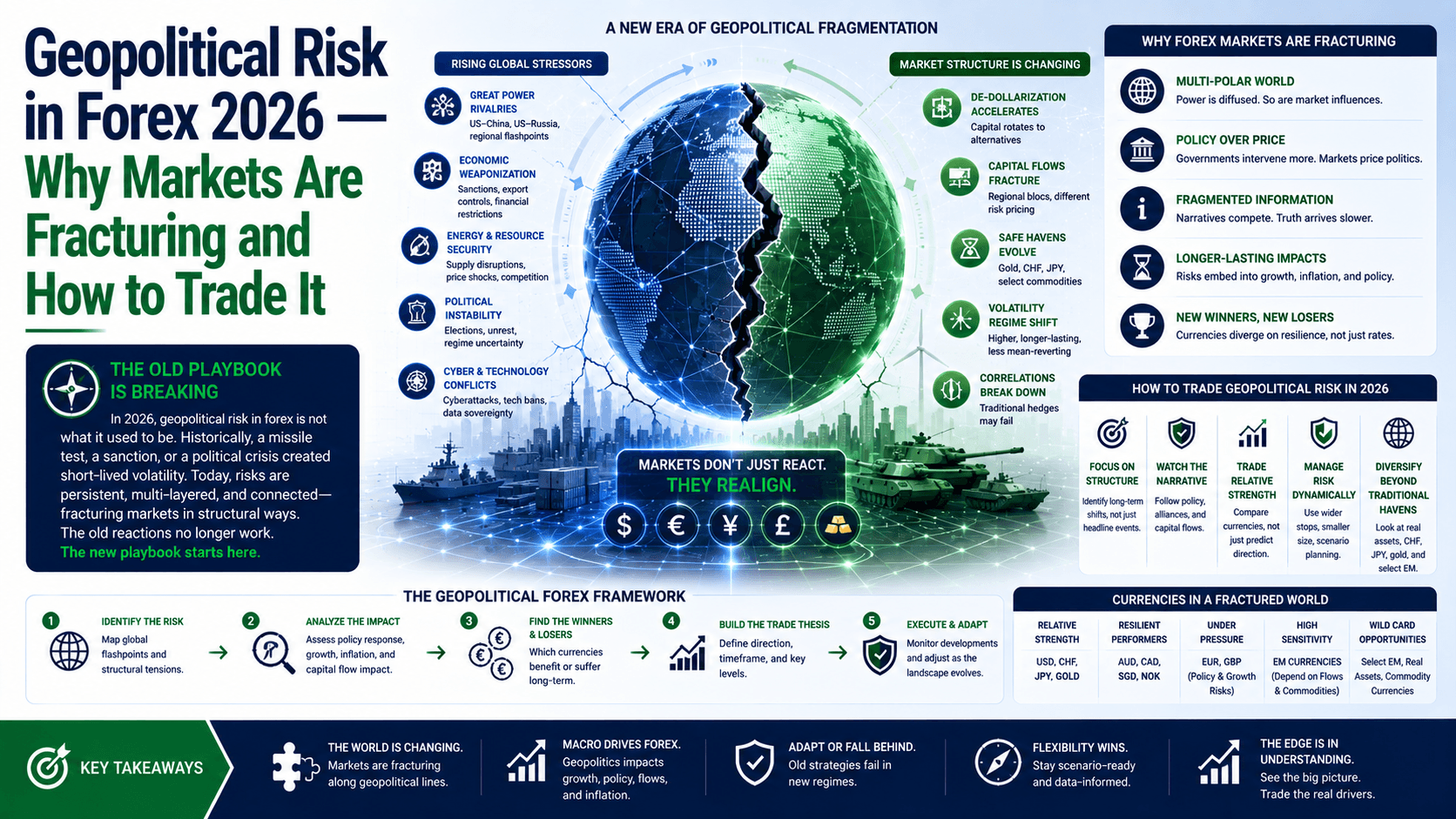
In 2026, geopolitical risk in forex is not what it used to be. Historically, a missile test, a trade tariff, or a diplomatic walkout would spike volatility for a few days and then fade. Markets would shrug. Trends would resume.
That pattern is changing. Data from RoboForex analyzing 70 geopolitical shocks since 1970 shows that the median impact on global stocks, oil, and the U.S. dollar has been short-term — typically reversing within one to three months. But the current environment is different. We're not seeing isolated shocks. We're seeing structural fracturing.
The question every forex trader needs to answer in 2026 is not "Will this event move the market?" It's "Is this a temporary spike or the beginning of a new regime?"
Let's break down what's actually happening, which currency pairs are most exposed, and how to adjust your approach without gambling on headlines.
What Is Geopolitical Risk in Forex? (And Why It's Different in 2026)
Geopolitical risk, in its simplest form, is the potential for political events to disrupt financial markets. Wars, sanctions, elections, trade disputes — these are the usual suspects. They create uncertainty, and uncertainty creates volatility.
In forex, this volatility translates into sharp, often irrational moves in currency pairs. The Japanese yen strengthens because it's a safe haven. The Turkish lira collapses because of regional instability. The U.S. dollar either rallies on fear or sells off on inflation fears — depending on the day.
But here's the critical shift happening in 2026: Global interconnectedness is weakening. Countries are forming new trade alliances outside the U.S. The European Union signed a historic free-trade agreement with India covering 2 billion people. Canada and China cut tariffs in January. The U.K. sent its first official delegation to China since 2018.
This is not a temporary shock. This is a reordering of global capital flows. And that has direct, measurable consequences for currency markets.
The 3 Mechanisms Driving Geopolitical Risk in Forex Right Now
1. Safe-Haven Flows Are Becoming More Complex
The traditional safe-haven playbook was simple: buy USD, CHF, JPY, and gold. That still works — partially. But the U.S. dollar is no longer the unquestioned king.

Data from the IMF shows the dollar still accounts for nearly 60% of global reserves, and it's used in 89% of all currency transactions. But the trend is shifting. Central banks are diversifying. The euro is gaining traction. The Chinese yuan is being used more in trade settlements.
Real-world example from 2026: When US-Iran tensions escalated in February, gold surged from $2,350 to $2,480 in 48 hours. The yen strengthened 2.3% against the dollar. But the euro also gained — because traders were betting on a multipolar world where Europe becomes a more independent financial hub.
The takeaway? Don't assume USD is the only safe haven. Watch EUR/CHF, EUR/JPY, and even EUR/USD during geopolitical shocks.
2. Commodity Currencies Are Now Geopolitical Barometers
Oil is the most immediate responder to geopolitical risk. When tensions rise in the Middle East, Brent crude spikes. And that directly impacts currencies tied to energy exports.
Example: In the February 2026 US-Iran escalation, Brent crude jumped from $78 to $86 in three days. The Canadian dollar (CAD) strengthened because Canada is a major oil exporter. The Norwegian krone (NOK) did the same. Meanwhile, the Japanese yen weakened slightly — Japan imports most of its oil, so higher energy costs hurt the economy.
If you're trading USD/CAD or EUR/NOK during a geopolitical event, you're essentially trading oil. Understand the supply chain, not just the headlines.
3. Inflation Expectations Are the Hidden Variable
Geopolitical risk doesn't just move prices in the short term. It changes inflation expectations. And inflation expectations drive central bank policy.
When oil prices spike due to geopolitical tensions, inflation rises. Central banks respond by keeping rates higher for longer. That strengthens the currency — but only if the economy can handle it.
Contrast example: In 2022, the Fed raised rates aggressively and the dollar surged. In 2026, the situation is more nuanced. The U.S. is running a large fiscal deficit. Higher rates could slow the economy. So a geopolitical oil spike might actually weaken the dollar if it raises recession fears.
The key is to watch the interaction between geopolitical events and economic data — not just the event itself.
Geopolitical Risk vs Economic Risk — Why the Distinction Matters
| Feature | Geopolitical Risk | Economic Risk |
|---|---|---|
| Source | Political events, conflicts, sanctions | GDP, inflation, employment data |
| Predictability | Low — sudden and unscheduled | Higher — scheduled releases |
| Market Impact | Sharp, volatile, often exaggerated | Gradual, trend-based, more structured |
| Typical Duration | Days to weeks (usually) | Weeks to months |
| Example (2026) | US-Iran escalation, EU-India trade deal | Fed rate decision, U.S. CPI release |
This distinction is crucial for position sizing. During geopolitical shocks, the initial move is often emotional and exaggerated. Don't trade the first spike. Wait for the correction or confirmation. Economic data, on the other hand, allows for more structured analysis.
The Wrong Way vs The Right Way to Trade Geopolitical Risk in Forex
Wrong Way: Reacting to Headlines
You see a news alert: "Iran launches missile test. Oil spikes 4%." You immediately buy USD/JPY because "safe haven." But by the time you execute, the move is already priced in. Price retraces. You're left holding a losing position.
Real numbers: You buy USD/JPY at 149.50 after the headline. The pair spikes to 149.80, then reverses to 149.20 within 30 minutes. You're down 30 pips on 0.1 lots — a $30 loss. Not catastrophic, but it adds up. And it's driven by emotion, not analysis.
Right Way: Apply a Structured Framework
- Assess asset sensitivity — Is the currency pair directly exposed to the event? (e.g., USD/CAD during an oil spike)
- Reduce exposure — Cut your lot size by 50% during high-volatility periods
- Define invalidation level — Set a stop loss before entry
- Wait for confirmation — Don't trade the first spike. Let the market settle
- Execute selectively — Only take setups with a clear risk:reward ratio
Example: You wait 2 hours after the Iran headline. Brent crude has stabilized at $84. USD/CAD is at 1.3650, down 40 pips from the pre-event level. You see a bullish reversal candle on the 1-hour chart. You go long at 1.3650 with a stop at 1.3620 (30 pips) and a target at 1.3710 (60 pips). Risk:reward = 1:2. That's a trade worth taking.
3 Actionable Strategies for Trading Geopolitical Risk in 2026
Strategy 1: The "Wait for the Retrace" Approach
Most geopolitical shocks cause an overreaction. The market spikes, then retraces as traders take profits. Wait for the retrace to a key technical level (support or resistance) before entering.
Best for: Oil, gold, and safe-haven currencies like USD/CHF.
Strategy 2: The "Correlation Trade"
Identify which assets move together during geopolitical events. For example, when oil spikes, USD/CAD tends to fall (because CAD strengthens). You can trade the correlation rather than the headline.
Example: Oil spikes 5% on a Middle East escalation. You sell USD/CAD at 1.3680, stop at 1.3710, target 1.3620. The correlation gives you an edge.
Strategy 3: The "Diversification Play"
If you're unsure which direction a currency will move, use a basket approach. Go long on one safe haven (e.g., CHF) and short on a risk-sensitive currency (e.g., AUD). This hedges your exposure.
Example: Buy USD/CHF (safe haven) and sell AUD/USD (risk-sensitive). If the crisis deepens, both trades benefit. If it fades, you have offsetting risk.
FAQ
How does geopolitical risk affect forex trading?
Geopolitical risk creates sudden volatility in currency pairs. Safe-haven currencies like USD, CHF, and JPY tend to strengthen, while risk-sensitive currencies like AUD, NZD, and emerging market currencies weaken. Oil-exporting currencies like CAD and NOK are also affected by energy price spikes.

Can geopolitical risk be predicted?
No. While you can monitor rising tensions, the timing and scale of geopolitical events are unpredictable. The goal is not to predict but to manage risk — through position sizing, stop losses, and diversification.
Which currency pairs are most affected by geopolitical risk in 2026?
USD/JPY and USD/CHF are most sensitive to safe-haven flows. USD/CAD and EUR/NOK are heavily influenced by oil price movements. EUR/USD is affected by shifts in global trade alliances and central bank policy divergence.
Is geopolitical risk short-term or long-term?
Historically, most geopolitical shocks have short-term impacts (days to weeks). However, the current fracturing of global alliances may have longer-lasting effects on currency valuations, trade flows, and inflation expectations.
Quick Recap
- Geopolitical risk in forex 2026 is evolving from short-term shocks to structural fracturing
- Safe-haven flows are becoming more complex — don't assume USD is the only option
- Commodity currencies like CAD and NOK are now geopolitical barometers
- Inflation expectations are the hidden variable linking geopolitical events to central bank policy
- Apply a structured framework: assess sensitivity, reduce exposure, wait for confirmation
Quick Win — Do This Today
Open your charting platform. Pull up USD/CAD on the 4-hour timeframe. Identify the last 3 times oil had a 3%+ daily move. How did USD/CAD react? Did it correlate? Did it lag? Note the relationship. That's your edge for the next geopolitical event.