
The Most Misunderstood Number in Forex
You open your economic calendar on a Friday morning. The US GDP report is due in 30 minutes. Your heart rate picks up. You've heard that GDP moves markets. But what do you actually do with the number once it's released?
Most traders get this wrong. They see a strong GDP figure and buy the dollar. They see a weak number and sell. Then they watch the market move in the exact opposite direction, wondering what they missed.
Here's the deal: GDP and its effect on currency is not about whether the number is high or low. It's about what the number signals for future central bank policy. And that distinction is what separates traders who profit from news events from those who get stopped out.
What Is GDP in Plain English?
Gross Domestic Product is the total monetary value of every finished good and service produced within a country's borders over a specific period—usually a quarter or a year.
Think of it as the country's annual report card. If GDP is growing, the economy is expanding. Companies are hiring, consumers are spending, and the government is collecting more tax revenue. If GDP is shrinking, the economy is contracting. Jobs disappear, spending slows, and recession fears take hold.
In Q1 2025, the US economy grew at an annualized rate of 2.4%. That's solid, but not spectacular. In contrast, China's GDP growth slowed to 4.6% in the same period, marking its weakest expansion outside of pandemic lockdowns in decades.
For forex traders, these numbers matter because they drive interest rate expectations—and interest rates are the single most powerful force behind currency movements.
The Real Mechanism: How GDP Moves Currencies
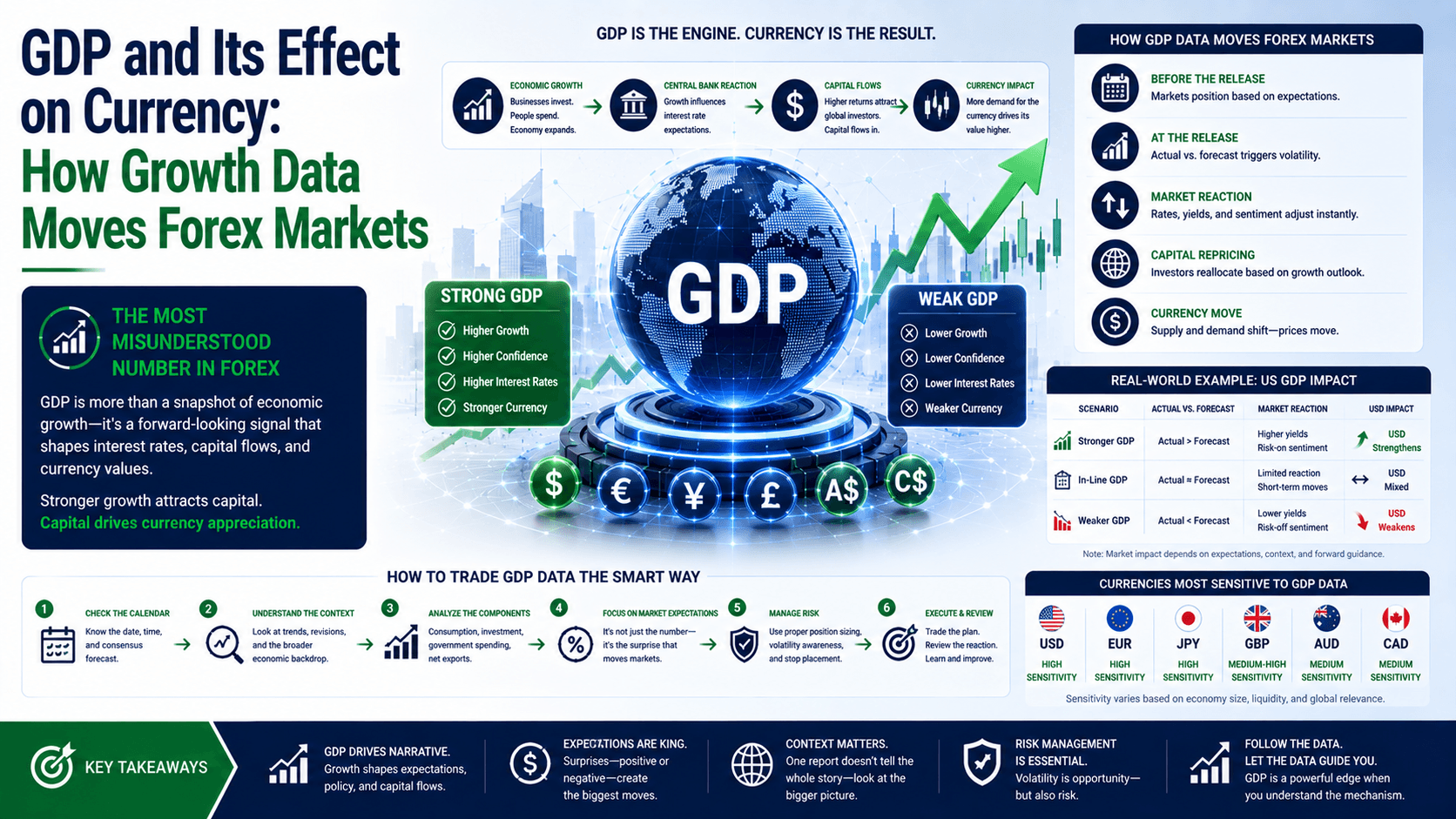
GDP and its effect on currency follows a clear chain of cause and effect. Understanding this chain is essential.
The Chain Reaction
Strong GDP → Economy growing → Inflation pressure builds → Central bank raises rates → Currency attracts capital → Currency strengthens
Weak GDP → Economy slowing → Recession risk rises → Central bank cuts rates → Capital flees → Currency weakens
This is the textbook relationship. But markets rarely follow textbooks. The real world adds two critical complications.
Complication 1: Expectations Are Everything
Markets price in expectations weeks before the data is released. By the time the GDP number hits the news wire, the market has already moved to reflect the consensus forecast.
Let's say the US GDP is expected to come in at 2.0%. The actual number is released at 2.3%—a beat of 0.3%. You might think the dollar rallies. But what if the whisper number (the unofficial market consensus) was 2.5%? Suddenly, 2.3% is a disappointment, and the dollar drops.
This is why you should never trade based on whether the number is "good" or "bad." Trade based on whether it's better or worse than what was already priced in.
Complication 2: Inflation Context Changes Everything
A strong GDP number during a period of low inflation is very different from a strong GDP number during a period of high inflation.
Consider two scenarios:
Scenario A: US GDP comes in at 3.0%, but inflation is at 1.5% (below the Fed's 2% target). The Fed is in no rush to hike rates. The dollar barely moves.
Scenario B: US GDP comes in at 2.5%, but inflation is at 3.5% (well above target). The Fed is already hawkish. This GDP number gives them cover to hike further. The dollar rallies hard.
The same growth rate produces completely different currency reactions depending on the inflation backdrop.
Real Trade Examples: GDP in Action
Let's look at a concrete example from August 2025.

The Setup: The UK GDP report for Q2 2025 was due. The forecast was 0.3% quarter-on-quarter. GBP/USD was trading at 1.2850.
You, as a prepared trader, have already checked the inflation context. UK CPI is running at 2.8%—sticky but not alarming. The Bank of England has been cautious, holding rates at 5.0%.
The Release: UK GDP comes in at 0.5% QoQ—a significant beat. But here's the key: the whisper number was 0.4%. So the beat is real but not massive.
The Reaction: GBP/USD spikes from 1.2850 to 1.2910 in the first 15 minutes. That's 60 pips. On a standard 0.1 lot position, that's a $60 move. On a 1.0 lot, it's $600.
But then the market hesitates. Traders start asking: "Does this GDP beat actually change the BoE's rate path?" The answer is no—not by itself. The pound gives back 30 pips over the next hour, settling at 1.2880.
The Lesson: The initial spike was a momentum trade. The subsequent drift was the market properly digesting the implications. The traders who made money were the ones who entered early and took profit within 30 minutes—not the ones who held hoping for a sustained rally.
When Strong GDP Fails to Boost a Currency
There are specific conditions where GDP and its effect on currency breaks down entirely. Recognising these situations will save you from costly mistakes.
1. Low inflation, low urgency: Strong GDP with benign inflation means no rate action. The currency stays flat.
2. Supply-driven growth: If GDP growth comes from temporary factors like government stimulus or inventory restocking, the market sees through it. The currency doesn't benefit.
3. Global risk-off environment: During a global crisis, strong GDP in one country won't save its currency if capital is fleeing to safe havens. In March 2020, US GDP was still positive, but the dollar sold off as the Fed slashed rates to zero.
4. Political instability: Strong economic data can't offset political risk. If a country is facing an election crisis or geopolitical conflict, the currency will weaken regardless of GDP.
GDP Components: What Smart Traders Look At
Headline GDP is useful, but the components tell the real story. Here's what to watch:
| Component | What It Tells You | Forex Impact |
|---|---|---|
| Consumer Spending | 70% of US GDP. Strong spending = healthy economy | Supports currency, especially if retail sales confirm the trend |
| Business Investment | Signals future growth. Rising investment = confidence | Strong positive for currency over 6-12 months |
| Government Spending | Can boost GDP short-term, but may raise debt concerns | Mixed—short-term boost, long-term risk |
| Net Exports | Exports minus imports. Surplus = more demand for currency | Directly strengthens currency if trade surplus widens |
A trader who only looks at the headline number misses the nuance. If GDP beats expectations but the beat comes entirely from government spending, the currency reaction will be muted. If the beat comes from consumer spending and business investment, that's a different story entirely.
How to Trade GDP Releases
Here is a step-by-step framework for trading GDP releases.
Step 1: Know the forecast and the whisper number. Check the economic calendar for the consensus estimate. Then check financial news sites or social media for the whisper number—the unofficial market consensus that often differs from the official forecast.
Step 2: Check the inflation context. Is inflation above or below the central bank's target? This determines how the central bank will interpret the GDP data.
Step 3: Identify the key level. Before the release, mark the current price and identify a key support and resistance level. For example, if EUR/USD is at 1.0950 with resistance at 1.0980 and support at 1.0920, you know the range.
Step 4: Wait for the release. Do NOT enter before the number comes out. The spread will widen, and the initial spike can hit your stop before you even see the data.
Step 5: Let the first 30 seconds pass. The initial spike is noise. Let the market settle, then look for a retracement to enter in the direction of the trend.
Step 6: Have a profit target. GDP moves often last 30-60 minutes. Take profit at 30-50 pips and walk away. Chasing the move is how you give back your gains.
GDP vs Other Economic Indicators
| Indicator | Frequency | Market Impact | Best Use |
|---|---|---|---|
| GDP | Quarterly | High (but lagging) | Confirms trend, sets medium-term direction |
| Non-Farm Payrolls | Monthly | Very high (leading) | Immediate reaction, short-term trades |
| CPI (Inflation) | Monthly | Very high | Drives rate expectations, often overrides GDP |
| Retail Sales | Monthly | High | Leading indicator for consumer spending component of GDP |
| PMI (Manufacturing/Services) | Monthly | Medium-High | Early signal of GDP direction |
GDP is a lagging indicator. By the time it's released, the data is already 3 months old. This is why smart traders use leading indicators like PMI and retail sales to anticipate GDP trends before the official number is published.

FAQ
How does GDP affect forex markets?
GDP affects forex by signaling economic momentum and influencing central bank interest rate decisions. Strong GDP supports rate hikes and currency strength. Weak GDP suggests rate cuts and currency weakness. The actual impact depends on whether the number beats or misses market expectations.
Why do traders watch GDP data so closely?
Traders watch GDP because it's the broadest measure of economic health. It influences monetary policy, capital flows, and market sentiment across all asset classes. A GDP surprise can trigger sharp moves in currency pairs, stock indices, and commodities.
What's the difference between nominal and real GDP?
Nominal GDP uses current market prices without adjusting for inflation. Real GDP adjusts for inflation, showing actual economic growth. For forex trading, real GDP is more meaningful because it strips out price distortions and reflects genuine economic expansion.
Can GDP trends help me predict market moves?
Yes, but with caveats. GDP trends provide context for medium-term currency direction. A country with consistently strong GDP growth will generally see its currency appreciate over time. However, short-term reactions depend on surprises versus expectations, not the absolute numbers.
Quick Recap
- GDP measures the total value of goods and services produced in a country
- Markets react to surprises vs expectations, not the absolute number
- Inflation context determines how central banks interpret GDP data
- GDP components (consumer spending, business investment) matter more than the headline
- Trade GDP releases with a plan: wait for the initial spike, enter on retracement, take profit within 60 minutes
- Use leading indicators like PMI and retail sales to anticipate GDP trends
Quick Win
Open your economic calendar right now. Find the next GDP release for the US, UK, or Eurozone. Note the forecast. Then open a chart for the relevant currency pair (EUR/USD, GBP/USD, or USD/JPY). Mark the current price level. Identify support and resistance 30 pips above and below. That's your trading range for the release. You now have a plan before the number even drops.