
Why Your Charts Are Only Half the Story
You've spent hours learning candlestick patterns. You can spot a head and shoulders from across the room. Your moving averages are perfectly aligned. And yet — EUR/USD just dropped 80 pips in 10 minutes for "no reason."
There was a reason. You just weren't looking at it.
That reason is fundamental analysis forex for beginners — the art of understanding why price moves, not just where it's been. And it's the missing piece for most retail traders.
What Is Fundamental Analysis in Forex Trading?
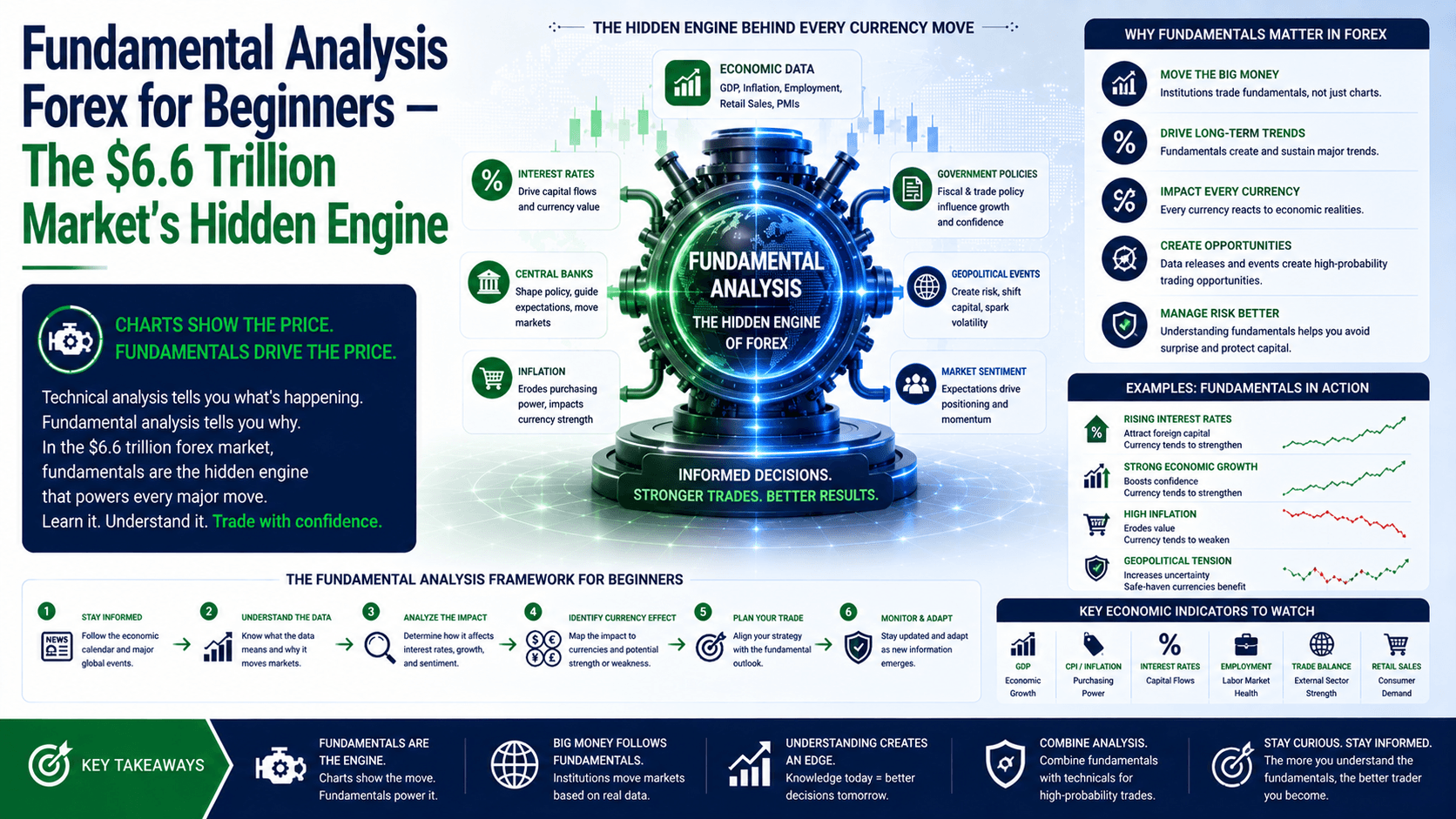
Fundamental analysis is the process of evaluating a currency's value by examining the economic, social, and political forces that drive supply and demand. Unlike technical analysis — which reads charts and patterns — fundamental analysis asks: "Is this country's economy getting stronger or weaker?"
The logic is simple. A strong economy attracts foreign investment. Foreign investment requires buying that country's currency. More buying = higher price.
But here's where beginners get tripped up: currencies trade in pairs. You're not asking "Is the US dollar strong?" You're asking "Is the US dollar stronger than the euro right now?"
That distinction changes everything.
The Supply and Demand Mechanism — Economics 101, Applied
Let's make this concrete. Imagine the US economy is booming. The Federal Reserve raises interest rates to keep inflation in check. Suddenly, US government bonds pay 5% while German bonds pay 2%.
What happens? Global investors sell euros, buy dollars, and purchase US bonds. That increased demand for dollars pushes EUR/USD down.
Here's the math in real terms:
- EUR/USD is at 1.0850
- The Fed raises rates by 0.25%
- Within hours, EUR/USD drops to 1.0780 — a 70-pip move
- On a 0.1 lot trade, that's $70 profit for a short seller
- On a 1.0 lot trade, that's $700
That single interest rate decision just moved more money than most traders make in a month. And it had nothing to do with a chart pattern.
Key Economic Indicators Every Forex Beginner Must Know
Not all economic data moves markets equally. Here are the indicators that matter most for fundamental analysis forex for beginners:

| Indicator | What It Measures | Market Impact |
|---|---|---|
| GDP | Total value of goods and services produced | High — shows overall economic health |
| CPI (Consumer Price Index) | Change in consumer prices (inflation) | Very High — directly influences interest rate decisions |
| Employment Data (NFP) | Number of jobs added/lost | Extreme — can move markets 100+ pips in minutes |
| Interest Rate Decisions | Central bank rate changes | Extreme — the single most powerful driver |
| Retail Sales | Consumer spending levels | Moderate-High — shows consumer confidence |
| Trade Balance | Exports minus imports | Moderate — affects long-term currency trends |
The Wrong Way vs. The Right Way
The Wrong Way: Most beginners see "CPI came in higher than expected" and immediately buy USD. They don't check if the market already priced in that number. They buy at the top, get stopped out, and blame "the news."
The Right Way: Before any major release, check the consensus forecast. The market moves on surprises, not the number itself.
Example:
- Consensus: CPI at 3.2%
- Actual: CPI at 3.1%
- The number is still high — but it's lower than expected
- Result: USD weakens because the surprise was to the downside
This is the single most important concept in fundamental analysis forex for beginners: Buy the rumor, sell the fact is real. Markets price in expectations. The actual release either confirms or contradicts those expectations.
How to Build a Simple Fundamental Analysis Routine
You don't need a PhD in economics. You need a system. Here's a 10-minute daily routine:
- Check the economic calendar — Know what's coming today (use Forex Factory or Investing.com)
- Note the consensus forecast — What does the market expect?
- Identify the surprise potential — Is the actual number likely to differ?
- Set alerts — Don't stare at charts. Let the data come to you.
- Wait 15 minutes after release — Let the initial volatility settle, then analyze the direction
This routine takes 10 minutes in the morning and can save you from trades that look good on a chart but are about to get destroyed by a rate decision.
Common Beginner Traps in Fundamental Analysis
Trap #1: Trading every news release. You don't need to trade every CPI or NFP. The best trades are the ones you skip because the setup isn't clear.
Trap #2: Ignoring market context. A good jobs number in a recession is different from a good jobs number in a booming economy. Context matters.
Trap #3: Mixing timeframes. Fundamental analysis works best on higher timeframes (4H, daily, weekly). Don't use it to scalp 5-pip moves on a 1-minute chart.
FAQ
Is fundamental analysis or technical analysis better for forex beginners?
Neither is inherently better. Most successful traders use a combination. Start with technical analysis for entries and exits, then layer in fundamental analysis to understand why a pair is trending.

How much time do I need to learn fundamental analysis forex for beginners?
You can grasp the core concepts in a few hours. Mastering the application takes months of practice — watching how markets react to data releases and building intuition.
Do I need to follow every economic indicator?
No. Focus on 3-5 key indicators for the pairs you trade. For EUR/USD, watch interest rate decisions, CPI, and GDP. For USD/JPY, add trade balance and bond yield differentials.
Can fundamental analysis predict exact entry and exit points?
No. Fundamental analysis tells you direction and bias, not precise levels. Use technical analysis for entry and exit timing.
Quick Recap
- Fundamental analysis evaluates currency value through economic, social, and political factors
- Supply and demand drives currency prices — strong economy = strong currency
- Focus on surprises, not raw numbers — markets price in expectations
- Use an economic calendar — know what's coming, know the consensus
- Combine with technical analysis — fundamentals for direction, technicals for timing
Quick Win — Do This Today
Open an economic calendar (Forex Factory or Investing.com). Find the next high-impact event for EUR/USD — likely an ECB speech or US CPI release. Write down the consensus forecast. Set a reminder for 15 minutes after the release. Watch how price reacts. Don't trade it. Just observe. Do this for 5 events. You'll start seeing the pattern.
That's the first step to mastering fundamental analysis forex for beginners.