
Ever Opened a Trade and Immediately Seen Red?
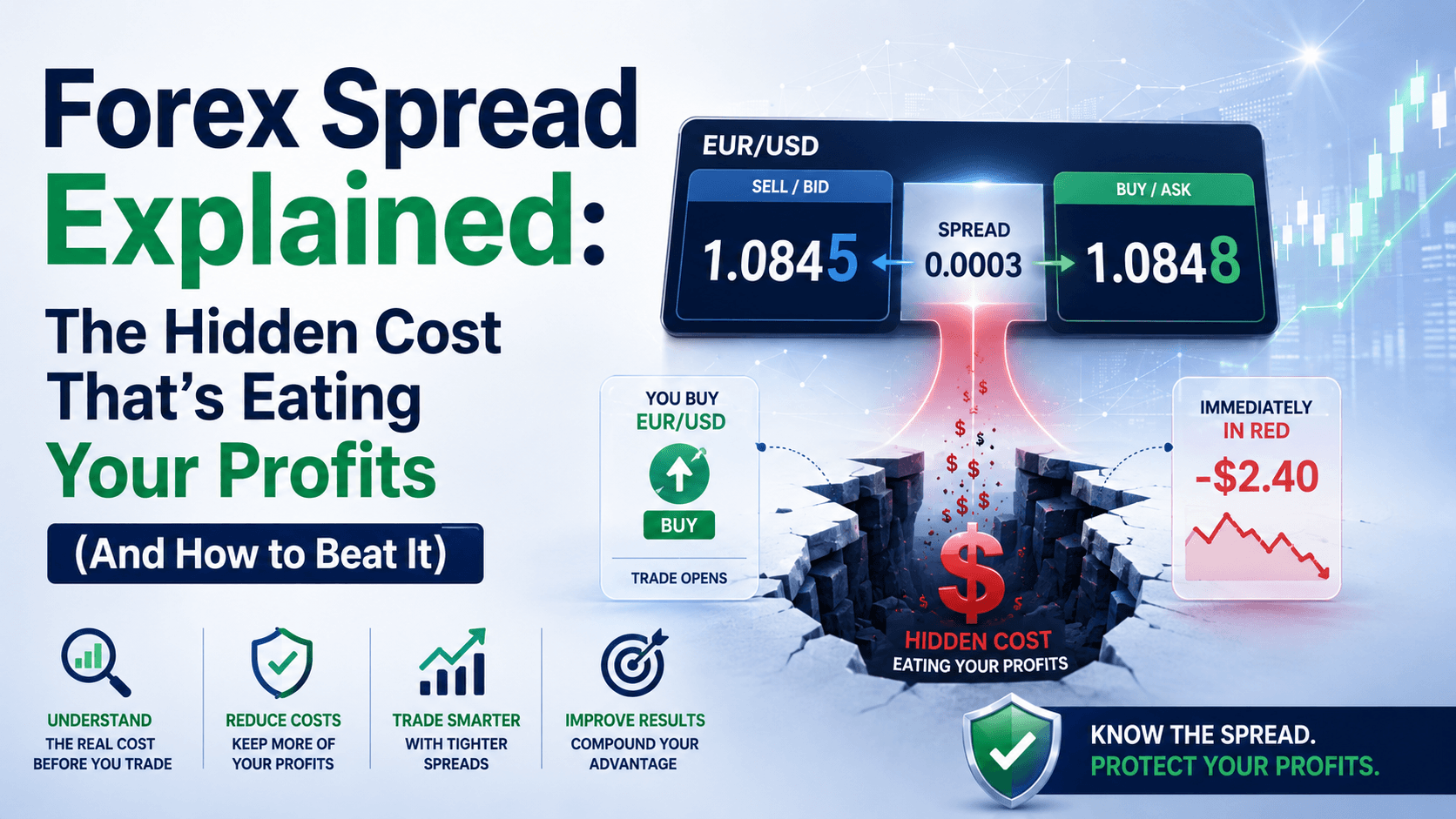
You hit the button to buy EUR/USD. The trade opens. And right away — you're down $2.40.
No, you didn't make a bad call. You didn't enter at the wrong time.
That's the forex spread doing what it does best: taking a little slice off the top before you've even started.
Most beginners panic when they see this. "I'm already losing money!" they think. And they close the trade — taking a real loss on what was actually just the cost of entry.
Here's the deal: the forex spread explained simply is this — it's the fee built into every trade. And once you understand it, you stop fighting it. You start working with it.
What Is a Forex Spread? (The Airport Currency Exchange Analogy)
Imagine you're at the airport. You want to exchange $100 for euros. The board shows two prices:
- Buy EUR: 1.10
- Sell EUR: 1.08
That 2-cent difference? That's the spread. The exchange booth keeps it as their fee for doing the transaction.
Forex works the same way. Every currency pair has two prices:
- Bid — the price you can SELL at (lower)
- Ask — the price you can BUY at (higher)
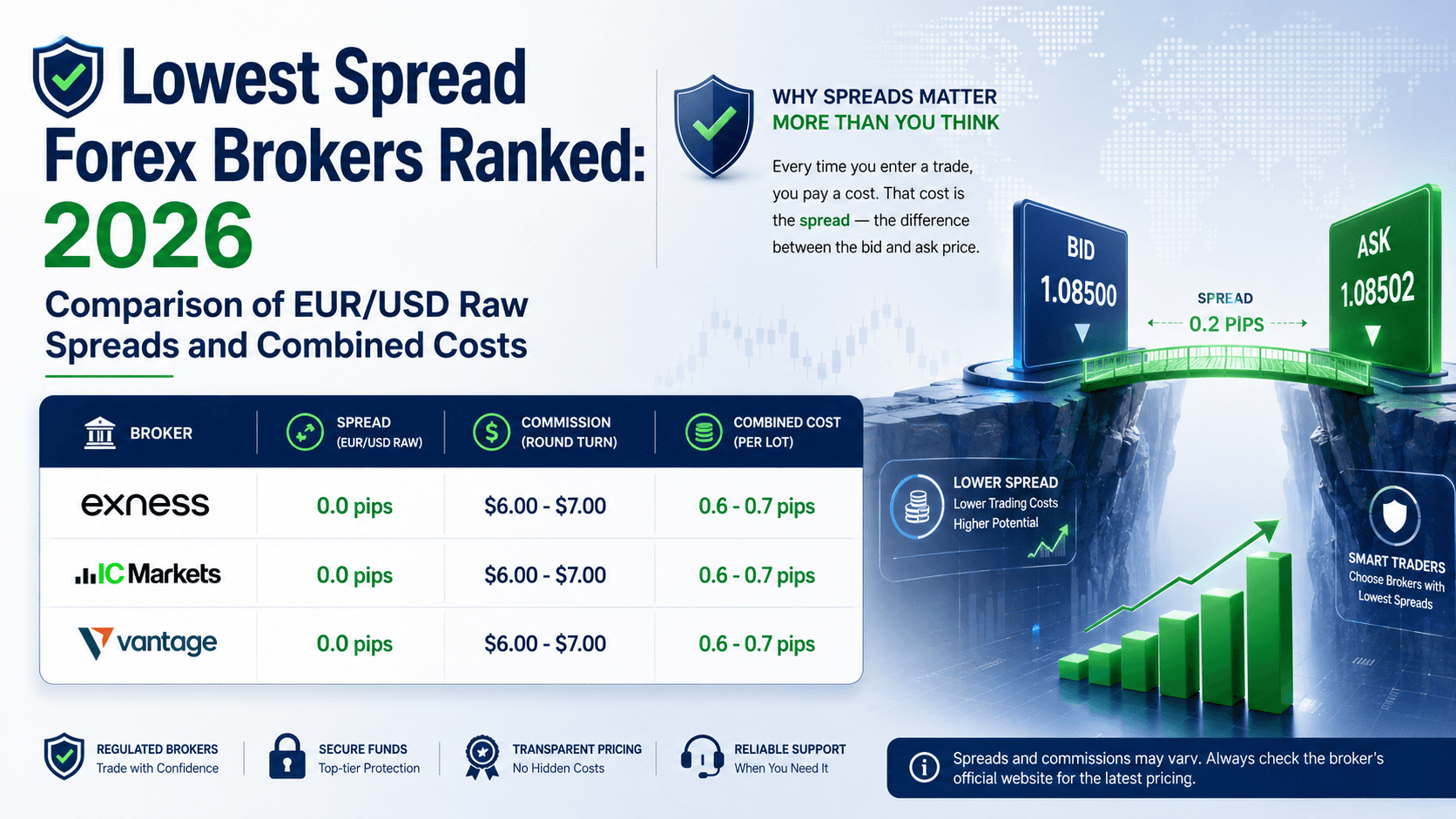
The spread is the gap between them. And it's how your broker makes money without charging a separate commission.
Let me show you what this looks like in real life.
How to Calculate the Spread in Forex (With Real Numbers)
Let's use EUR/USD — the most traded pair in the world. Say the price is:
- Bid: 1.0850
- Ask: 1.0852
The spread is 0.0002. In trader language, that's 2 pips.
Now let's make it hurt (in a good way).
Scenario: You buy 0.1 lots of EUR/USD at 1.0852. The moment you enter, the market is at 1.0850/1.0852. Your position is immediately 2 pips underwater.
On 0.1 lots, each pip is worth $1. So you're down $2 the instant you click "buy."
Price has to move 2 pips in your direction just for you to break even. Only after that are you in profit.
Now scale it up. Trade 1.0 lots? That's $20 gone immediately. Trade 5.0 lots? $100.
See why knowing the spread matters?
Fixed vs Variable Spreads — Which One Should You Use?
Not all spreads are created equal. Here's the breakdown:

| Feature | Fixed Spread | Variable (Floating) Spread |
|---|---|---|
| Cost | Stays the same always | Changes with market conditions |
| Best for | Beginners, news traders | Scalpers, experienced traders |
| Downside | Higher cost in calm markets | Can widen wildly during news |
| Requotes | Common during volatility | Rare |
| Transparency | Lower | Higher |
Fixed spreads are predictable. You know exactly what you'll pay every time. Great if you're learning and don't want surprises.
Variable spreads reflect real market conditions. During the London-New York overlap (1 PM - 5 PM GMT), EUR/USD spreads can drop to 0.6 pips. During a Fed announcement, they can blow out to 20 pips.
Here's the trap: beginners often choose variable spreads because they see "0.6 pips" and think it's cheaper. But when news hits, that spread explodes. Your trade that looked good at 0.6 pips suddenly costs you 15 pips to exit.
The fix: If you trade during quiet hours, variable spreads save you money. If you trade news or hold overnight, fixed spreads protect you from nasty surprises.
What Makes Spreads Change?
Spreads don't stay the same. They move based on three things:
1. Liquidity
Major pairs like EUR/USD, USD/JPY, and GBP/USD have the tightest spreads because billions of dollars trade them daily. Exotic pairs like USD/TRY or USD/ZAR? Spreads can be 50+ pips.
2. Volatility
When big news drops — NFP, Fed rate decisions, Brexit headlines — spreads widen. Sometimes dramatically. A 2-pip spread on EUR/USD can become 15 pips in seconds.
3. Market Hours
During the Asian session (Tokyo), spreads are wider. During London/New York overlap, they're tightest. Trading EUR/USD at 3 AM vs 2 PM is a completely different cost experience.
The Wrong Way vs The Right Way
Wrong way: You see EUR/USD at 1.0850/1.0852. You buy at 1.0852 without checking the spread. Price goes to 1.0853 — you think you're up 1 pip. But you're actually still down 1 pip because of the spread. You close in frustration.
Right way: You check the spread before entering. You know it's 2 pips. You set your take profit at 1.0872 — 20 pips above entry. Now you know you need 22 pips of actual movement to hit your target. You plan for it. You don't panic when you're down 2 pips immediately.
How to Minimize Spread Costs (3 Actionable Tips)
- Trade major pairs during peak hours. EUR/USD, GBP/USD, USD/JPY between 1 PM - 5 PM GMT. Spreads are tightest then.
- Use limit orders, not market orders. Market orders execute at the current ask price. Limit orders let you enter at a specific price — you can sometimes get in when the spread is narrower.
- Check your broker's average spreads. Most brokers publish this. If your broker's EUR/USD spread averages 1.5 pips and another averages 0.8 pips, that's $0.70 saved per 0.1 lot trade. Over 100 trades? $70 saved.
FAQ
Is the forex spread a commission?
Yes and no. It's not a separate fee, but it's built into the buy/sell price. Think of it as a built-in commission. Some brokers offer "raw spreads" with a separate commission — those are usually cheaper for high-volume traders.

Why is the spread wider on some pairs?
Liquidity. Major pairs like EUR/USD have billions in daily volume, so spreads are tight. Exotic pairs like USD/MXN have less trading activity, so spreads are wider to compensate brokers for the risk.
Can I avoid the spread entirely?
No. Every trade has a spread. But you can minimize it by trading during liquid hours, using limit orders, and choosing a broker with competitive spreads.
Does the spread affect my stop loss?
Yes. If the spread widens suddenly, your stop loss might get triggered at a worse price than expected. This is called slippage. Always account for spread widening when setting stops, especially around news events.
Quick Recap
- The spread is the difference between the bid and ask price — your cost of trading
- Calculated in pips: ask price minus bid price
- Fixed spreads stay constant; variable spreads change with market conditions
- Trade major pairs during peak hours for the tightest spreads
- Always account for the spread when calculating your risk and reward
Quick Win — Do This Now
Open your trading platform. Find EUR/USD. Write down the current bid and ask prices. Calculate the spread in pips. Now multiply that by your typical lot size. That's what you pay per trade. If it's more than you expected, consider switching to a broker with tighter spreads or trading during peak hours.