
What Is Forex Sentiment Analysis, Really?
You've got your charts. You've got your economic calendar. You know where support and resistance are. And yet — price does the exact opposite of what you expected.
Sound familiar?
The missing piece? Forex sentiment analysis — understanding what the crowd FEELS, not just what the data says.
Here's the deal: the forex market is a $6.6 trillion network of humans making decisions based on fear, greed, hope, and panic. That's not a bug — it's a feature. And if you're only looking at technicals and fundamentals, you're trading blind to the single biggest force moving price: market psychology.
Let's break down what sentiment analysis actually is, how to measure it, and — most importantly — how to use it so you're not the one getting stopped out while the smart money laughs.
Why Most Traders Ignore Sentiment (And Why That Costs Them)
Think about your typical trading day. You open the chart. You see a clean uptrend on EUR/USD. RSI says it's not overbought. The 50 EMA is sloping up. You go long.
But here's what you didn't check: 80% of retail traders are already long. The crowd is already in. Who's left to buy?
That's the trap. By the time the majority agrees on a direction, the move is usually exhausted.
Let's put numbers on it. Say you have a $2,000 account. You see EUR/USD at 1.0850, looking bullish. You buy 0.1 lots with a 30-pip stop. Your risk: $30 (1.5%).
But 75% of traders are already long. The market is "crowded." What happens next? A 20-pip drop hits your stop. You're out $30. Price then bounces 50 pips without you.
That's not bad luck. That's sentiment ignoring you back.
The data is clear: according to multiple broker studies, 70-80% of retail traders lose money. And when the crowd is overwhelmingly on one side, the opposite trade often wins. That's not conspiracy — that's liquidity. The big players need the crowd to take the other side of their trades.
The Two Flavors of Forex Sentiment Analysis
There are two main ways to measure sentiment. Let's compare them:

| Method | What It Measures | Example | Reliability |
|---|---|---|---|
| Survey-based | What traders SAY they feel | Sentix, ZEW, Reuters polls | Moderate — people say one thing, do another |
| Position-based | What traders are ACTUALLY DOING | Commitment of Traders (COT) report, broker client data | Higher — money talks |
Survey-based sentiment is useful for gauging the broad mood. The Sentix index, for example, surveys over 4,400 investors across the US, Europe, and Japan. When it drops sharply, it often precedes risk-off moves. But surveys have a lag — by the time the data is published, the market may have already moved.
Position-based sentiment is where the real edge lives. The COT report, released weekly by the CFTC, shows exactly how many long and short contracts large speculators and commercial hedgers hold. When retail traders (small specs) are heavily long and commercials are heavily short — that's a red flag.
Let's look at a concrete example using Myfxbook's live data (which aggregates real broker client positions):
| Pair | % Short | % Long | What It Suggests |
|---|---|---|---|
| EUR/USD | 64% | 36% | Crowd is bearish — contrarian signal to watch for longs |
| GBP/USD | 69% | 31% | Extreme bearish — potential reversal zone |
| USD/CAD | 20% | 80% | Crowd is heavily long — caution if you're also long |
| AUD/USD | 90% | 10% | Extreme — contrarian buy signal if other factors align |
Here's the key: These numbers are a snapshot of retail positioning. They don't tell you when the reversal will happen — only that the trade is crowded. And crowded trades tend to reverse.
The Contrarian Playbook: How to Use Sentiment as a Leading Indicator
This is where forex sentiment analysis becomes actionable. The idea is simple: when everyone is on one side of the boat, it's time to check the other side.
But it's not automatic. You don't just fade every extreme reading. Here's the framework:
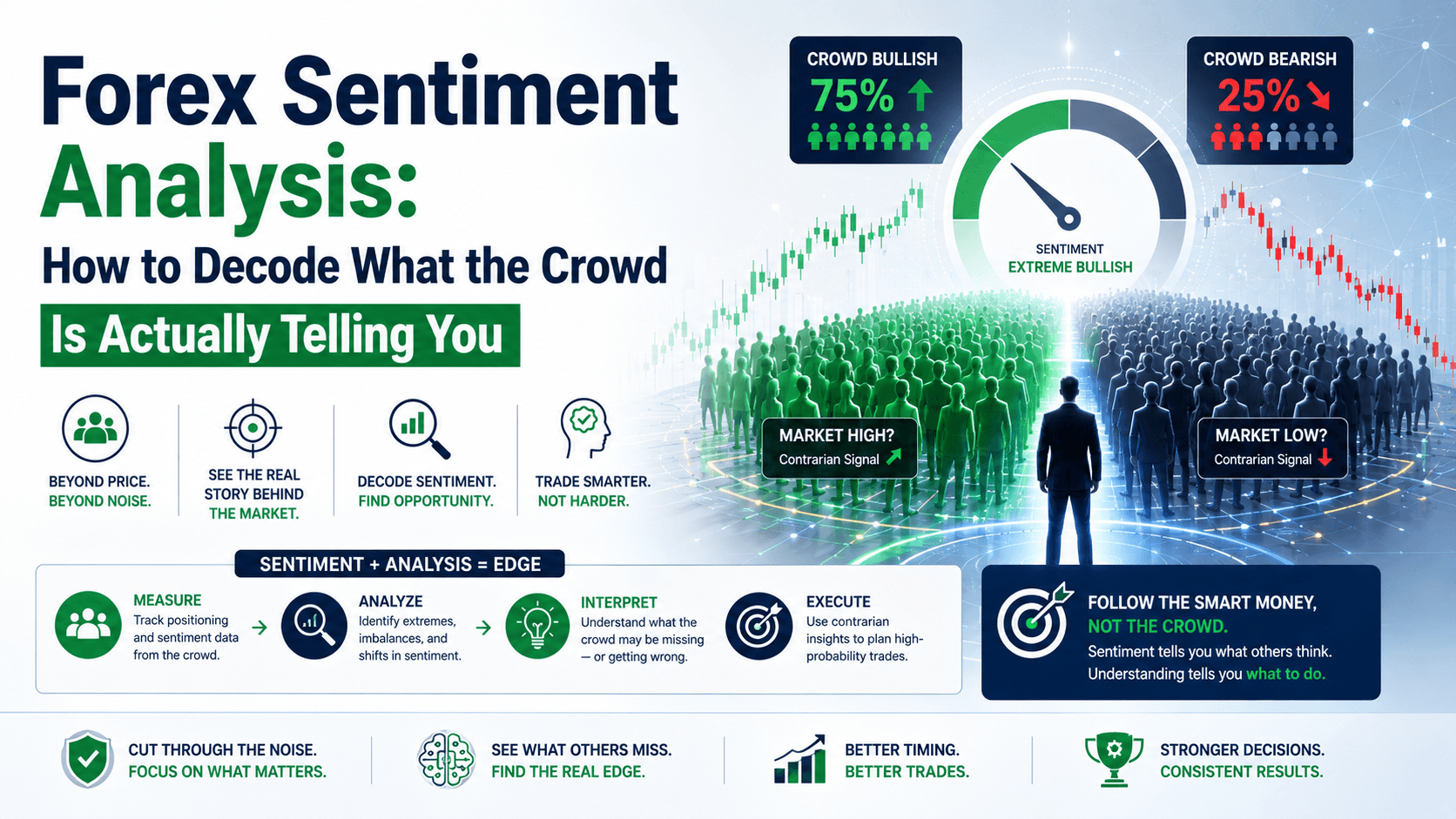
Step 1: Identify extreme readings. Look for pairs where retail positioning is 70%+ on one side. That's your warning light.
Step 2: Check the trend. Is the extreme reading aligned with or against the prevailing trend? If 80% of traders are short but the pair is in a strong uptrend, the crowd is fighting the trend — and they're likely wrong.
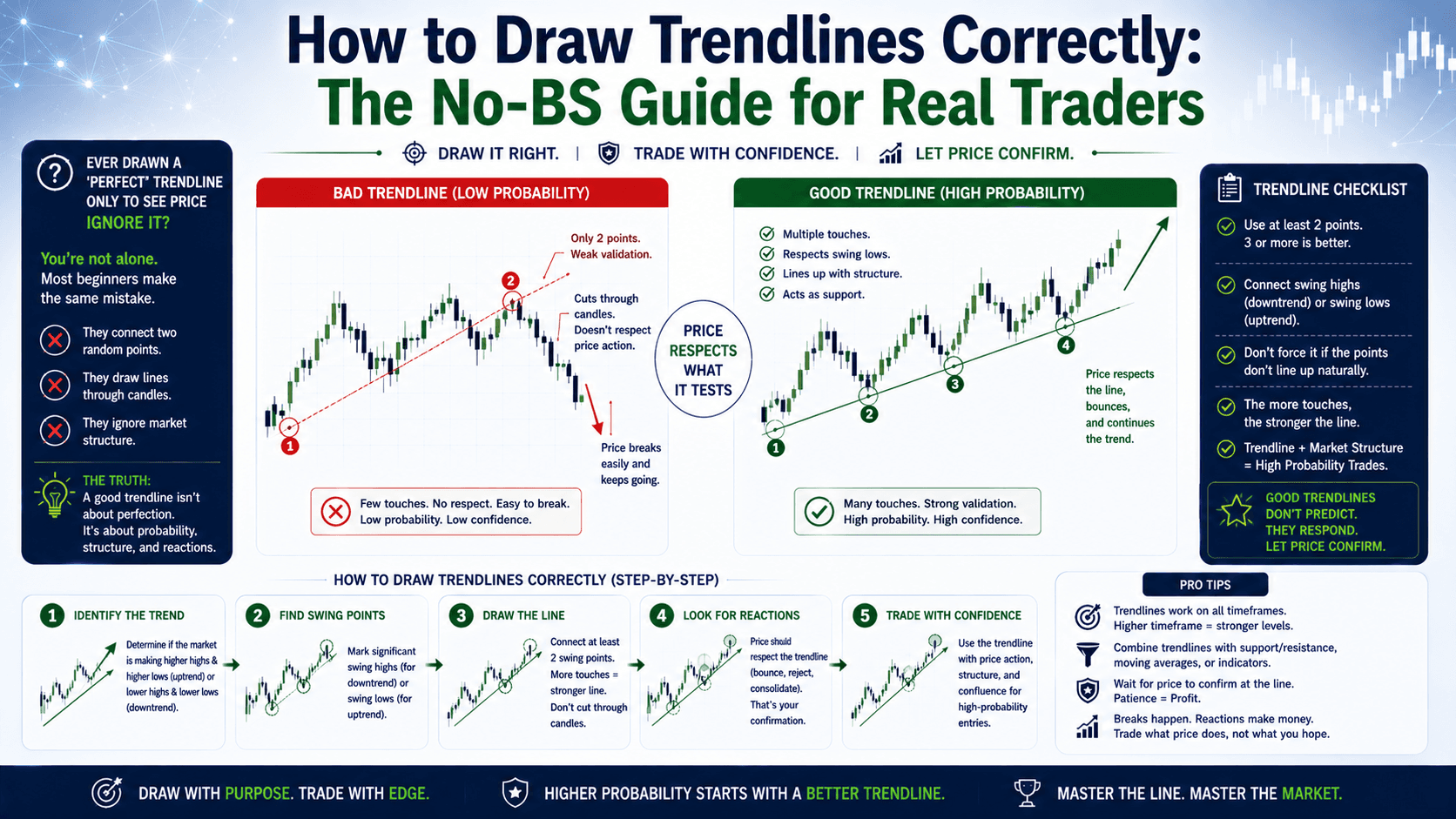
Step 3: Look for confirmation. Don't trade sentiment alone. Wait for price action to confirm. A bullish rejection candle at support when the crowd is heavily short? That's a high-probability setup.
Step 4: Manage risk. Just because the crowd is wrong doesn't mean you'll be right tomorrow. Use a stop loss. Always.
Let's run a scenario. It's Tuesday. You check the Myfxbook sentiment data and see that 85% of traders are short AUD/USD. The pair is at 0.7200, testing a major support level that has held three times this month. The RSI on the daily chart is showing a bullish divergence.
What do you do?
You don't blindly buy. But you pay attention. You mark the support zone. You wait for a bullish engulfing candle on the 1-hour chart. When it forms, you go long at 0.7205 with a stop at 0.7180 (25 pips). Target: 0.7250 (45 pips).
Risk: $25 on 0.1 lots (1.25% of a $2,000 account). Reward: $45. Risk:reward = 1:1.8.
That's not gambling. That's using sentiment as one piece of a larger puzzle.
The Trap Most Beginners Fall Into
Here's the mistake: treating sentiment analysis as a crystal ball.
You see 90% of traders are short. You think "time to buy!" You go long with full size. The pair drops another 100 pips. You lose money. And you blame the indicator.
The truth is: extreme sentiment can persist longer than you can stay solvent. The crowd can be wrong for weeks before the reversal happens.
That's why sentiment is a warning signal, not a trigger. It tells you to be cautious, to tighten your stops, to look for confirmation. It doesn't tell you exactly when to enter.
Another trap: ignoring the context. A 70% short reading on EUR/USD during a risk-off panic (like a surprise rate hike) is different from the same reading during a quiet Tuesday. Sentiment data is most powerful when it's extreme and the fundamental backdrop supports a reversal.
FAQ
Is forex sentiment analysis reliable?
It's a useful piece of the puzzle, not a standalone system. When combined with technical and fundamental analysis, it helps you avoid crowded trades and spot potential reversals. On its own, it's not reliable enough to trade.

How often should I check sentiment data?
For daily or swing trading, check once a day. For scalping, it's less useful — sentiment shifts slower than price. Use the COT report (weekly) or broker sentiment tools (live) depending on your timeframe.
What's the best free tool for forex sentiment analysis?
Myfxbook's Market Sentiment page is excellent — it shows live long/short percentages by pair. DailyFX also offers a retail sentiment indicator. Both are free and updated in real-time.
Does sentiment work better for certain currency pairs?
Yes. It tends to work best on major pairs like EUR/USD, GBP/USD, and USD/JPY because they have the most participants. Exotic pairs have thinner data and less reliable readings.
Quick Recap
- Forex sentiment analysis measures what traders FEEL and DO, not just what data says
- Two main types: survey-based (what people say) and position-based (what people do)
- Extreme retail positioning (70%+ one side) is a contrarian warning signal
- Always combine sentiment with technical confirmation — don't trade it alone
- The crowd can be wrong for a long time — manage risk accordingly
Your 5-Minute Quick Win
Open a new browser tab. Go to Myfxbook's Market Sentiment page. Look at EUR/USD, GBP/USD, and AUD/USD. Write down the long/short percentages.
Now open your trading platform. Look at the daily chart for each pair. Is the sentiment extreme? Is it aligned with or against the trend? Mark any support or resistance levels nearby.
You're not trading yet — you're just building the habit of checking sentiment before you click. Do this for 5 days. You'll start seeing patterns you never noticed before.
That's the edge.