
You're Staring at a 5-Minute Chart. Now What?
You've opened the 5-minute chart. Candles are flying by. You see price spike, you think "buy," then it reverses. You feel like you're always one step behind.
Sound familiar?
Here's the truth: forex scalping on a 5 minute chart is one of the most popular ways to trade. But 90% of beginners lose money doing it. Not because scalping doesn't work — but because they don't have a real plan.
In this article, I'm going to show you exactly how to trade the 5-minute chart. No fluff. Just a step-by-step strategy you can use today.
What is Forex Scalping on a 5 Minute Chart?
Scalping is a short-term trading style. You open and close trades in minutes — sometimes seconds. The goal isn't to catch a 100-pip move. It's to grab 5-10 pips, over and over again.
Forex scalping on a 5 minute chart means you're using the 5-minute timeframe to find entries. Each candle represents 5 minutes of price action. That gives you about 12 candles per hour — plenty of opportunities.
Here's a real example:
EUR/USD is at 1.0850. You see a clear rejection at 1.0855 on the 5-minute chart. You go short at 1.0853. You set a stop loss at 1.0863 (10 pips). You set a target at 1.0843 (10 pips).
Price drops to 1.0842 in 8 minutes. You just made $10 on a 0.1 lot trade. Do that 5 times in a session? That's $50.
But — and this is the big "but" — you need a system. You can't just guess.
The #1 Mistake Beginners Make on the 5-Minute Chart
Most beginners see a green candle and buy. They see a red candle and sell. That's not a strategy. That's gambling.
The real mistake? Trading without confirmation. You need more than one signal to enter a trade. Otherwise, you're just reacting to noise.
Here's what happens:
- You see a big green candle → you buy at the top → price reverses → you're stopped out.
- You see a big red candle → you sell at the bottom → price bounces → you're stopped out again.
That's the contrast effect in action. The big candle looks exciting. But by the time you see it, the smart money already got in. You're buying the hype.
The fix? Wait for confirmation. Use indicators to filter the noise.
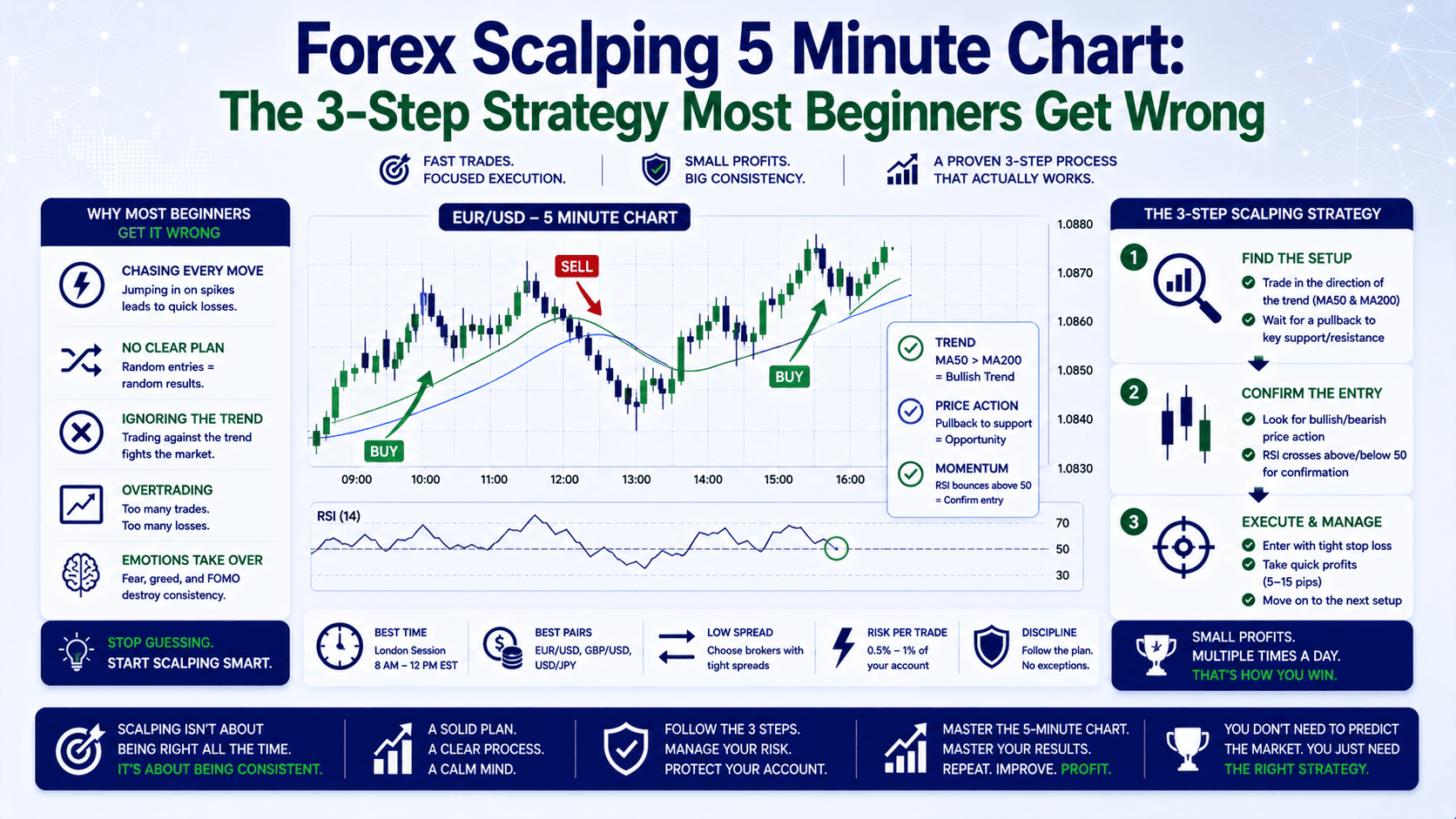
Your 3-Step Forex Scalping Strategy for the 5-Minute Chart
Here's a simple, repeatable strategy. You'll need two indicators:

- 20 EMA (Exponential Moving Average) — shows the short-term trend direction
- MACD (Moving Average Convergence Divergence) — confirms momentum
That's it. No need for 5 indicators. Keep it simple.
Step 1: Identify the Trend
Look at the 5-minute chart. Is price above or below the 20 EMA?
- Price above the 20 EMA → trend is up → look for BUY entries
- Price below the 20 EMA → trend is down → look for SELL entries
This is your filter. Don't trade against the trend on the 5-minute chart.
Step 2: Wait for MACD Confirmation
Now check the MACD. You want it to confirm the direction.
- For a BUY: MACD line crosses above the signal line (positive momentum)
- For a SELL: MACD line crosses below the signal line (negative momentum)
Don't enter until both conditions are met. Price above EMA + MACD bullish crossover = green light.
Step 3: Enter and Manage the Trade
Here's the exact execution plan:
For a LONG position:
- Wait for price to cross above the 20 EMA
- Wait for MACD to show a bullish crossover (within the last 5 bars / 25 minutes)
- Enter 10 pips above the 20 EMA
- Set stop loss at the lowest low of the last 5 candles, or 20 pips below EMA (whichever is tighter)
- Set target at 20 pips above entry
- Once price moves 10 pips in your favor, move stop loss to breakeven
- Use a trailing stop for the remaining position
For a SHORT position:
- Wait for price to cross below the 20 EMA
- Wait for MACD to show a bearish crossover (within the last 5 bars / 25 minutes)
- Enter 10 pips below the 20 EMA
- Set stop loss at the highest high of the last 5 candles, or 20 pips above EMA
- Set target at 20 pips below entry
- Once price moves 10 pips in your favor, move stop loss to breakeven
- Use a trailing stop for the remaining position
Let's see this with real numbers on EUR/USD:
- EUR/USD at 1.0850. Price breaks above 20 EMA at 1.0852. MACD crosses bullish.
- You enter at 1.0862 (10 pips above EMA). Stop loss at 1.0832 (30 pips). Target at 1.0882 (20 pips).
- Risk: $30 on 0.1 lots. Reward: $20. That's a 1:0.67 risk-reward — not great. So you need a high win rate.
That's why the trailing stop is crucial. It lets you capture more when the trend extends.
Comparison: 5-Minute Scalping vs. Other Timeframes
| Factor | 5-Minute Scalping | 15-Minute Scalping | 1-Hour Scalping |
|---|---|---|---|
| Number of trades/day | 10-30 | 3-8 | 1-3 |
| Average hold time | 5-15 minutes | 15-45 minutes | 1-4 hours |
| Pips per trade | 5-15 | 15-30 | 30-60 |
| Stress level | High | Medium | Low |
| Best for | Active traders | Part-time traders | Patient traders |
The 5-minute chart gives you the most opportunities. But it also demands the most attention. If you can't sit in front of the screen for 2-3 hours, this isn't for you.
Wrong Way vs. Right Way: A Real Trade Example
Wrong way (most beginners):
EUR/USD is at 1.0850. You see a big green candle. You buy at 1.0855. No stop loss. No target. Price hits 1.0860, you feel good. Then it reverses to 1.0840. You panic and sell at 1.0838. Loss: 17 pips = $17 on 0.1 lots. You just lost money because you had no plan.
Right way (using the strategy):
Same setup. EUR/USD at 1.0850. Price breaks above 20 EMA. MACD crosses bullish. You enter at 1.0862. Stop loss at 1.0832. Target at 1.0882. Price hits 1.0872 (10 pips profit), you move stop to breakeven. Price continues to 1.0882. You close. Profit: 20 pips = $20 on 0.1 lots.
See the difference? The right way has rules. The wrong way is gambling.
3 Common Traps in Forex Scalping on a 5 Minute Chart
Trap 1: Overtrading. You see a setup, you take it. Then another. Then another. Before you know it, you've taken 20 trades and lost on 15 of them. The fix? Set a maximum of 10 trades per session. Stick to it.
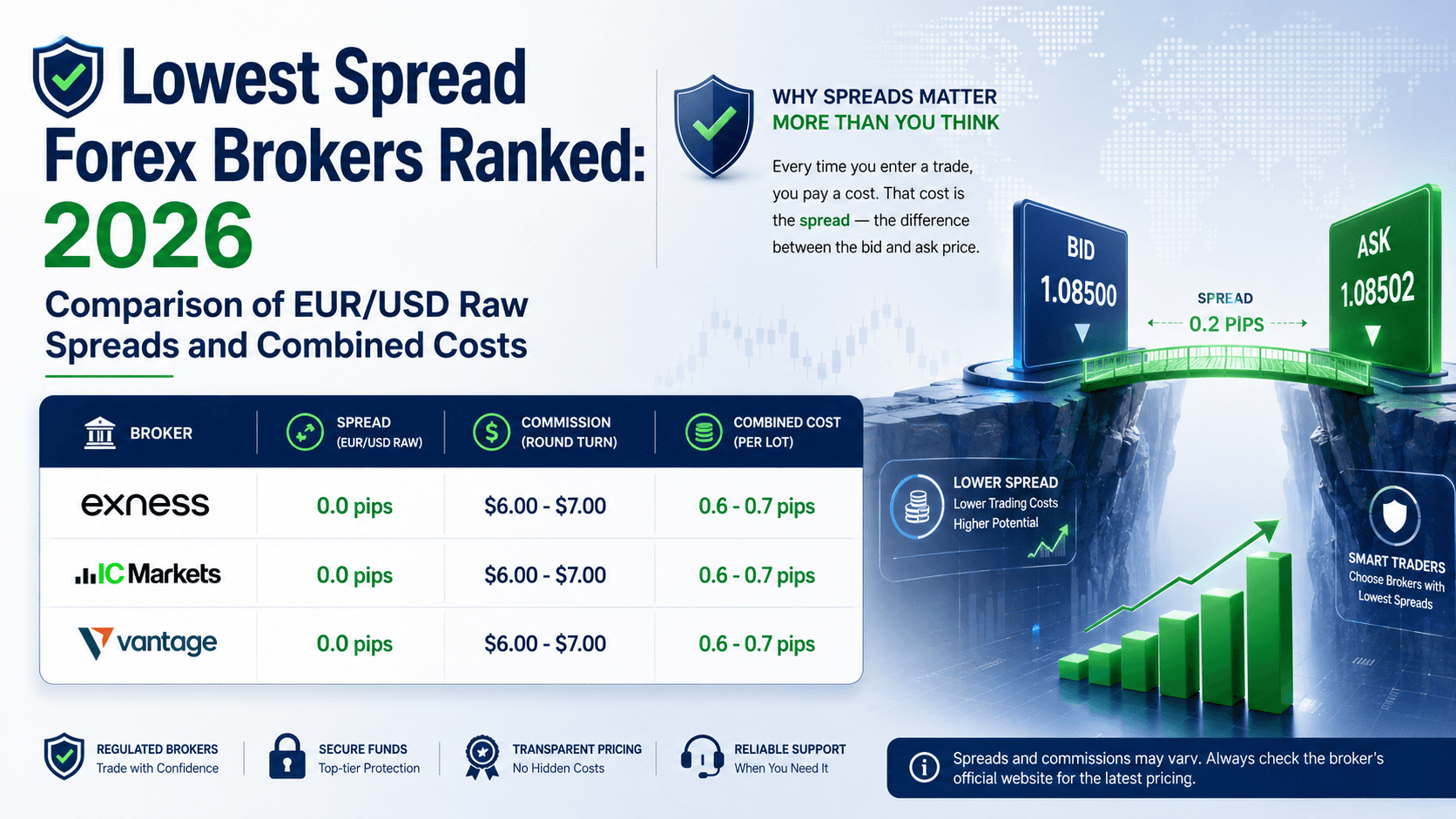
Trap 2: Ignoring spreads. On the 5-minute chart, every pip matters. If your broker has a 2-pip spread on EUR/USD, you need the market to move 2 pips just to break even. That cuts into your 5-10 pip target. Use a broker with tight spreads (0-1 pip on majors).
Trap 3: Trading during low liquidity. The 5-minute chart is noisy during Asian session. Stick to London and New York sessions (8 AM - 12 PM EST). That's when the volume is highest and the moves are cleanest.
FAQ
Is forex scalping on a 5 minute chart profitable?
Yes, but only with a solid strategy and strict risk management. Most beginners lose because they trade without a plan. With a 60% win rate and 1:1 risk-reward, you can be profitable.

What indicators work best for 5-minute scalping?
The 20 EMA and MACD are a simple, effective combo. The EMA shows trend direction. The MACD confirms momentum. Start with these two before adding more.
How much money do I need to start scalping the 5-minute chart?
Start with at least $500. With a $500 account, risk 2% per trade ($10). On EUR/USD with a 30-pip stop, that means 0.03 lots. You can grow from there.
Can I scalp the 5-minute chart on Gold (XAU/USD)?
Yes, but be careful. Gold is more volatile than EUR/USD. A 30-pip stop on Gold might be too tight. Use a wider stop (50-60 pips) and smaller lot size to compensate.
Quick Recap
- Forex scalping on a 5 minute chart means holding trades for 5-15 minutes, targeting 5-20 pips per trade
- Use the 20 EMA for trend direction and MACD for momentum confirmation
- Always set a stop loss — move it to breakeven after 10 pips of profit
- Trade during London/New York sessions for the best liquidity
- Keep it simple — don't use more than 2-3 indicators
Your Quick Win
Open your trading platform right now. Pull up EUR/USD on the 5-minute chart. Add the 20 EMA. Add the MACD with default settings (12, 26, 9).
Now, look at the last 10 candles. Is price above or below the EMA? Is MACD above or below the signal line?
If both align (price above EMA + MACD bullish = buy setup), mark it. If not, wait. Do this for 10 minutes. Don't trade. Just observe.
You just started training your eyes to see setups. Do this for a week before you trade with real money.