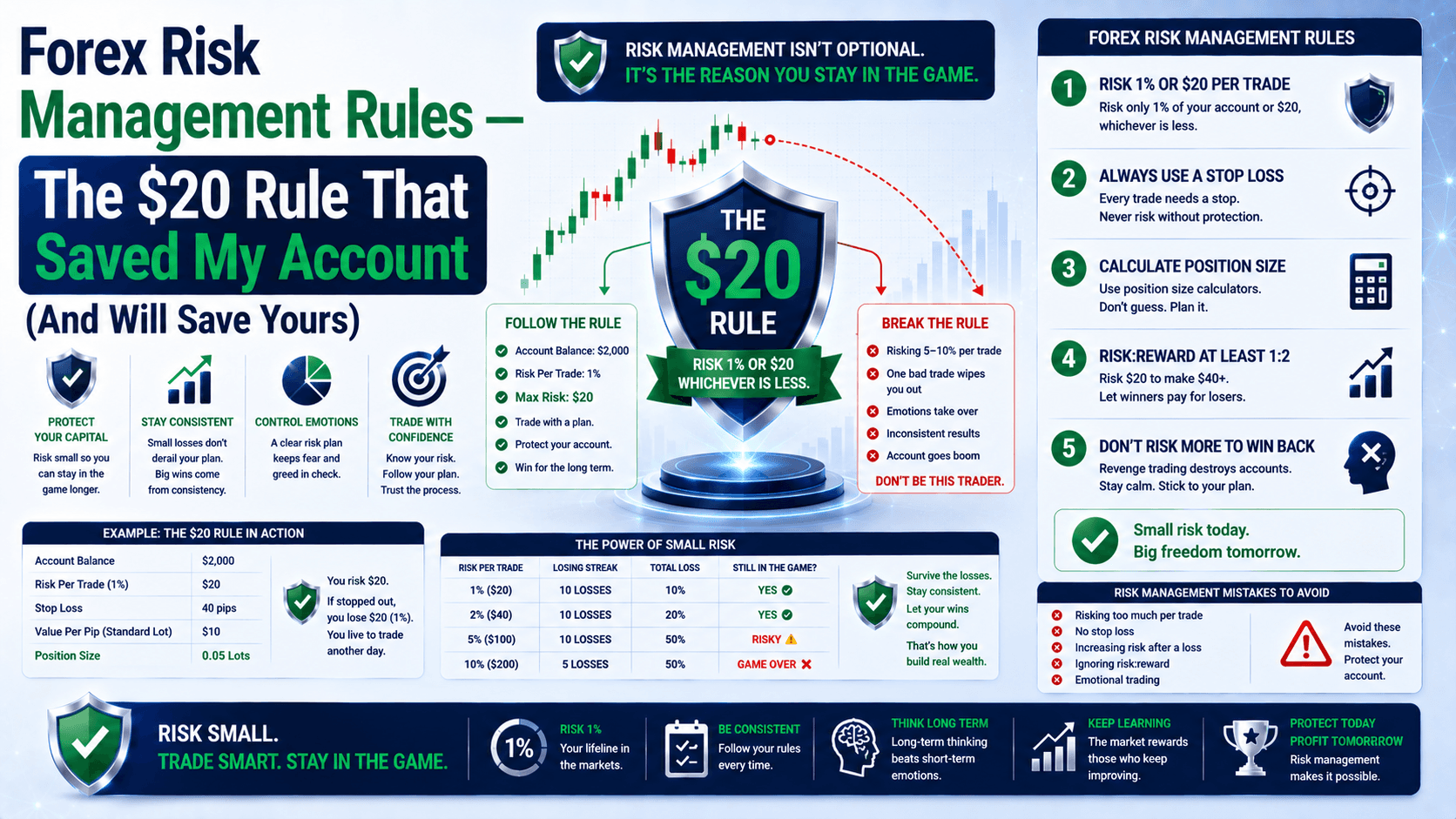

You're Doing Risk Management Wrong. Here's Proof.
Let me guess. You've read about risk management. You know you should use a stop loss. Maybe you even have a rule like "I'll risk 2% per trade."
But then EUR/USD drops 50 pips in 10 minutes. Your trade is losing $150. And you freeze. You don't close it. You hope it comes back.
Sound familiar?
That's not risk management. That's hopium. And hopium is why 90% of retail traders blow their accounts.
Here's the truth: Forex risk management rules aren't about being conservative. They're about staying in the game long enough to actually make money. I blew my first $2,000 account learning this lesson. You don't have to.
What Are Forex Risk Management Rules? (The Simple Definition)
Risk management rules are the guardrails that keep one bad trade from wiping you out. They're not optional. They're the difference between a trader who lasts 10 years and one who lasts 10 days.
Think of it like this: You wouldn't drive a car without brakes. Trading without risk management is the same thing. The market moves fast. You need a way to stop.
The core idea is simple: Know exactly how much you can lose before you enter the trade. And accept it.
Rule #1: The 1-2% Rule — Your Account's Seatbelt
This is the most important forex risk management rule you'll ever learn. Professional traders risk 1-2% of their account per trade. Period.
Here's why it matters with real numbers:
Let's say you have a $2,000 account. You risk 2% per trade = $40 max loss per trade.
You take a trade on GBP/USD at 1.2650. Your stop loss is 20 pips away. On a mini lot (0.1), each pip is worth $1. So 20 pips = $20 risk. That's 1% of your account. Perfect.
Now imagine you risk 10% per trade instead. Same trade. $200 risk. One bad trade and you're down 10%. Two bad trades and you're down 20%. Five bad trades and half your account is gone.
With the 2% rule, you can lose 50 trades in a row before your account hits zero. That's nearly impossible if you have a decent strategy. But with 10%? Five bad trades and you're done.
How to Calculate Your Risk Per Trade
Follow these steps:
- Check your account balance. Let's say it's $2,000.
- Decide your risk percentage. Use 2% for now. That's $40.
- Measure your stop loss in pips. If it's 20 pips, each pip on 0.1 lots is $1.
- Calculate: $40 risk ÷ 20 pips = $2 per pip. That means you trade 0.2 lots.
Done. You now know exactly how much you can lose. No guesswork. No hoping.
| Risk % Per Trade | $2,000 Account | Losses to Blow Account | What It Feels Like |
|---|---|---|---|
| 1% | $20 | 100 trades | Boring. Safe. You sleep well. |
| 2% | $40 | 50 trades | Standard. Professional. |
| 5% | $100 | 20 trades | Aggressive. Risky. |
| 10% | $200 | 10 trades | Gambling. You're toast. |
Rule #2: Stop Losses Are Not Optional
I can't tell you how many times I've heard: "I don't use stop losses because the market always takes them out."

That's not a reason to skip them. That's a reason to place them better.
A stop loss is your escape hatch. Without one, a 50-pip move against you becomes a 200-pip disaster. And that $40 loss? Now it's $160. And you're down 8% in one trade.
The Wrong Way vs. The Right Way
Wrong way: Place your stop loss right at the support level. EUR/USD is at 1.0850, support is at 1.0800. You put your stop at 1.0800. Price dips to 1.0797, takes your stop, then bounces to 1.0880. You're out. And furious.
Right way: Give your stop 5-10 pips of breathing room. Place it at 1.0790 instead of 1.0800. Yes, your risk is slightly bigger. But you actually stay in the trade. The market can breathe without kicking you out.
Rule #3: Risk-Reward Ratio — Don't Trade Unless It's Worth It
Every trade should have a clear risk-reward ratio. The minimum is 1:2. That means you risk $40 to make $80.
Here's the math that makes this work:
Let's say you take 10 trades with a 1:2 risk-reward ratio. You lose 6 trades and win 4.
- Losses: 6 × $40 = $240
- Wins: 4 × $80 = $320
- Net profit: $80
You were wrong 60% of the time. And you still made money. That's the power of a good risk-reward ratio.
How to Set Your Risk-Reward Ratio
- Measure your stop loss in pips. Let's say 20 pips.
- Set your target at least 40 pips away (1:2 ratio).
- If the market can't give you 40 pips of potential profit, don't take the trade.
Simple. But most beginners ignore this because they're chasing quick wins. Don't be that person.
Rule #4: Leverage Is a Weapon — Treat It Like One
Leverage amplifies everything. Your wins. Your losses. Your emotions.
Most brokers offer 50:1 or even 100:1 leverage. That means a $1,000 deposit controls $50,000 or $100,000 in the market. Sounds amazing, right?
Here's the catch: A 1% move against you at 100:1 leverage wipes out your entire account.
Professional traders use low leverage. They know that high leverage is a trap for beginners who think they're invincible.
My rule: Never use more than 10:1 leverage until you've been profitable for 6 months. That means a $1,000 account controls $10,000. A 2% loss on your account is still just $20. You can survive that.
| Leverage | Deposit | Position Size | 1% Move Against You |
|---|---|---|---|
| 1:1 | $1,000 | $1,000 | - $10 |
| 10:1 | $1,000 | $10,000 | - $100 |
| 50:1 | $1,000 | $50,000 | - $500 |
| 100:1 | $1,000 | $100,000 | - $1,000 (account gone) |
Rule #5: Keep a Trading Journal — Your Most Underrated Tool
You can't improve what you don't measure. A trading journal is where you track every trade: entry, exit, stop loss, target, reason for the trade, and your emotional state at the time.
After 20-30 trades, review your journal. You'll see patterns. Maybe you lose money on Wednesday afternoons. Maybe you revenge trade after a loss. Maybe your best trades are on EUR/USD, not on exotic pairs.
This data is gold. It tells you exactly where to improve.
FAQ
What is the best forex risk management rule for beginners?
The 2% rule. Never risk more than 2% of your account on a single trade. This keeps you alive long enough to learn and improve.

How much should I risk per trade in forex?
1-2% of your account balance. If you have $1,000, risk $10-$20 per trade. This ensures one bad trade doesn't destroy your account.
Is leverage bad for beginners?
High leverage is dangerous for beginners. Stick to 10:1 or less until you're consistently profitable. Higher leverage amplifies losses faster than most beginners realize.
How do I calculate position size for forex risk management?
Divide your max risk (e.g., $20) by your stop loss in pips (e.g., 20 pips). That gives you the dollar value per pip ($1). Then adjust your lot size to match. On most pairs, 0.1 lots = $1 per pip.
📝 Quick Recap
- Risk 1-2% per trade — This is your survival rule. Never break it.
- Always use a stop loss — Give it breathing room, but never skip it.
- Aim for 1:2 risk-reward minimum — You can be wrong most of the time and still profit.
- Use low leverage — 10:1 max until you're profitable for 6 months.
- Keep a trading journal — Track everything. Review it. Improve.
Your Quick Win Today
Open your trading platform right now. Check your account balance. Calculate your 2% risk number. Write it down. Stick it on your monitor.
Next trade you take, use that number to calculate your position size. Don't guess. Don't hope. Use the math.
That one habit will save you more money than any trading strategy ever will.