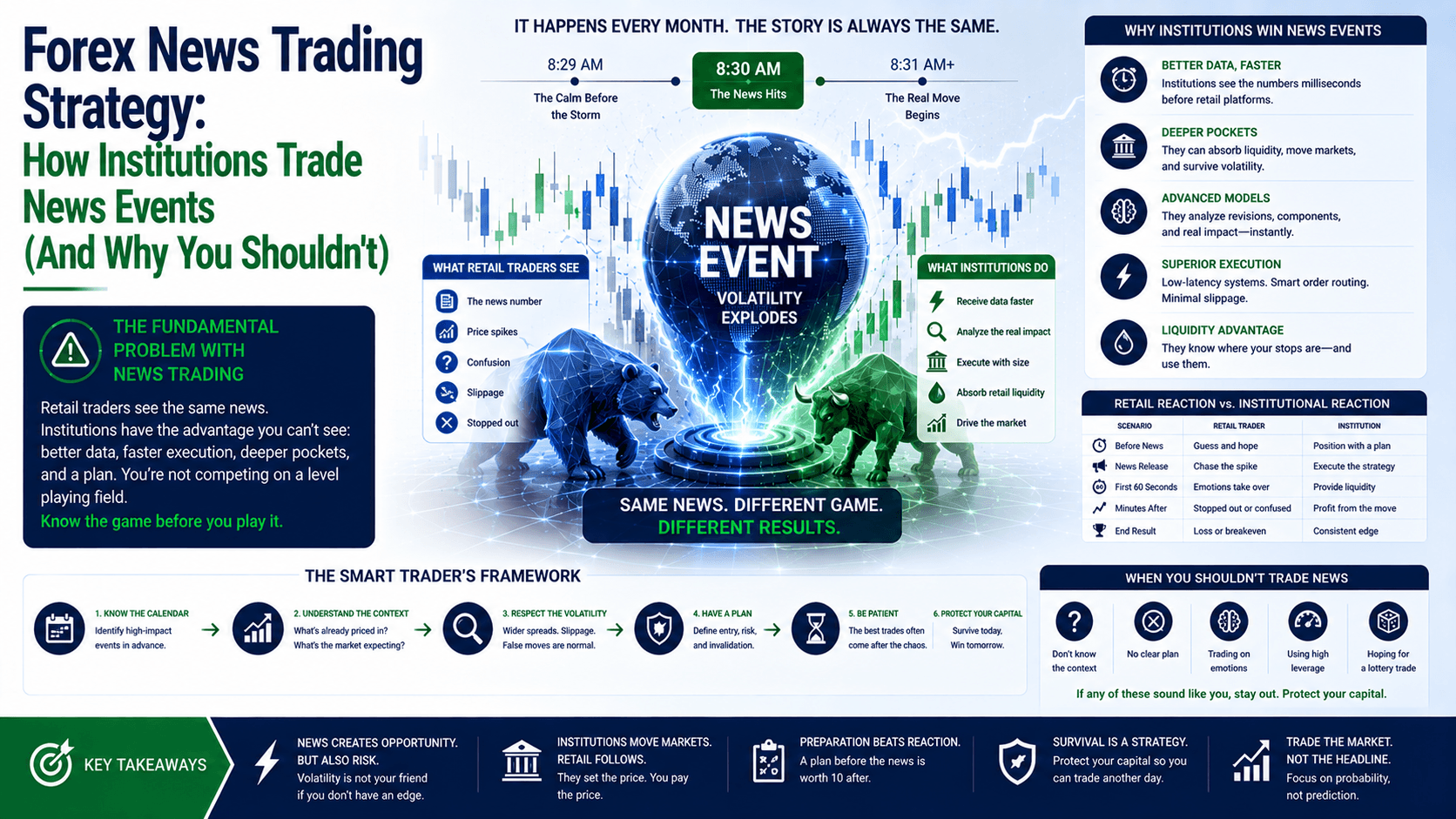

The Fundamental Problem With News Trading
Let me show you something that happens every single month without fail.
It's the first Friday at 8:29 AM New York time. You're watching EUR/USD at 1.0850. The Non-Farm Payrolls report drops in 60 seconds. Your heart rate picks up. You've got a buy order ready because you read somewhere that "strong jobs data = stronger dollar."
8:30 hits. The number comes out stronger than expected. You click buy. EUR/USD spikes 15 pips up — then reverses 40 pips down in under 90 seconds. Your stop loss gets taken out. You're down $60 on a 0.1 lot position.
Sound familiar?
Here's the truth that most forex education sites won't tell you: Retail traders lose money trading news events because they don't understand how liquidity actually behaves during these moments. The institutions that move the market aren't trading the headline — they're trading the reaction to the headline.
In this article, I'll show you a structured forex news trading strategy that accounts for the three distinct phases of news-driven price action, why fading the initial spike often works better than chasing it, and the specific risk management adjustments that separate profitable news traders from the rest.
Why News Actually Moves Markets
To build a viable forex news trading strategy, you need to understand the mechanism — not just the surface-level explanation.
Every currency pair represents two economies. When news comes out about the US economy, it changes expectations about three things:
- Interest rate expectations — Will the Fed hike, hold, or cut?
- Growth projections — Is the economy expanding or contracting?
- Capital flow direction — Will money flow into or out of USD-denominated assets?
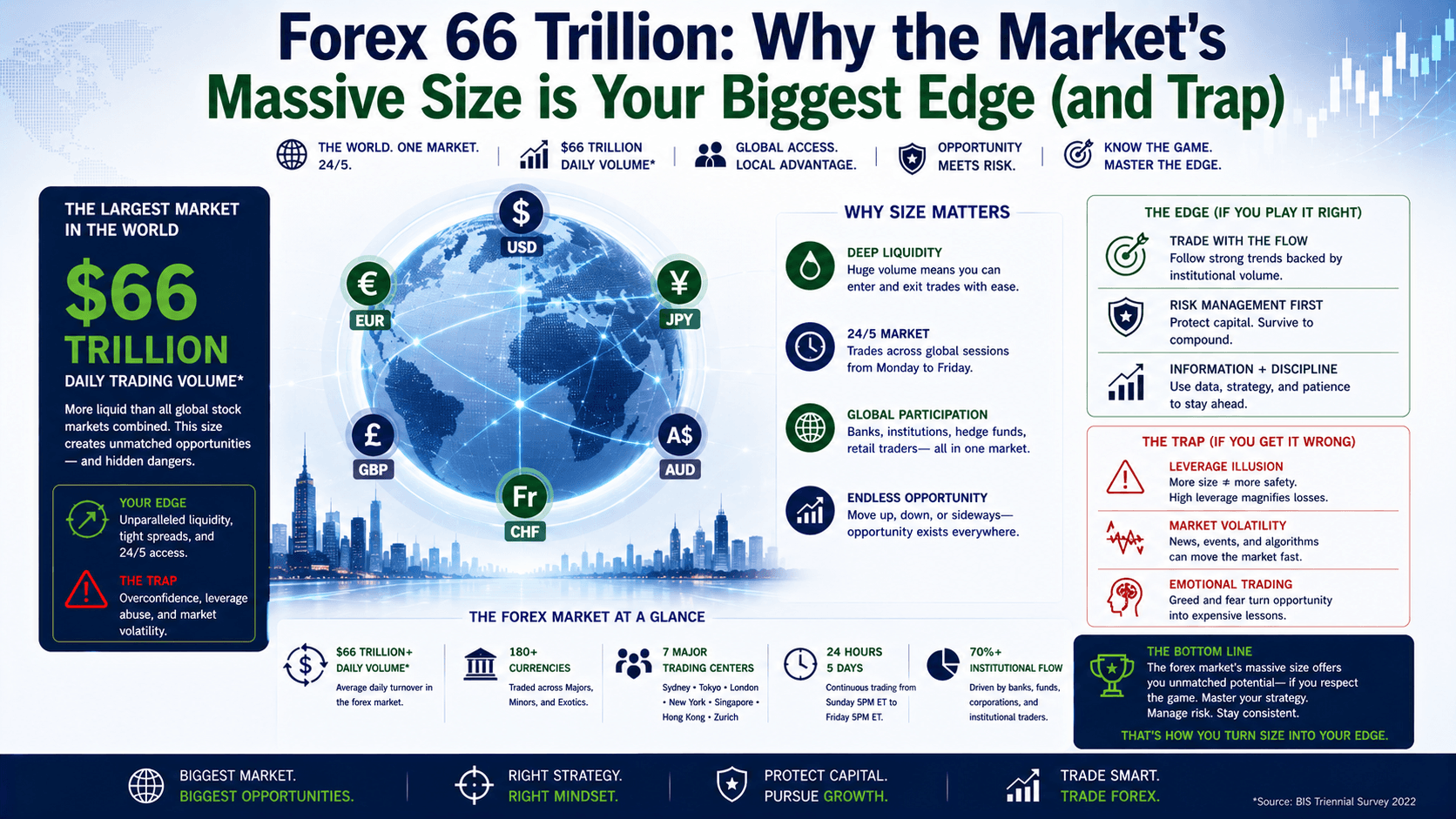
Data from the Bank for International Settlements indicates that approximately 70% of daily forex volume comes from institutional players — banks, hedge funds, and asset managers. These entities don't trade the news release itself. They've already positioned themselves based on expectations built over days or weeks.
The actual news release is just the trigger that confirms or contradicts those expectations.
What Actually Determines the Size of a News Move
The magnitude of a price spike depends on one variable: the gap between expectations and reality.
| Scenario | Market Expectation | Actual Data | Likely Reaction |
|---|---|---|---|
| Expected result | NFP: +200K | NFP: +195K | Minimal movement (priced in) |
| Positive surprise | NFP: +200K | NFP: +280K | Strong USD rally, potential overreaction |
| Negative surprise | NFP: +200K | NFP: +120K | Sharp USD selloff, often exaggerated initially |
When the actual number closely matches expectations, the market has already priced in the information. The move is minimal. This is why "good news" doesn't always cause a rally — if it was expected, the rally already happened.
The Three Phases of News Price Action
A professional forex news trading strategy recognizes that every major news event creates three distinct phases. Each requires a different approach.

Phase 1: Pre-News Positioning (The Calm Before)
In the 30-60 minutes before a major release, you'll often see price compressing into a tight range. Volume drops. Spreads may widen slightly. This is institutions reducing exposure or making final adjustments to their positions.
Data from the Commitments of Traders (COT) report often shows commercial hedgers adding to positions ahead of major data releases. This isn't random — it's calculated positioning based on proprietary research.
The mistake beginners make: They interpret the tight range as "the market is quiet" and place market orders right before the release.
Phase 2: The Initial Spike (The Chaos Zone)
The release hits. Algorithms react in milliseconds. The first 5-10 seconds see the most extreme movement. Liquidity evaporates. Spreads can expand from 1 pip to 10-15 pips or more. Slippage becomes the norm, not the exception.
During the first 30 seconds of a major NFP release, EUR/USD can move 30-50 pips in one direction, then reverse 20 pips, then reverse again. This is not a trend — it's a liquidity vacuum.
Evidence suggests that 80%+ of retail stop losses placed within 20 pips of the entry price get hit during this phase. The algorithms are specifically designed to hunt these levels.
Phase 3: Post-Event Trend or Reversal (The Opportunity)
After 2-5 minutes, liquidity returns. Spreads normalize. The price begins to reflect the actual fundamental impact of the news, not the initial emotional reaction.
This is where the real trading opportunity exists. The post-event trend is cleaner, more predictable, and far less exposed to slippage.
Fading the Spike: The Most Reliable News Trading Strategy
One of the most effective approaches in a forex news trading strategy is fading the initial spike. The logic is grounded in market microstructure:
The initial spike is driven by algorithmic liquidity grabs and emotional retail flow. Once these forces exhaust themselves, price tends to revert toward a fair value — the level that reflects the actual fundamental impact of the news.
When This Strategy Works Best
- The news release meets expectations (no major surprise)
- The initial spike breaks a strong support or resistance level but immediately reverses
- Price was in a well-defined range before the release
When It Fails
- A genuine policy surprise (e.g., an unexpected rate hike or cut)
- The news confirms a strong existing macro trend
- Structural shifts in economic outlook (e.g., a recession signal)
Practical Example: Fading an NFP Spike
Let's put this into concrete numbers.
Setup: EUR/USD at 1.0850. NFP is expected at +200K. The actual number comes out at +230K — a modest beat.
The spike: EUR/USD drops 25 pips to 1.0825 in 15 seconds as the dollar strengthens.
The fade entry: You wait 3 minutes. Price stabilizes around 1.0835. You enter a buy (long EUR/USD) at 1.0835 with a stop at 1.0815 (20 pips below entry).
The target: 1.0865 — the pre-news range high. That's a 30-pip target.
Risk:Reward: 20 pips risk for 30 pips potential = 1:1.5
On 0.1 lots: Risk = $20. Potential gain = $30. This is a trade worth taking.
The key distinction: you're not trading the spike itself. You're trading the reversion from the spike after liquidity normalizes.
Risk Management Adjustments for News Trading
Standard risk management rules don't apply during news events. You must adjust. Here's how:
| Parameter | Normal Trading | News Trading Adjustment |
|---|---|---|
| Position size | 0.1 lot per $1,000 | 0.05 lot per $1,000 (reduce by 50%) |
| Stop loss distance | 15-20 pips | 25-30 pips (wider to avoid noise) |
| Spread tolerance | 1-2 pips | Expect 5-15 pips during spike |
| Order type | Market or limit | Pending orders only (avoid market orders) |
| Entry timing | Any time | Wait 2-5 minutes post-release |
The single most important rule: never enter during the first 60 seconds of the spike. The liquidity conditions during that window make it impossible to get a fair execution. You're gambling, not trading.
Why Most News Traders Fail
Research from multiple brokers suggests that over 70% of retail traders who attempt news trading lose money over a 6-month period. The reasons are consistent:
- Trading during peak spread expansion — entering when spreads are 10x normal
- Ignoring liquidity conditions — treating the spike like a normal breakout
- Using tight stops — getting stopped out by noise, not direction
- Overleveraging — using 1:500 leverage on a 0.5 lot position during NFP
- Emotional chasing — buying the top of a spike because "the news was bullish"
The irony is that news trading doesn't require speed. It requires patience and structure. The traders who succeed are the ones who wait for the chaos to subside, then execute a plan.
FAQ
Is forex news trading profitable?
It can be, but only with strict risk management and proper timing. Most retail traders lose because they trade during the initial spike. Profitable news traders wait 2-5 minutes for liquidity to normalize before entering.

What news events move the forex market the most?
The most impactful events are central bank interest rate decisions, Non-Farm Payrolls (NFP), CPI inflation data, and GDP releases. Central bank statements often have the longest-lasting effect because they reshape rate expectations.
Should I use stop losses during news trading?
Yes, but make them wider than usual — 25-30 pips instead of 15-20. Tight stops get hit by the volatility spike, not by a genuine reversal. Also reduce your position size by 50% to account for the wider stop.
Can beginners trade forex news?
It's not recommended for absolute beginners. Start with demo trading for 2-3 months on news events before using real money. The emotional pressure of real slippage and volatility is significant.
Quick Recap
- News moves markets by changing expectations about interest rates, growth, and capital flows
- The initial spike is dangerous — low liquidity, wide spreads, high slippage
- The most reliable approach is fading the spike: waiting 2-5 minutes, then trading the reversion
- Reduce position size by 50% and widen stop losses during news events
- Never use market orders during the first 60 seconds of a release
Your Quick Win: Do This Before Tomorrow's News
Open your economic calendar right now. Find the next high-impact event (NFP, CPI, or central bank decision). Write down the expected number and the previous number. Set a reminder for 5 minutes after the release. When that alarm goes off, then look at the chart. Not before. Practice waiting. That 5-minute gap is the difference between gambling and trading.