
Ever Woken Up at 3 AM to Trade, Only to See Nothing Happen?
You're not alone.
Most beginners sit down to trade whenever they have free time. After work. During lunch. At 2 AM because they can't sleep.
And then they wonder why their charts look like a flat line.
Here's the truth: forex market hours and sessions matter more than your strategy. Trade during the wrong session, and even the best setup in the world won't move.
Trade during the right session? You'll see 80-pip moves in an hour.
Let me break this down so you never waste time staring at a dead chart again.
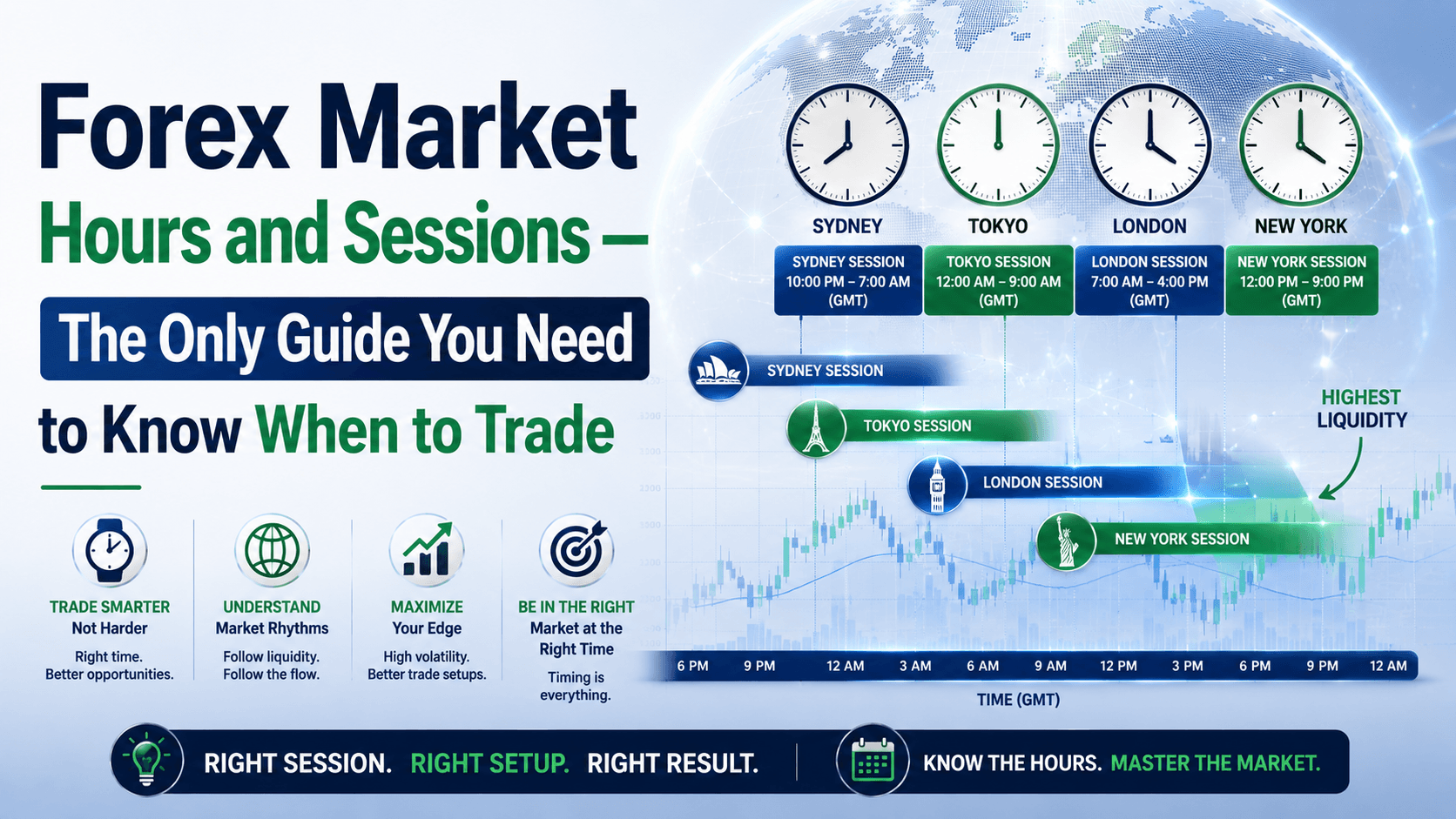
The 4 Forex Trading Sessions — Your Clock Matters
The forex market runs 24 hours a day, 5 days a week. But it's not one continuous blob of activity.
It's broken into four main sessions, each named after a major financial hub:
- Sydney — Opens the week
- Tokyo — Asian powerhouse
- London — The king of volume
- New York — Where the dollar rules
Think of it like a relay race. Sydney hands off to Tokyo. Tokyo to London. London to New York. Then New York rests, and Sydney starts again.
Here's the schedule in UTC (the standard forex time):
| Session | Open (UTC) | Close (UTC) |
|---|---|---|
| Sydney | 10:00 PM | 7:00 AM |
| Tokyo | 12:00 AM | 9:00 AM |
| London | 8:00 AM | 5:00 PM |
| New York | 1:00 PM | 10:00 PM |
Quick note: During Daylight Saving Time (March, April, October, November), these times shift by an hour. Always check your broker's clock.
The London Session — Where the Real Action Starts
If you only trade one session, make it London.
London handles about 38% of all daily forex volume. That's more than New York and Tokyo combined. When London opens at 8 AM UTC, the market wakes up.
Here's what that looks like in real numbers:
You're trading EUR/USD at 1.0850 during the London open. Within 30 minutes, price moves 20 pips. On 0.1 lots, that's $20. On 0.5 lots? $100. In half an hour.
During the Asian session earlier, EUR/USD might have moved 10 pips all morning.
The London session is where trends are born. European economic data drops, banks start trading, and the market finds its direction for the day.
The New York Session — The Dollar's Playground
New York opens at 1 PM UTC, right when London is still going strong. This overlap is the holy grail of forex trading.

For two hours (1 PM to 3 PM UTC), the two biggest financial centers in the world are trading at the same time. Volume spikes. Spreads tighten. Price moves fast.
Example: It's 1:30 PM UTC. The US releases Non-Farm Payrolls. EUR/USD jumps 50 pips in 2 minutes. If you're positioned correctly, that's $250 on 0.5 lots.
But here's the trap: Most beginners see the volatility and think "more is better." They chase every move and get burned.
The right approach: Wait for the first 15 minutes of the overlap to pass. Let the initial spike settle. Then look for your setup.
The Asian Session — Slow and Steady (But Not for Everyone)
The Tokyo and Sydney sessions are quieter. Price moves are smaller. Ranges are tighter.
This is great if you're a beginner or prefer a less stressful environment. But don't expect 80-pip swings.
Currency pairs that love the Asian session:
- USD/JPY — Tokyo is the yen's home
- AUD/USD — Sydney drives the Aussie
- NZD/USD — Kiwi follows the same rhythm
Typical daily range during Asian hours: 30-60 pips for USD/JPY. Compare that to 60-100 pips during London-New York overlap.
My advice: If you're a scalper or day trader, focus on London and New York. If you're a swing trader with longer timeframes, Asian hours work fine — just set wider stops.
Session Overlaps — Where the Magic Happens
Here's the single most important thing to remember: Trade during overlaps.
The two key overlaps:
- London + New York (1 PM - 5 PM UTC): Highest volume, tightest spreads, biggest moves
- Tokyo + London (8 AM - 9 AM UTC): Good for EUR/JPY and GBP/JPY
During the London-New York overlap, EUR/USD can move 80-100 pips in a single session. That's $80-$100 on 0.1 lots, or $800-$1,000 on 1.0 lots.
Compare that to trading during Sydney-only hours (10 PM - 12 AM UTC) when volume is thin and spreads are wide. You might see 15 pips in 3 hours.
Why does this matter? Because tighter spreads mean less slippage. Higher volume means your orders fill faster. More participants means price moves with conviction.
Professional traders don't trade 24 hours a day. They trade 4-6 hours during the best sessions. That's it.
Wrong Way vs Right Way — A Real Example
The wrong way:
You have a $1,000 account. You decide to trade EUR/USD at 6 AM UTC (Tokyo only session). You see a small range and enter a breakout trade. Spread is 2 pips. Price moves 10 pips and reverses. You lose $12 on 0.1 lots.
The right way:
You wait until 1 PM UTC. London and New York are both open. Spread is 0.5 pips. You see a clean breakout. Price moves 40 pips in your direction. You make $40 on 0.1 lots.
Same strategy. Different session. Result: -$12 vs +$40.
The session made the difference, not the setup.
How to Pick Your Best Trading Time
Here's a simple framework:

- What pairs do you trade? — EUR/USD loves London-New York. USD/JPY loves Tokyo. AUD/USD loves Sydney.
- What's your timezone? — Don't force yourself to trade at 3 AM. Pick a session that fits your schedule.
- What's your strategy? — Scalpers need high volatility (London-New York). Swing traders can handle quieter hours.
If you're in New York (ET), here's your cheat sheet:
- 8 AM - 12 PM ET: London + New York overlap (best time)
- 3 AM - 8 AM ET: London only (still good)
- 7 PM - 4 AM ET: Asian session (quiet)
If you're in London (BST):
- 8 AM - 5 PM BST: London session (prime time)
- 1 PM - 5 PM BST: Overlap with New York (best)
If you're in Sydney (AEST):
- 10 PM - 7 AM AEST: Sydney session (your local hours)
- 6 PM - 2 AM AEST: London open (overnight for you)
FAQ
What are the best forex market hours and sessions for beginners?
The London session (8 AM - 5 PM UTC) or the London-New York overlap (1 PM - 5 PM UTC). Volume is high, spreads are tight, and price moves are predictable.
Can I trade forex 24 hours a day?
Technically yes — the market is open 24/5. But trading during low-volume hours (like Sydney-only) means wider spreads and less movement. Stick to active sessions.
What time does the forex market open on Sunday?
The market opens at 5 PM ET on Sunday (10 PM UTC). Sydney starts first, followed by Tokyo, then London, then New York.
Why is the London session so important?
London handles ~38% of global forex volume. It's the most active session, setting the trend for the day. Most major currency pairs see their biggest moves during London hours.
Quick Recap
- Forex runs 24/5 but not all hours are equal
- Four sessions: Sydney, Tokyo, London, New York
- London-New York overlap (1 PM - 5 PM UTC) is the best time to trade
- Asian sessions are quieter — good for beginners or swing traders
- Match your session to your pairs and your schedule
Quick Win — Do This in 5 Minutes
Open your trading platform right now.
Check what time it is in UTC. Then look at the session table above.
Is a session open? Is there an overlap?
If yes — look at the last 10 candles on EUR/USD. See how the range expands during active hours.
If no — set a calendar reminder for the next London open. That's your trading window.
Start trading with the clock, not against it.