
So What Exactly Is a Lot Size?
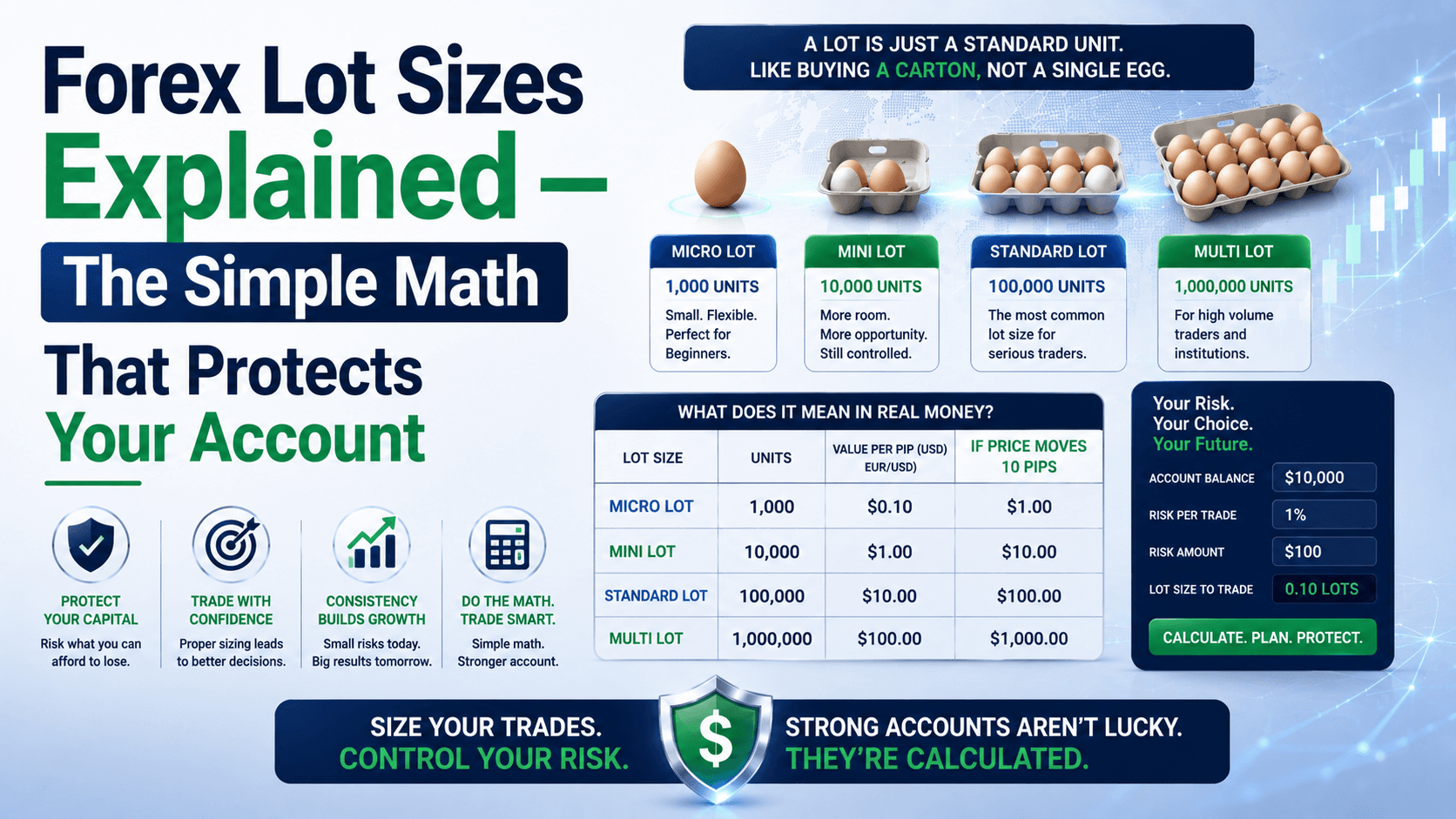
Ever walked into a grocery store and bought just one egg? No. You buy a carton. A standard unit.
Forex works the same way. You don't buy or sell one single dollar or euro. You trade in standardized bundles called lots. A lot is just a fixed number of currency units — like an egg carton, but for money.
Here's the thing most beginners miss:
Your lot size is the single biggest factor controlling how much money you make or lose on a trade. Get it wrong, and you can blow your account on one bad move. Get it right, and you sleep peacefully at night.
Let me show you exactly how it works.
The 4 Lot Sizes You Need to Know
There are four standard lot sizes in forex. Think of them as different-sized containers for your trade.
| Lot Type | Units of Currency | Best For |
|---|---|---|
| Standard | 100,000 | Professional traders with large accounts |
| Mini | 10,000 | Intermediate traders |
| Micro | 1,000 | Beginners and small accounts |
| Nano | 100 | Testing strategies with tiny risk |
Here's the real-world difference:
Let's say you're trading EUR/USD at 1.0850. Price moves 1 pip (0.0001).
- Standard lot (100,000 units): That 1 pip = $10
- Mini lot (10,000 units): That 1 pip = $1
- Micro lot (1,000 units): That 1 pip = $0.10
See the pattern? Each step down in lot size cuts your risk by 10x. That's why forex lot sizes explained properly always starts with this table — because it's the foundation of everything.
Why Your Lot Size Is Your Risk Control
Most beginners make the same mistake: they pick a lot size based on how much they want to make, not how much they can afford to lose.

Sound familiar?
Here's the wrong way: "I want to make $100 per trade, so I'll use a standard lot."
Here's the right way: "I have a $1,000 account and I risk 2% per trade. Let me calculate the lot size that keeps my risk at $20."
The Math That Saves Your Account
Let me walk you through a real example using EUR/USD at 1.0850.
- Account balance: $1,000
- Risk per trade: 2% = $20 max loss
- Stop loss: 30 pips from entry
- Pip value on a mini lot (10,000 units): $1
Calculation: $20 risk ÷ (30 pips × $1 per pip) = 0.67 mini lots
That's 6,700 units — well under a standard lot. If you'd used a standard lot, your risk would be $300 (30% of your account). One bad trade and you're almost wiped out.
Forex Lot Sizes and Pip Value — The Connection
Every beginner asks: "How much is a pip worth in real money?"
The answer depends entirely on your lot size.
| Lot Size | Pip Value (EUR/USD) | Pip Value (USD/JPY at 150) |
|---|---|---|
| Standard (100,000) | $10.00 | $6.67 |
| Mini (10,000) | $1.00 | $0.67 |
| Micro (1,000) | $0.10 | $0.067 |
Here's why this matters: A 50-pip move on EUR/USD with a standard lot = $500. With a micro lot = $5. Same trade, same price movement, but the impact on your account is 100x different.
The Wrong Way vs. The Right Way
The Wrong Way
You see a setup on GBP/USD. You're excited. You open MetaTrader and click "1.00 lot" because that's what the YouTuber used. Your stop loss is 40 pips away.
Price reverses. Hits your stop. You lose $400 on a single trade. Your $2,000 account is now $1,600. That's 20% gone in 15 minutes.
What went wrong? You didn't match your lot size to your account size.
The Right Way
Same setup. Same 40-pip stop. But this time, you calculate first.
- Account: $2,000
- Risk: 1% = $20
- Stop: 40 pips
- Pip value on mini lot: $1
- Lot size: $20 ÷ (40 × $1) = 0.5 mini lots (5,000 units)
Price hits your stop. You lose $20. Your account is now $1,980. You're still in the game.
FAQ
What is the best lot size for a beginner?
Start with micro lots (1,000 units). Each pip is worth $0.10, so even a 50-pip loss is only $5. This lets you learn without destroying your account.

How do I calculate lot size for my account?
Use this formula: (Account balance × Risk %) ÷ (Stop loss in pips × Pip value per lot). Most brokers also offer free lot size calculators on their websites.
Can I trade forex with $100?
Yes. With $100, use nano or micro lots. A micro lot with a 30-pip stop risks only $3 per trade. Start small, build consistency, then scale up.
What happens if I use too large a lot size?
You risk losing a large percentage of your account on a single trade. If your stop loss is hit, you might lose 10-20% or more. This is called overleveraging — the #1 reason beginners blow up accounts.
Quick Recap
- Lot sizes standardize how much currency you trade — standard, mini, micro, nano
- Your lot size directly controls your pip value and overall risk
- Always calculate lot size based on your account balance and risk tolerance, not greed
- Start with micro lots until you're consistently profitable
Your Quick Win (Do This Now)
Open your trading platform. Go to the EUR/USD chart. Write down your account balance. Now calculate the lot size you'd use if you risked 1% with a 30-pip stop loss.
If you have a $500 account: $5 risk ÷ (30 pips × $0.10 per pip) = 1.67 micro lots. That's your max position size. Write it down. Stick to it.
This one habit — calculating before clicking — separates profitable traders from the rest.