
I Still Remember the Trade That Broke Me
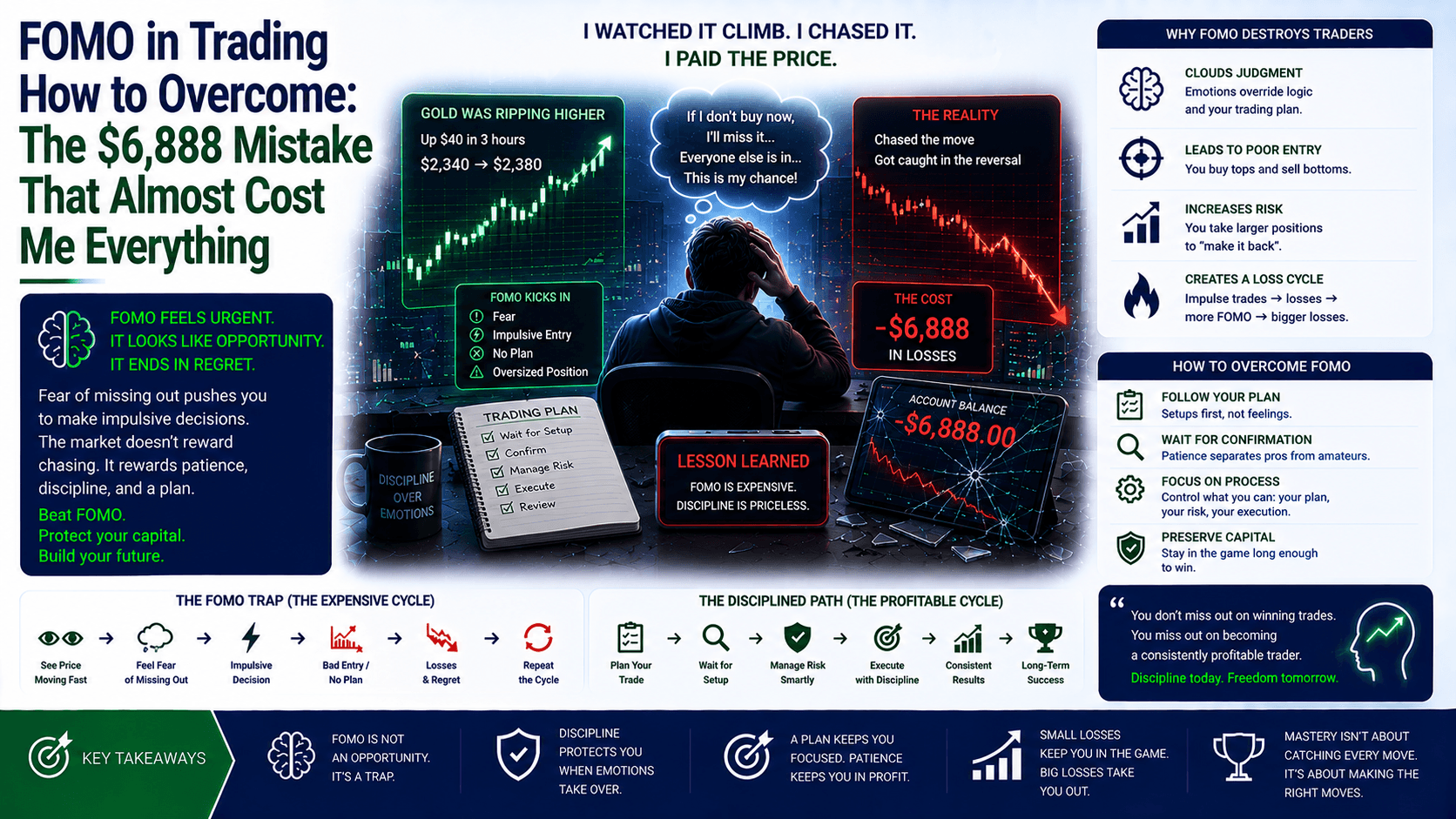
It was a Tuesday morning. Gold was ripping higher — up $40 in three hours. I watched it climb from $2,340 to $2,380, telling myself I'd wait for a pullback. But the pullback never came. My heart started pounding. I saw tweets about "the breakout of the month." My fingers moved before my brain did.
I bought at $2,382. Stop loss? Didn't set one. Target? No idea. I just knew I had to be in.
Price hit $2,385, then reversed hard. Within 90 minutes, it was at $2,340. I lost $1,200 on that single trade. But here's the thing: that wasn't even the worst part. The worst part was the three revenge trades I took after it — trying to "make it back." By the end of the day, I was down $2,450.
That's FOMO in trading. And if you've never felt that gut-punch, you either haven't traded long enough, or you're lying to yourself.
What Is FOMO in Trading? (And Why Your Brain Loves It)
FOMO — Fear of Missing Out — is that urgent, almost physical feeling that you're watching other people make money without you. In trading, it shows up as the compulsion to enter a trade after the move has already happened, because the thought of missing more upside feels worse than the risk of losing money.
Here's what it looks like in practice:
- You see EUR/USD jump 40 pips in 15 minutes
- You check Twitter — everyone's posting green screenshots
- You tell yourself "it's going higher"
- You buy at the top, right when the smart money is selling
Sound familiar? That's because FOMO isn't a strategy. It's your brain's reward system hijacking your decision-making.
When you see a currency pair surging, your brain releases dopamine — the same chemical that fires when you eat sugar or win a bet. It makes the potential profit feel real, even though you haven't made a cent. Meanwhile, the risk gets pushed to the back of your mind.
The $6,888 Month: What the Data Shows
Research by Barber and Odean (2000) found that the most active traders — the ones driven by FOMO and overconfidence — underperformed passive investors by 6.5% annually. But let me give you a real number that hits harder.

One trader using a journaling platform tagged every "FOMO entry" for a single month. At the end of the month, he ran the numbers: his FOMO trades had cost him $6,888.
That's not a theory. That's real money gone because of impulse.
Let me show you how the math works on a smaller scale:
| Scenario | Account Size | Risk Per FOMO Trade | FOMO Trades/Month | Monthly Cost |
|---|---|---|---|---|
| Beginner | $1,000 | $50 (5%) | 5 | $250 (25% of account) |
| Intermediate | $5,000 | $150 (3%) | 8 | $1,200 |
| Aggressive | $10,000 | $500 (5%) | 10 | $5,000 |
And that's just the direct losses. It doesn't count the opportunity cost of the trades you should have taken instead.
How to Identify FOMO in Yourself (Before You Click)
Here's the thing nobody tells you: FOMO isn't just an emotion — it has physical symptoms. Learn to spot them, and you can stop yourself before you enter a bad trade.
The 3-Second Self-Check
Before you click "buy" or "sell," ask yourself these three questions:
- Is my heart racing or am I sweating? — Physical agitation is a red flag
- Am I thinking about past trades I missed? — If you're chasing yesterday's loss, stop
- Is this an urge or a decision? — Urges feel urgent. Decisions feel calm.
If you answer "yes" to any of these, you're in FOMO territory. Close the chart. Walk away for 5 minutes.
I'll be honest with you: the first time I tried this, I failed. I felt the urge, told myself I'd wait 5 minutes, and still clicked "buy" after 2 minutes. It takes practice. But every time you resist, you're rewiring your brain.
5 Practical Ways to Overcome FOMO in Trading
Let's move from theory to action. Here are the exact methods I use — and teach my students — to kill FOMO before it kills your account.
1. The 5-Minute Rule
Any trade that wasn't on your pre-market watchlist requires a 5-minute wait before entry. Set a timer. Do not touch the mouse. FOMO depends on urgency — take the urgency away, and the impulse usually fades.
What do you do during those 5 minutes? Write down the trade idea. Entry price. Stop loss. Target. If you can't fill in all three fields, you have no business taking the trade.
2. Create a "Watch But Don't Trade" List
When you feel that pull to chase a move, add the setup to a watchlist instead of trading it. Track what happens over the next hour, day, or week.
I did this for a month. Out of 23 "missed opportunities" I tracked, only 3 would have been profitable at the entry I would have gotten. The rest either reversed or went sideways. That data changed how I see FOMO forever.
3. Reframe "Missed Trades" as "Saved Capital"
Every trade you don't take is money you didn't lose. Sounds obvious, right? But most traders frame missed moves as losses. "I could have made $200." No — you saved $200 by not chasing.
Shift your language. Instead of "I missed that move," say "I protected my capital." It changes your psychology.
4. Tag Every FOMO Trade in Your Journal
You can't fix what you don't measure. Create a tag in your trading journal called "FOMO" or "Impulse." Every time you take a trade that wasn't planned, tag it.
At the end of the month, run the numbers. Most traders who do this discover that their FOMO trades have a negative win rate AND smaller average wins. That's a double loss.
5. Limit Social Media During Market Hours
Twitter, Discord, Telegram — these platforms are FOMO factories. You see the winners, not the losers. You see the 500% gains, not the 10 accounts that blew up trying to get them.
Close the apps during trading hours. You can catch up on market news after the close, when your positions are locked in and the emotional pressure is off.
FOMO vs. Revenge Trading: The Twin Killers
FOMO and revenge trading are cousins. FOMO gets you in at the wrong time. Revenge trading gets you back in after you've been stopped out — usually with a bigger position, trying to "win back" the loss.
Here's the cycle:
- You miss a move → FOMO kicks in → you chase → you lose money
- You get stopped out → anger kicks in → you revenge trade → you lose more
- Now you're down 10% in one day, chasing losses, and your plan is out the window
The fix? A hard daily loss limit. I set mine at 3% of my account. Once I hit that, I'm done for the day. No exceptions. No "one more trade."
Let's compare the two:
| Emotion | Trigger | What You Do | Cost |
|---|---|---|---|
| FOMO | Seeing a big move without you | Chase entry after the move | Bad entry, no stop, oversizing |
| Revenge | Getting stopped out | Re-enter with bigger size | Doubled losses, blown account |
FAQ
Is FOMO in trading always bad?
Yes, when it leads to unplanned trades. FOMO-driven entries skip your process, and skipping your process has a measurable cost. A calculated, late entry with a stop and target is different from a FOMO chase.

How do I stop FOMO trading immediately?
Use the 5-minute rule: any unplanned trade requires a 5-minute wait. During that time, write down your entry, stop, and target. If you can't, don't trade. This breaks the urgency cycle.
Can FOMO ever be useful in trading?
No. FOMO is an emotional reaction, not a strategy. However, noticing FOMO can be useful as a signal that you're stressed or overtrading. Use it as a cue to step back, not to act.
How much money do traders lose to FOMO?
It varies, but studies show excessive traders underperform by 6.5% annually. In real terms, one trader tracked $6,888 in losses from FOMO trades in a single month. The cost is real and measurable.
📝 Quick Recap
- FOMO is the urge to chase trades after the move has already happened — it costs real money
- Identify it by physical symptoms: racing heart, sweating, urgency without a plan
- Use the 5-minute rule to break the urgency cycle
- Tag every FOMO trade in your journal — data beats emotion
- Reframe missed trades as saved capital, not lost opportunities
⚡ Your Quick Win Today
Open your trading journal (or a blank spreadsheet). Create a new column or tag called "Entry Type." Go back through your last 10 trades and mark each one as "Planned" or "FOMO." Calculate the total P&L for each group.
I promise you — seeing the numbers in black and white will change how you trade tomorrow.
Now close this article, open your chart, and don't take a trade you haven't planned. That's the win.