
I Still Remember the Exact Moment My Hands Started Shaking
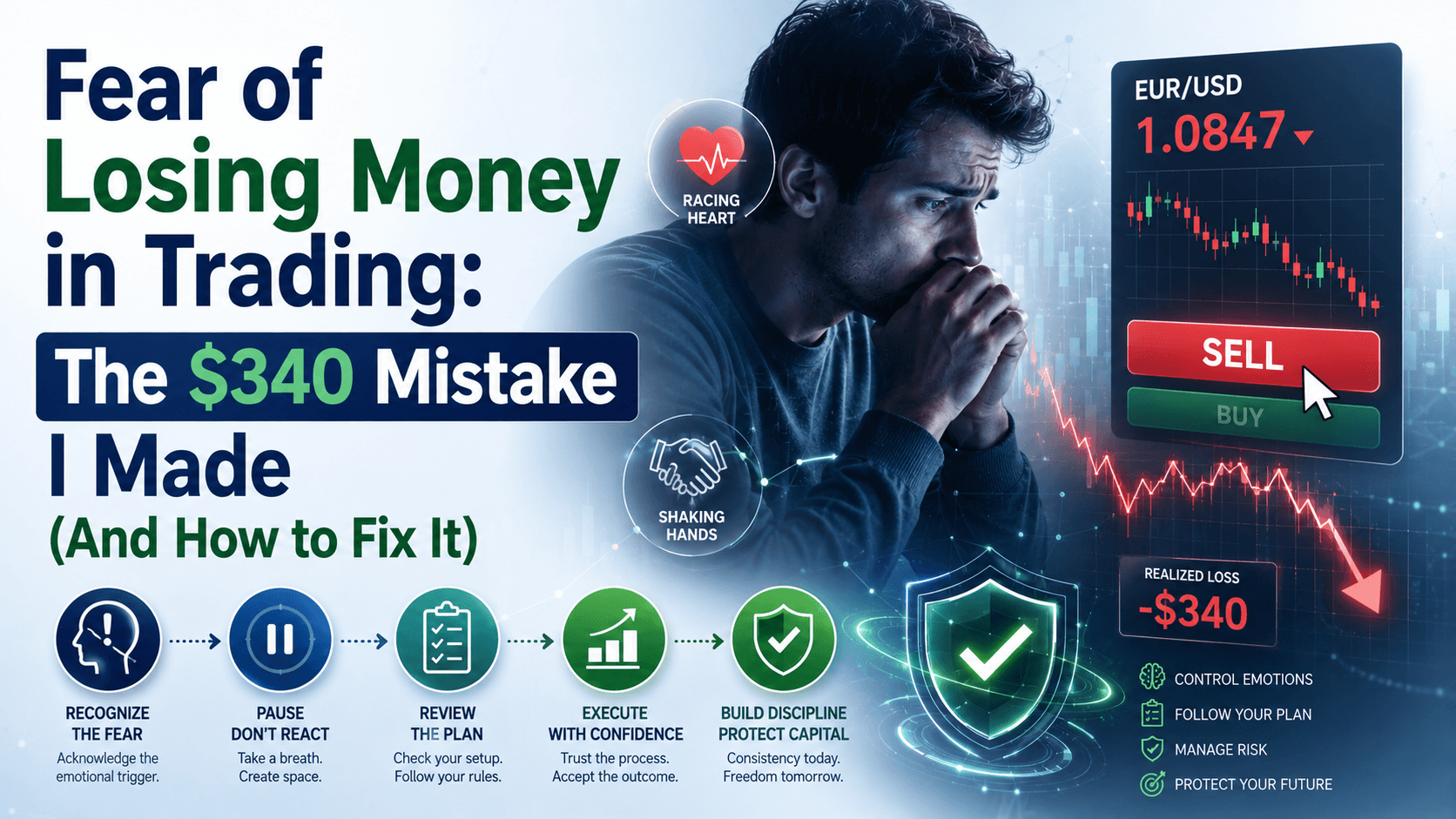
EUR/USD was at 1.0847. I was staring at my screen, cursor hovering over the "Sell" button. My heart was pounding so loud I could barely hear my own thoughts.
I didn't click.
The trade would have been a textbook setup — a clear rejection at resistance, a bearish engulfing candle, everything I'd learned. But I froze. Fear of losing money in trading had me paralyzed.
Price dropped 40 pips in the next hour. I watched my missed profit tick by, feeling sick. Then, out of frustration, I revenge-traded the next setup. Lost $340 in 12 minutes.
The fear of losing money didn't protect me — it cost me more than if I'd just taken the original trade with a proper stop loss.
Let me tell you what I learned the hard way about facing this fear, and how you can get past it without blowing your account first.
The 3 Faces of Fear in Trading (And Which One Is Sabotaging You)
Most traders think fear is just one thing. It's not. In my experience, fear of losing money in trading shows up in three distinct ways — and each one needs a different fix.
| Type of Fear | What It Looks Like | What It Costs You |
|---|---|---|
| Entry Paralysis | You see a good setup but can't pull the trigger | Missed opportunities — watching price run without you |
| Premature Exit | You close winning trades too early for fear they'll reverse | Leaving 60-70% of potential profit on the table |
| No Exit at All | You hold losing trades hoping they'll come back | Turning a $50 loss into a $500 loss or worse |
I've done all three. The first two cost me opportunity. The third one cost me real money.
Entry Paralysis: When Your Brain Freezes at the Moment of Truth
This is the most common form of fear of losing money in trading. You've done your analysis. You've identified your setup. But when it's time to click "Buy" or "Sell," your brain goes into lockdown.
Here's what happens inside your head:
"What if I'm wrong? What if this time is different? What if I enter and price immediately reverses?"
I used to think this was just lack of experience. It's not. It's your amygdala — that ancient part of your brain that remembers every loss you've ever taken — screaming at you to stay safe.
The fix? Size down until the fear disappears.
If trading 0.1 lots on EUR/USD makes you hesitate, trade 0.01 lots. Yes, you'll only make $1 per 10 pips instead of $10. But you'll actually TAKE the trade. And taking small trades builds the muscle of execution.
I tell my students: "Trade 0.01 lots until you can execute without hesitation. Then double it. Then double it again." This works because it bypasses the fear response — your brain doesn't panic over $1 risk the way it panics over $10 risk.
Premature Exit: The "Get Out Before It Turns" Trap
This one hurts in a different way. You enter a trade. Price moves in your favor. You're up $50. Then you think: "I should close now before it reverses."
So you close. Price then continues another 40 pips in your direction. You just left $200 on the table.
Sound familiar?
The problem is you're treating trading like a casino game where you cash out while you're ahead. But trading isn't blackjack. Your edge comes from letting winning trades run to your target.
The fix? Set your take-profit when you enter the trade, and don't touch it until price hits it or your stop loss is triggered.
Here's a concrete example:
You enter GBP/USD at 1.2680. Your stop loss is at 1.2650 (30 pips). Your target is 1.2740 (60 pips). Risk:reward = 1:2.
If you close at +20 pips ($20 on 0.1 lots), you've broken your own system. You need to trust the math: if your strategy wins 40% of the time with a 1:2 risk:reward, you're profitable. But only if you let winners run.
No Exit at All: The "It'll Come Back" Lie
This is the most dangerous form of fear of losing money in trading. You're in a losing trade. Price is moving against you. Instead of accepting the loss, you hold on, telling yourself: "It'll come back. It always does."
Until it doesn't.
I once watched a trader lose $4,000 on a single EUR/USD trade because he refused to take a $200 loss. He held for three days, hoping for a reversal that never came. That $200 loss became a $4,000 loss because of fear.
The fix? Place your stop loss before you enter the trade. Treat it as non-negotiable. If price hits your stop, you're out. No second-guessing. No "just one more pip."
Think of it this way: A stop loss isn't a prediction of where price will go. It's a boundary that says, "If I'm wrong beyond this point, I'm getting out."
Why Backtesting Is the Only Real Cure for Fear
Here's the thing nobody tells you: fear of losing money in trading doesn't come from the market. It comes from uncertainty. You're afraid because you don't actually know if your strategy works.

The solution is boring but effective: backtest.
Go back through 50-100 historical trades of your strategy. Track every entry, exit, win, and loss. Calculate your win rate, average win, average loss, and profit factor.
When you KNOW your strategy wins 55% of the time with a 1:2 risk:reward, the fear of any single trade drops dramatically. Why? Because you understand that individual trades don't matter. The system does.
Here's the math:
If you take 100 trades with a 55% win rate and 1:2 risk:reward:
- 55 winning trades × $200 profit = $11,000
- 45 losing trades × $100 loss = $4,500
- Net profit: $6,500
Now, will you lose some trades? Yes. Will you have losing streaks? Absolutely. But the system works over time. That knowledge is your armor against fear.
The One Question That Kills Fear Instantly
Before every trade, ask yourself this:
"If this trade hits my stop loss, will I be okay?"
If the answer is no — because the risk is too big, or because you're emotionally attached — don't take the trade.
If the answer is yes — because you've sized correctly and you trust your system — take the trade without hesitation.
This question forces you to confront the worst-case scenario before it happens. And when you've already accepted the loss mentally, the fear loses its power.
FAQ
Is fear of losing money in trading normal?
Yes. Every trader experiences it, including professionals. The difference is that successful traders have systems and processes that allow them to act despite the fear.

How do I stop being afraid to enter a trade?
Size down until the fear disappears. Trade 0.01 lots or 1 share until you can execute without hesitation. Build the habit of taking trades, then gradually increase size.
What's the best way to deal with fear of losing?
Backtest your strategy until you trust it. When you know your edge statistically, individual losses stop feeling catastrophic. Also, always use a stop loss — it limits your downside.
Can fear ever be useful in trading?
Yes — healthy fear keeps you from taking reckless trades. The problem is when fear prevents you from taking good trades. The goal isn't to eliminate fear, but to manage it.
📝 Quick Recap
- Fear of losing money in trading shows up as entry paralysis, premature exits, or refusing to exit losers
- Size down until you can execute without hesitation — 0.01 lots or 1 share
- Set your stop loss and take profit before you enter, then don't touch them
- Backtest your strategy until you trust the math over your emotions
- Before every trade, ask: "If this hits my stop, will I be okay?"
⚡ Your Quick Win Today
Open your trading platform right now. Pull up EUR/USD on the 1-hour chart. Find the last 3 times price rejected a key level (support or resistance). Write down: the entry price, where you would have placed your stop loss, and your target. Don't trade it. Just practice the act of planning. Do this for 5 minutes daily for a week. You'll notice the fear starts to fade when the plan is clear before you even look at the chart.