
What Does the DXY Dollar Index Actually Measure?
Let's say you're a trader, and you want a single number that tells you if the US dollar is getting stronger or weaker against the world's major currencies. That's exactly what the DXY dollar index is designed to do.
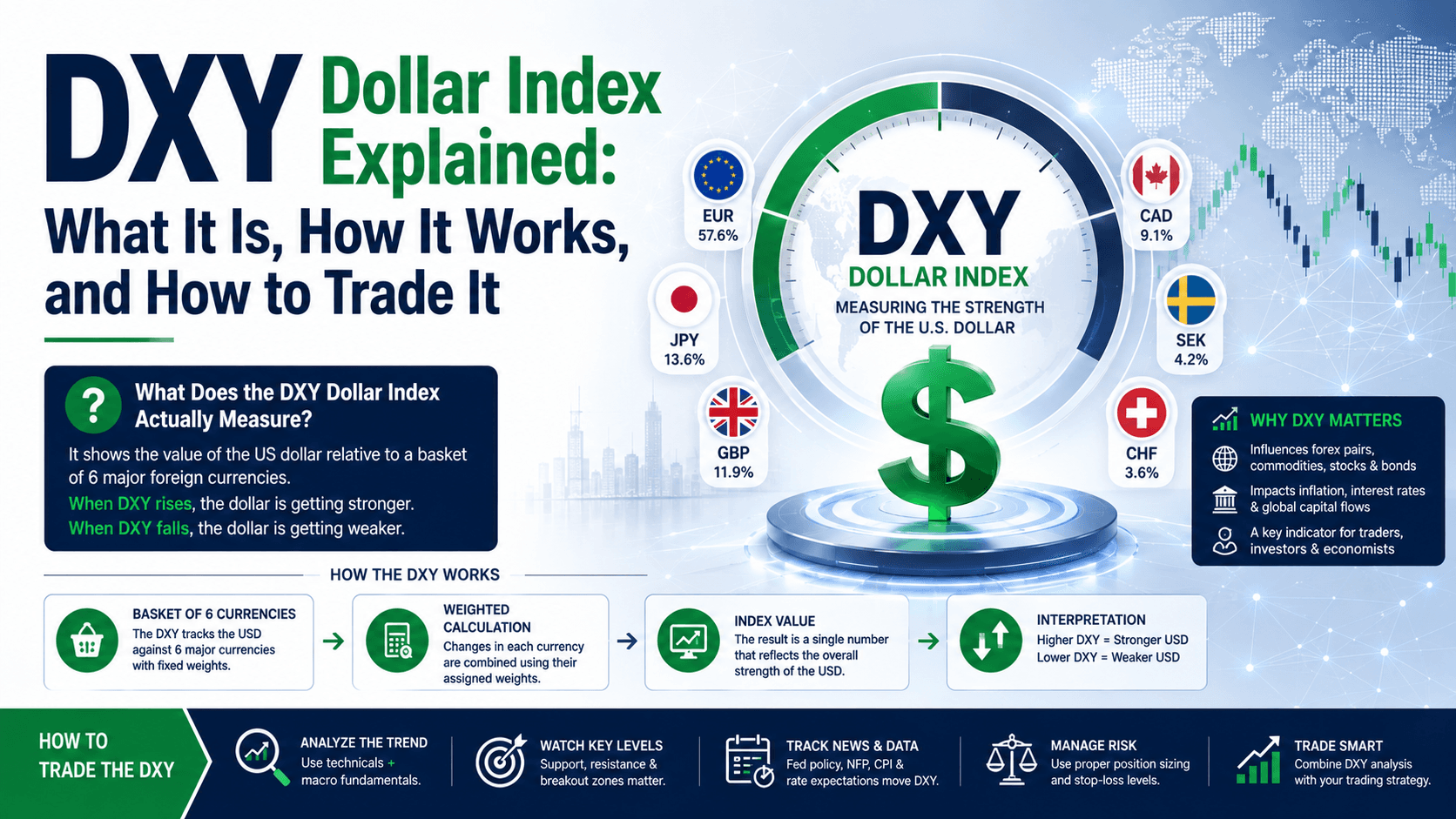
The DXY dollar index (also called USDX or DX) is a weighted basket of six major foreign currencies. It measures the value of the US dollar relative to the euro, Japanese yen, British pound, Canadian dollar, Swedish krona, and Swiss franc.
Think of it like the Dow Jones for the dollar. One number. One chart. One quick read on the greenback's global strength.
The index was created by the US Federal Reserve in 1973, right after the Bretton Woods Agreement fell apart. Before that, currencies were pegged to gold. After Nixon suspended gold convertibility, the world moved to floating exchange rates — and the DXY was born to track the dollar's new reality.
DXY Dollar Index Composition: Why the Euro Dominates
Here's where it gets interesting — and where most beginners get confused. The DXY is NOT an equal-weight index. Some currencies matter way more than others.
Let's look at the exact weightings:
| Currency | Weight in DXY | Pair Format |
|---|---|---|
| Euro (EUR) | 57.6% | EUR/USD |
| Japanese Yen (JPY) | 13.6% | USD/JPY |
| British Pound (GBP) | 11.9% | GBP/USD |
| Canadian Dollar (CAD) | 9.1% | USD/CAD |
| Swedish Krona (SEK) | 4.2% | USD/SEK |
| Swiss Franc (CHF) | 3.6% | USD/CHF |
Notice something? The euro alone makes up more than half the index. That means when EUR/USD moves, the DXY moves — hard. If EUR/USD drops 1%, the DXY typically rises about 0.57% (all else equal).
This is the single most important relationship to understand: the DXY and EUR/USD are inversely correlated. When one goes up, the other tends to go down.
How the DXY Is Calculated (The Math Behind the Number)
You don't need to calculate this yourself — your trading platform does it automatically. But understanding the formula helps you see how the pieces fit together.

The DXY is a geometric weighted average. Here's the actual formula:
USDX = 50.14348112 × EUR/USD^(-0.576) × USD/JPY^(0.136) × GBP/USD^(-0.119) × USD/CAD^(0.091) × USD/SEK^(0.042) × USD/CHF^(0.036)
The index started at a base value of 100 in 1973. So if the DXY is at 105 today, that means the dollar has strengthened 5% against the basket since 1973. If it's at 95, it's weakened 5%.
Here's a quick comparison of historical levels:
| Year | DXY Level | What It Means |
|---|---|---|
| 1984 (All-time high) | ~165 | Dollar extremely strong |
| 2007 (All-time low) | ~70 | Dollar extremely weak |
| 2022 (Recent peak) | ~114 | Dollar strong (Fed hiking cycle) |
| Late 2025 | ~99 | Dollar moderate/neutral |
The index is updated in real-time, roughly every 15 seconds, using midpoint prices between bid and offer for each currency.
Why the DXY Matters for Forex Traders
Here's the thing: the DXY is not just a number. It's a tool that can improve your trading decisions in three specific ways.
1. It Confirms Currency Pair Trends
If you're trading EUR/USD and you see the DXY rising, that's a bearish signal for EUR/USD. The dollar is getting stronger across the board. Your short on EUR/USD has a tailwind.
On the flip side, if the DXY is falling and you're long GBP/USD, you have confirmation that the dollar is weakening — your trade aligns with the broader trend.
2. It's an Inverse Proxy for Risk Sentiment
The dollar is a safe-haven currency. When global markets panic, money flows into the dollar. When markets are calm, money flows out. So a rising DXY often coincides with falling stock markets and risk assets.
This is called the Dollar Smile Theory, first observed by Morgan Stanley's Stephen Jen. The dollar strengthens in two scenarios: extreme fear (safe-haven buying) and strong US economic growth. It weakens in the middle — when the US economy is sluggish but not in crisis.
3. It Helps You Hedge
Let's say you have a large long position in USD/JPY. You're bullish on the dollar against the yen. But you want protection against a broad dollar sell-off. You could short the DXY as a hedge. If the dollar weakens across the board, your DXY short gains offset your USD/JPY losses.
How to Trade the DXY Dollar Index
You can't buy the DXY directly. But you can trade it through derivatives. Here are the most common methods:
| Method | How It Works | Best For |
|---|---|---|
| DXY Futures (ICE) | Standardized contracts traded on ICE Futures | Institutional traders, large accounts |
| DXY Options | Options on DXY futures | Advanced hedging strategies |
| DXY ETFs (e.g., UUP, UDN) | ETFs that track DXY futures | Retail investors, longer-term views |
| DXY CFDs | Contracts for difference with leverage | Retail traders, short-term speculation |
Example with CFDs: You open a long position on the DXY at 99.50 with 0.1 lots. Your stop loss is at 98.50 (100 points risk). Your target is 101.50 (200 points reward). Risk:reward = 1:2. If price hits your target, you make a profit proportional to your position size. If it hits your stop, you lose your defined risk.
Remember: CFDs are leveraged. A small move in the DXY can mean a large move in your P&L. Manage your risk accordingly.
Common Mistake: Ignoring the DXY When Trading Pairs
Here's the wrong way: You see a beautiful pin bar on GBP/USD at support. You go long without checking the DXY. The DXY is rising sharply. Your pin bar fails immediately. You're stopped out.
Here's the right way: You check the DXY first. If the DXY is trending up, you know the dollar is strong. You look for short setups on EUR/USD, GBP/USD, and other pairs where USD is the quote currency. Your setups have a tailwind.
The DXY doesn't predict the future. But it gives you context. And context is what separates profitable traders from gamblers.
FAQ
What does the DXY dollar index tell you?
The DXY tells you whether the US dollar is strengthening or weakening against a basket of six major currencies. A rising DXY means the dollar is gaining value; a falling DXY means it's losing value.

Is the DXY the same as the US dollar index?
Yes. DXY, USDX, and DX all refer to the same index — the US Dollar Index. It's traded on the ICE exchange and calculated from the same six currency pairs.
How does the DXY affect EUR/USD?
The euro makes up 57.6% of the DXY. So the DXY and EUR/USD are inversely correlated. When the DXY rises, EUR/USD typically falls, and vice versa. This is the strongest correlation in the index.
Can I trade the DXY with a small account?
Yes, through CFDs or ETFs. With CFDs, you can trade 0.1 lots or smaller. With ETFs like UUP, you can buy shares. Always use proper risk management — the DXY can move 50-100 points in a day during high volatility.
Quick Recap
- The DXY measures the US dollar against a weighted basket of 6 currencies: EUR, JPY, GBP, CAD, SEK, CHF
- The euro dominates at 57.6% — EUR/USD and DXY move in opposite directions
- Base value of 100 (set in 1973) — values above 100 mean dollar strength, below mean weakness
- The DXY is inversely correlated with EUR/USD and GBP/USD; positively correlated with USD/JPY and USD/CAD
- You can trade it via futures, options, ETFs (UUP, UDN), or CFDs
Quick Win
Open your charting platform right now. Add the DXY (symbol: DX or USDX) as a separate chart below your EUR/USD chart. Look at the last 5 daily candles on both. Notice how they move in opposite directions? That's the DXY in action. Start checking it before every trade you take on a USD-based pair. You'll see the difference in your win rate within a week.