
Your Account Just Dropped 25%. Now What?
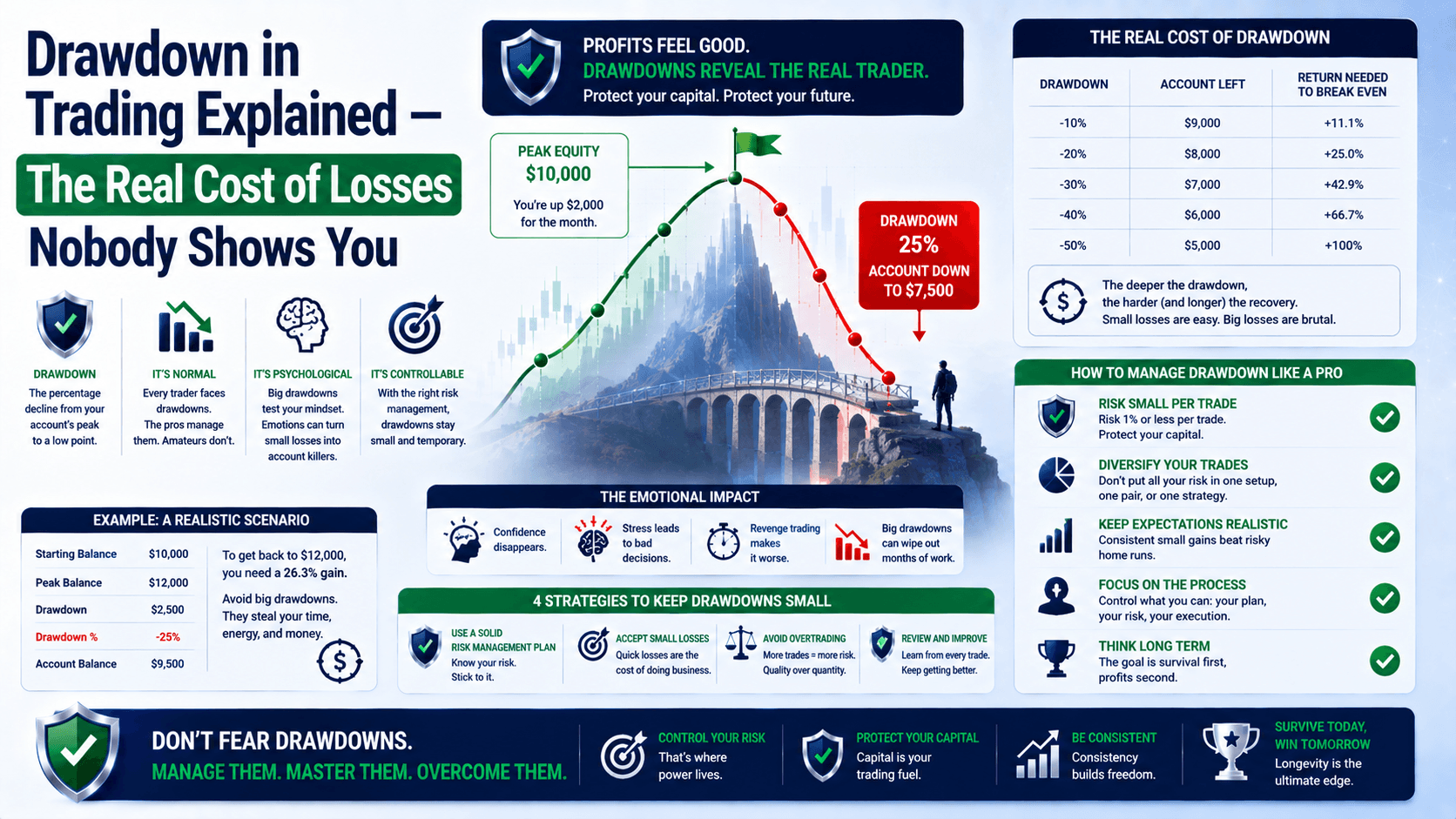
You're up $2,000 for the month. Feeling good. Then comes a bad week. EUR/USD reverses hard, your stop loss gets hit, and suddenly you're down $1,200 from your peak. Your account is still profitable overall — but it feels like you're losing money.
That feeling? That's a drawdown. And if you don't understand it, it will destroy your trading account before you even realize what's happening.
Here's the deal: drawdown in trading explained simply means the drop from your account's highest point to its lowest point before recovering. It's not the same as a loss. You can have a profitable account and still be in drawdown. Confusing, right?
Let's fix that. Here's exactly what drawdown is, why it matters more than your win rate, and how to keep it from wrecking your account.
What Is Drawdown in Trading? (The Simple Definition)
Drawdown measures the decline in your account equity from a peak to a trough. It's always measured until a new peak is reached.
Think of it like this: your account hits $10,000 (peak), drops to $8,000 (trough), then climbs back to $10,000 (new peak). Your drawdown was $2,000 — or 20%.
Key distinction: Drawdown is not the same as a loss. A loss is relative to your initial deposit. Drawdown is relative to your equity peak.
Example: You deposit $5,000. Your account grows to $7,500. Then it drops to $6,000.
- Loss: You're still up $1,000 from your deposit. No loss.
- Drawdown: $7,500 (peak) - $6,000 (trough) = $1,500 or 20% drawdown.
You're profitable but you're in drawdown. That's the trap most beginners fall into — they think they're fine because they haven't lost their initial capital. But the drawdown tells a different story.
Why Drawdown Matters More Than Your Win Rate
Every beginner obsesses over win rate. "I win 80% of my trades!" Sounds great, right? Until you see the drawdown.
Here's why: a 50% drawdown requires a 100% gain to recover.
Let that sink in. Lose half your account, and you need to double what's left just to break even. That's not a small task.
| Drawdown % | Gain Needed to Recover |
|---|---|
| 10% | 11.1% |
| 20% | 25% |
| 30% | 42.9% |
| 40% | 66.7% |
| 50% | 100% |
| 60% | 150% |
| 90% | 900% |
See the pattern? Losses grow geometrically. A small drawdown is recoverable. A deep one? You're digging a hole that gets exponentially harder to climb out of.
This is why drawdown in trading explained properly always comes back to one thing: capital preservation. Your goal isn't to make the most money possible. It's to survive long enough to let compounding work.
The 3 Types of Drawdown You Need to Know
Absolute Drawdown
This measures the drop from your initial deposit to your lowest equity point. It answers: "How much of my original money have I lost?"

Example: Deposit $10,000. Account drops to $8,500. Absolute drawdown = $1,500 or 15%.
Maximum Drawdown (MDD)
This is the worst-case scenario — the largest peak-to-trough decline in your account's history. It's the number that keeps you up at night.
Example: Your account peaks at $15,000, then crashes to $9,000. MDD = $6,000 or 40%.
This is the number professional traders watch most. It tells you the maximum pain your strategy can inflict.
Relative Drawdown
This is your maximum drawdown expressed as a percentage of your peak equity. It's the most common way drawdown is reported.
Formula: (Maximum Drawdown / Peak Equity) × 100
In the example above: ($6,000 / $15,000) × 100 = 40% relative drawdown.
The Wrong Way vs. The Right Way to Handle Drawdown
The Wrong Way (what 90% of beginners do):
You hit a 15% drawdown. Panic sets in. You start revenge trading — taking bigger positions, using more leverage, trying to win it all back fast. You lose another 10%. Now you're down 25% and your account is in serious trouble.
The Right Way (what professionals do):
- Stop trading immediately. Close all charts. Step away for 24-48 hours.
- Analyze the cause. Was it bad luck (random volatility) or bad strategy (flawed system)?
- Reduce position size. Cut your risk per trade by 50% until you're back in profit.
- Set a drawdown cap. Decide in advance: "If I hit X% drawdown, I stop trading for the month."
This is the contrast most traders never learn. The moment you feel the urge to "make it back fast" — that's exactly when you should be reducing risk, not increasing it.
5 Steps to Control Drawdown (Before It Controls You)
Step 1: Know Your Numbers
Calculate your maximum drawdown from your trading history. If you don't have a history, assume it's higher than you think. Most beginners underestimate their worst-case scenario by 2-3x.
Step 2: Set a Hard Cap
Decide your maximum acceptable drawdown before you trade. Common ranges:
- Conservative: 10% max drawdown
- Moderate: 15-20% max drawdown
- Aggressive: 25%+ max drawdown (not recommended for beginners)
Step 3: Calculate Your Risk Per Trade
If your max drawdown is 15% and you risk 2% per trade, you can survive 7-8 consecutive losses before hitting your cap. That's your margin for error. Any less, and one bad streak wipes you out.
Step 4: Use the "Drawdown Rule"
When you're in drawdown, cut your risk per trade in half. If you normally risk 2%, drop to 1%. If you hit 50% of your max drawdown, stop trading entirely for the week.
Step 5: Track It Religiously
Log every trade's impact on your equity curve. A simple spreadsheet with date, equity, and drawdown % is enough. Watch for patterns — do you hit drawdown after certain types of trades? After certain news events?
Drawdown in Forex Trading — Why It Hits Harder
Forex trading amplifies drawdown because of leverage. With 50:1 leverage, a 2% market move can wipe out your entire account if you're not careful.
Let's say you have a $2,000 account and you trade 0.5 lots on EUR/USD. A 20-pip move against you = $100 loss or 5% of your account. That's a 5% drawdown from one trade.
Three bad trades in a row? You're down 15% before you can blink.
This is why risk management in forex isn't optional — it's survival. Your position sizing directly determines your drawdown potential. Trade too big, and one bad week can set you back months.
FAQ
What is a good drawdown percentage in trading?
There's no universal number, but most professionals aim to keep drawdowns below 20%. A 10-15% max drawdown is considered conservative and sustainable for long-term trading.

How is drawdown different from a loss?
A loss is measured from your initial deposit. Drawdown is measured from your account's peak equity. You can have a profitable account (no loss) but still be in drawdown if you're down from your high.
Can I recover from a 50% drawdown?
Yes, but it requires a 100% gain on your remaining capital. That's extremely difficult and takes most traders months or years. This is why preventing deep drawdowns is critical.
What causes drawdown in forex trading?
The main causes are: over-leveraging, poor risk management, emotional trading after losses, and not having a rules-based system. Market volatility itself doesn't cause drawdown — your reaction to it does.
📝 Quick Recap
- Drawdown measures the drop from your account's peak to its trough — not from your initial deposit
- A 50% drawdown requires a 100% gain to recover — preventing deep drawdowns is everything
- Maximum drawdown (MDD) is your worst-case scenario — know this number for your strategy
- When in drawdown, reduce risk — never increase it to "make it back fast"
- Set a hard drawdown cap before you trade, and stick to it
Your Action Item
Open your trading platform right now. Look at your equity curve for the last 30 days. Identify your current drawdown from your peak. Write it down. If it's over 15%, cut your position size in half for your next 10 trades.
This one habit — knowing and respecting your drawdown — will save you more money than any trading strategy ever will.