
What Does a Doji Candlestick Actually Tell You?
Let's start with a scenario you've probably lived through.
You're watching EUR/USD at 1.0920. It's been climbing for the last 4 hours. Then you see a candle with almost no body — just a thin line. Open and close are nearly identical.
That's a doji.
And here's the trap most beginners fall into: they see a doji and immediately think "reversal!" They short the pair. Price continues up another 30 pips. Their stop gets hit. Sound familiar?
The doji candlestick meaning is simpler than most people make it. It tells you one thing: buyers and sellers are in a temporary stalemate. Neither side won that period.
The word "doji" comes from Japanese, meaning "the same thing" — a reference to the open and close being the same. In a market that moves $6.6 trillion daily, that's rare. And that rarity is exactly why traders pay attention.
But here's the data you need to know: a doji alone is NOT a reliable reversal signal. According to research on candlestick patterns, dojis on their own have a win rate below 50% when used in isolation. The edge comes from context — where it appears and what happens next.
Let's break down the 3 types that actually matter.
Type 1: Gravestone Doji — The Bearish Warning
The gravestone doji looks exactly like its name — a tombstone. It has a long upper shadow and little to no lower shadow. The open, close, and low are all at the same level.
Here's what happened during that candle: buyers pushed price up aggressively. Then sellers stepped in and drove it all the way back down to the open. By the close, the buyers' gains were completely erased.
Where it matters most: At the top of an uptrend. If you see a gravestone doji after a long green candle, it's a warning that buying momentum is fading.
Real numbers example:
GBP/USD at 1.2750, in an uptrend from 1.2650 over 3 days. A gravestone doji forms with a high of 1.2780 and close at 1.2750. The upper shadow is 30 pips — significant.
The next candle closes at 1.2720. That's confirmation. If you shorted 0.1 lots at 1.2750 with a stop at 1.2785 (35 pip risk), and target at 1.2690 (60 pips), you're risking $35 to make $60. That's a 1:1.7 risk:reward ratio.
⚠️ Common mistake: Don't trade the gravestone doji alone. Wait for the next candle to close lower. If the next candle closes higher, the doji was a false signal.
Type 2: Dragonfly Doji — The Bullish Reversal Signal
The dragonfly doji is the opposite of the gravestone. It has a long lower shadow and little to no upper shadow. The open, close, and high are all at the same level.

During this candle, sellers pushed price down hard. Then buyers stepped in and brought it all the way back up to the open. By the close, the sellers' gains were completely erased.
Where it matters most: At the bottom of a downtrend. It suggests selling pressure is exhausted and buyers are ready to take control.
Real numbers example:
Gold (XAU/USD) at $2,410, in a downtrend from $2,460 over 5 days. A dragonfly doji forms with a low of $2,395 and close at $2,410. The lower shadow is $15 — significant.
The next candle closes at $2,420. That's confirmation. If you bought 0.1 lots at $2,410 with a stop at $2,393 (17 point risk), and target at $2,440 (30 points), you're risking $170 to make $300. That's a 1:1.76 risk:reward ratio.
⚠️ Common mistake: The dragonfly doji is more reliable in downtrends than uptrends. In an uptrend, it can be a continuation signal, not a reversal.
Type 3: Long-Legged Doji — The Indecision Candle
The long-legged doji has both long upper and lower shadows. It looks like a plus sign or cross. The open and close are in the middle of the range.
This candle tells you that both buyers and sellers were active — price went up, then down, then back to the middle. Net result? Zero. Complete indecision.
Where it matters most: After a strong trend, especially if volume is high. It can signal exhaustion and a potential reversal. In a sideways market, it just confirms the range.
Real numbers example:
USD/JPY at 151.50, in a strong uptrend from 149.00 over 2 weeks. A long-legged doji forms with a high of 152.20 and low of 150.80 — a 140 pip range. Open and close both at 151.50.
The next candle closes at 151.00. That's a bearish signal. If you shorted 0.1 lots at 151.50 with a stop at 152.30 (80 pip risk), and target at 150.50 (100 pips), you're risking $80 to make $100. That's a 1:1.25 risk:reward ratio.
⚠️ Common mistake: Long-legged dojis in the middle of a range are noise. Only trade them at key support/resistance levels or after extended trends.
Doji vs Spinning Top — What's the Difference?
Many traders confuse these two patterns. Here's the clear distinction:
| Feature | Doji | Spinning Top |
|---|---|---|
| Body size | Very small or nonexistent (open = close) | Small but visible (open ≠ close) |
| Body as % of range | 0-5% of total candle range | 5-15% of total candle range |
| Meaning | Complete indecision | Weakness in current trend |
| Reversal reliability | Higher (when confirmed) | Lower — often just consolidation |
| Common in | Trend exhaustion zones | Ranging markets |
The key difference: a doji shows absolute balance. A spinning top shows slight imbalance — one side had a tiny edge, but not enough to establish control.
Both require confirmation. Neither should be traded alone.
The Wrong Way vs The Right Way to Trade Dojis
❌ The Wrong Way:
You see a doji on the 5-minute chart. You immediately enter a trade. Price reverses against you. You lose money.
✅ The Right Way — A 3-Step Framework:
- Identify the context: Is the doji at a key support/resistance level? Is it after an extended trend? If not, skip it.
- Wait for confirmation: The next candle must close in the direction you expect. No confirmation? No trade.
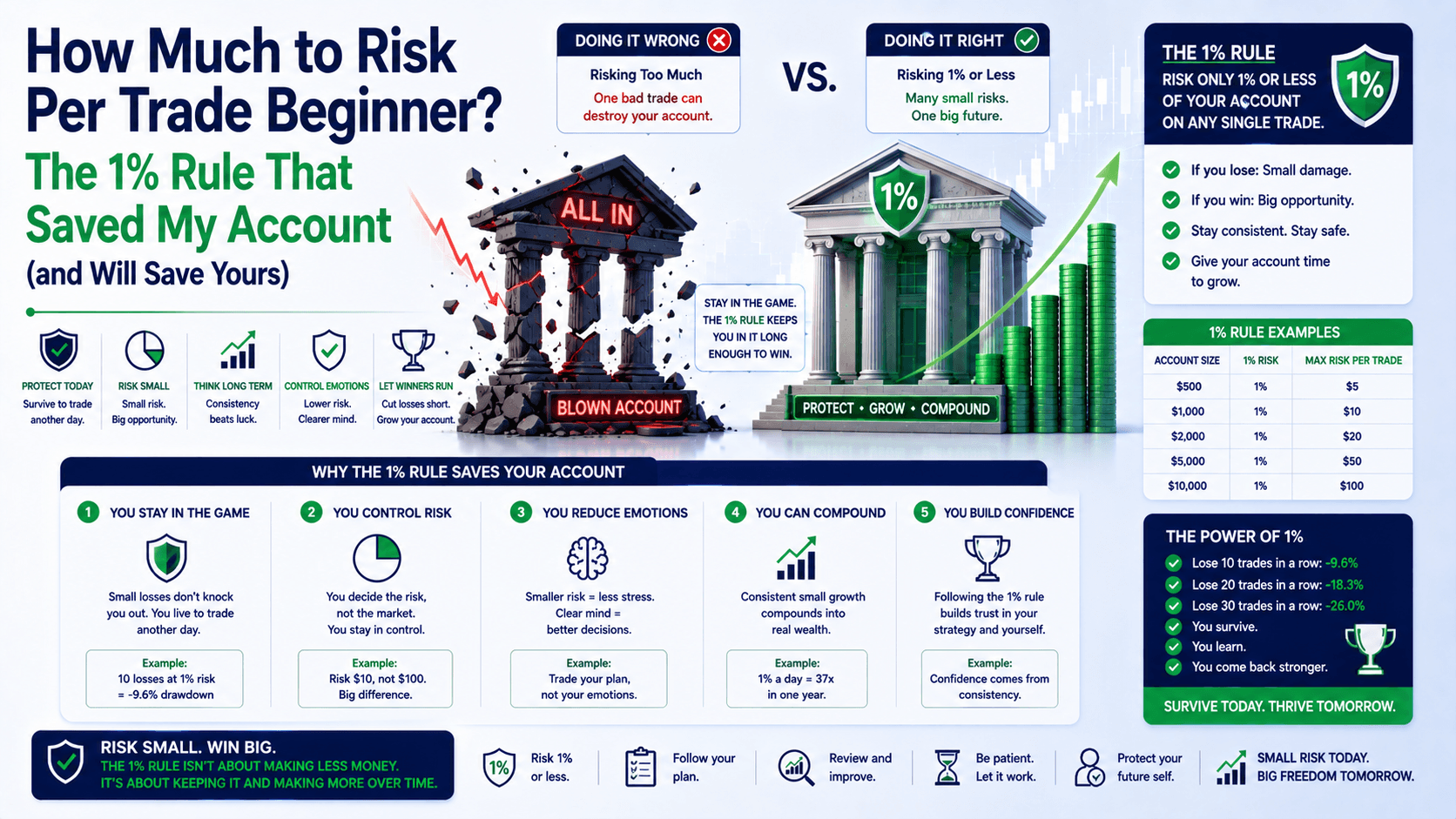
- Set your risk: Place your stop loss beyond the doji's high (for shorts) or low (for longs). Calculate your position size based on 1-2% account risk.
Let's math it out with a $1,000 account:
You see a gravestone doji on EUR/USD at 1.0900 after an uptrend. High is 1.0930. You want to short. Stop goes at 1.0935 (35 pips). 2% risk = $20 max loss. 35 pips × $0.57/pip = $20. So you trade 0.057 lots (round to 0.05). 35 pips × $0.50/pip = $17.50 risk. Under 2%. Safe.
FAQ
Is a doji candlestick bullish or bearish?
A doji is neutral — it signals indecision. Its direction depends on where it forms. A dragonfly doji at the bottom of a downtrend is bullish. A gravestone doji at the top of an uptrend is bearish. Always wait for the next candle to confirm.

How reliable is a doji for predicting reversals?
On its own, a doji has a win rate below 50% — not reliable. When confirmed by the next candle and combined with support/resistance levels, reliability improves to around 60-65%. No candlestick pattern is 100% reliable.
What time frame is best for trading dojis?
Dojis work best on H1 (1-hour) and higher time frames. On M5 or M15, they appear too frequently and create too many false signals. The 4-hour and daily charts produce the most reliable doji patterns.
Can a doji appear in a strong trend?
Yes. A doji in a strong trend can signal exhaustion. But it can also be a continuation pattern — the market pauses, then continues in the same direction. This is why confirmation is critical.
📝 Quick Recap
- A doji forms when open and close are nearly identical — signaling indecision between buyers and sellers
- Gravestone doji (long upper shadow) = potential bearish reversal at trend tops
- Dragonfly doji (long lower shadow) = potential bullish reversal at trend bottoms
- Long-legged doji (both shadows) = extreme indecision, often before breakouts
- Never trade a doji alone — always wait for the next candle to confirm direction
- Dojis on H1+ time frames are more reliable than lower time frames
💡 Quick Win — Do This in 5 Minutes
Open your chart right now. Pull up EUR/USD on the 4-hour timeframe. Scroll back 2 weeks. Find every doji candle. For each one, answer: Was it at a support/resistance level? Did the next candle confirm a reversal?
Track 10 dojis. Note how many gave valid signals. You'll start seeing the pattern — and more importantly, when to ignore it.
That's the doji candlestick meaning in practice. Not magic. Just data.