
What Is a Descending Triangle Pattern?
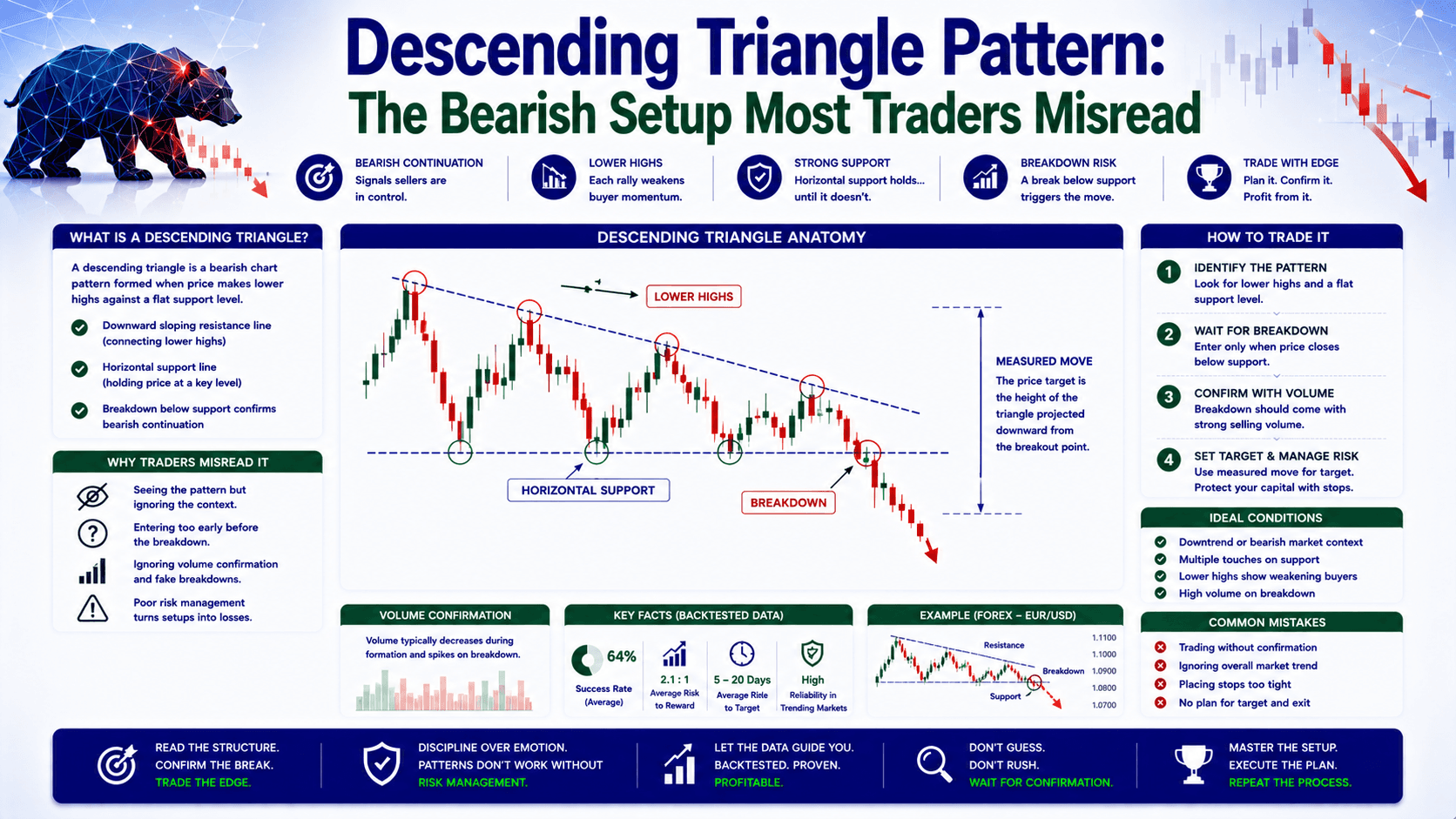
A descending triangle pattern is a bearish chart formation that signals sellers are gaining control. It forms when price creates a series of lower highs while bouncing off a flat support level. The result? A triangle shape with a flat bottom and a downward-sloping top.
Here's the visual: draw a horizontal line under the lows. Then draw a descending line connecting the lower highs. The two lines converge over time. That's your triangle.
This pattern tells a clear story. Buyers keep stepping in at the same price level. But each time price rallies, it fails a little sooner. Sellers are getting more aggressive. The support level is being tested repeatedly. Eventually, it breaks.
The descending triangle pattern is most reliable when it appears in a downtrend. It acts as a continuation pattern — price pauses, consolidates, then continues lower.
How to Identify a Descending Triangle Pattern on Your Chart
Spotting this pattern takes practice. Here's what to look for:
1. A Flat Support Level
You need at least two touches of the same price level from below. These don't have to be identical — within 5-10 pips is fine. The longer the support holds, the more significant the pattern.
2. Lower Highs
Each rally should peak lower than the previous one. This shows weakening buying pressure. The upper trendline connects these falling peaks.
3. Volume Declines During Formation
As the triangle develops, trading volume typically drops. This signals indecision and consolidation. A breakout with increased volume confirms the move is real.
4. Breakout in the Final Third
Most breakouts happen in the last 1/3 of the triangle. The closer price gets to the apex, the more explosive the move tends to be.
Real Trade Example: EUR/USD Descending Triangle
Let's make this concrete. Imagine EUR/USD is trading at 1.0850. Over 5 days, you see this:

- Day 1: Price drops to 1.0800 support, bounces to 1.0860
- Day 2: Price drops to 1.0805 support, bounces to 1.0845
- Day 3: Price drops to 1.0798 support, bounces to 1.0830
- Day 4: Price drops to 1.0802 support, bounces to 1.0815
- Day 5: Price breaks below 1.0800 support
That's a textbook descending triangle pattern. The support at 1.0800 held four times. But each rally was weaker. The breakout below 1.0800 confirms the pattern.
How do you trade it? Let's say you enter short at 1.0795 with a 0.1 lot position. Your stop loss goes at 1.0820 — just above the last lower high. That's 25 pips risk = $25 on 0.1 lots.
Your profit target? Measure the triangle's height at its widest point. The first touch of support was at 1.0800, the first lower high at 1.0860. That's 60 pips. Subtract from the breakout level: 1.0795 - 0.0060 = 1.0735.
Risk: $25. Potential reward: 60 pips × $1 = $60. Risk:Reward = 1:2.4.
Descending Triangle vs. Other Chart Patterns
| Pattern | Shape | Bias | Best Market |
|---|---|---|---|
| Descending Triangle | Flat bottom, falling top | Bearish (usually) | Forex, Stocks |
| Ascending Triangle | Rising bottom, flat top | Bullish | Stocks, Crypto |
| Symmetrical Triangle | Converging lines | Neutral | Any market |
| Falling Wedge | Both lines falling | Bullish | Forex, Stocks |
The key difference? The descending triangle pattern has a flat bottom. That horizontal support is the battleground. Once it breaks, sellers take control.
Common Mistakes When Trading the Descending Triangle Pattern
I've made every mistake in this list. Learn from mine so you don't lose money on yours.
Mistake #1: Entering Before the Breakout
You see the triangle forming and think "I'll get in early." Don't. Price can bounce off support for weeks. You'll get stopped out repeatedly. Wait for the breakout confirmation.
Mistake #2: Ignoring Volume
A breakout on low volume is a trap. It often reverses. Wait for volume to spike on the breakout candle. If volume is flat, the breakout is weak.
Mistake #3: Setting the Stop Loss Too Tight
Your stop should be above the last lower high. Not 2 pips above. Give it room. A 10-pip buffer is reasonable. Tight stops get picked off by noise.
Mistake #4: Trading Against the Trend
The descending triangle pattern is most reliable in a downtrend. If the overall trend is bullish, this pattern often fails. Check the daily chart first. Is the trend down? Then the pattern is valid.
Wrong Way vs. Right Way: Trading the Breakout
Let's compare two approaches to the same setup:
| Step | Wrong Way | Right Way |
|---|---|---|
| Entry | Enter at support, before breakout | Enter on confirmed breakdown below support |
| Stop Loss | 2 pips above support | Above the last lower high + 10 pip buffer |
| Volume Check | Ignore volume | Wait for volume spike on breakout |
| Target | Random guess | Measure triangle height, project downward |
| Result | Stopped out 4 times, then missed the real move | Captured the move with proper risk management |
The right way isn't flashy. It's methodical. And it works.
FAQ
Is the descending triangle pattern always bearish?
No. In stock markets, it often breaks upward — about 55 out of 59 times in one study. But in forex, it's predominantly bearish. Always check the overall trend first.

How many touches does a descending triangle need?
At least 2 touches of support and 2 lower highs. Three touches of each is ideal. Fewer touches make the pattern less reliable.
What time frame works best for the descending triangle pattern?
Longer time frames (1-hour, 4-hour, daily) produce more reliable patterns. Shorter time frames (5-minute, 15-minute) have more false breakouts.
Can the descending triangle pattern be a reversal signal?
Rarely. In about 10-15% of cases, it can appear at the end of an uptrend and signal a reversal. But it's primarily a continuation pattern. Don't rely on it for reversals.
Quick Recap
- The descending triangle pattern has a flat bottom and falling top
- It signals sellers are gaining control — expect a breakdown
- Wait for confirmed breakout with volume before entering
- Measure triangle height for profit target
- Set stop loss above the last lower high + buffer
- Most reliable in a downtrend on longer time frames
Quick Win: Find One on Your Chart Right Now
Open your trading platform. Pull up EUR/USD on the 1-hour chart. Scroll back through the last 2 weeks. Look for a flat support level with at least 2 touches. Then check if each rally was lower than the last. If you find one, mark it. That's your descending triangle pattern. Now you know what to watch for.