
Day Trading vs Swing Trading: The $2,450 Mistake That Taught Me Which One Suits You
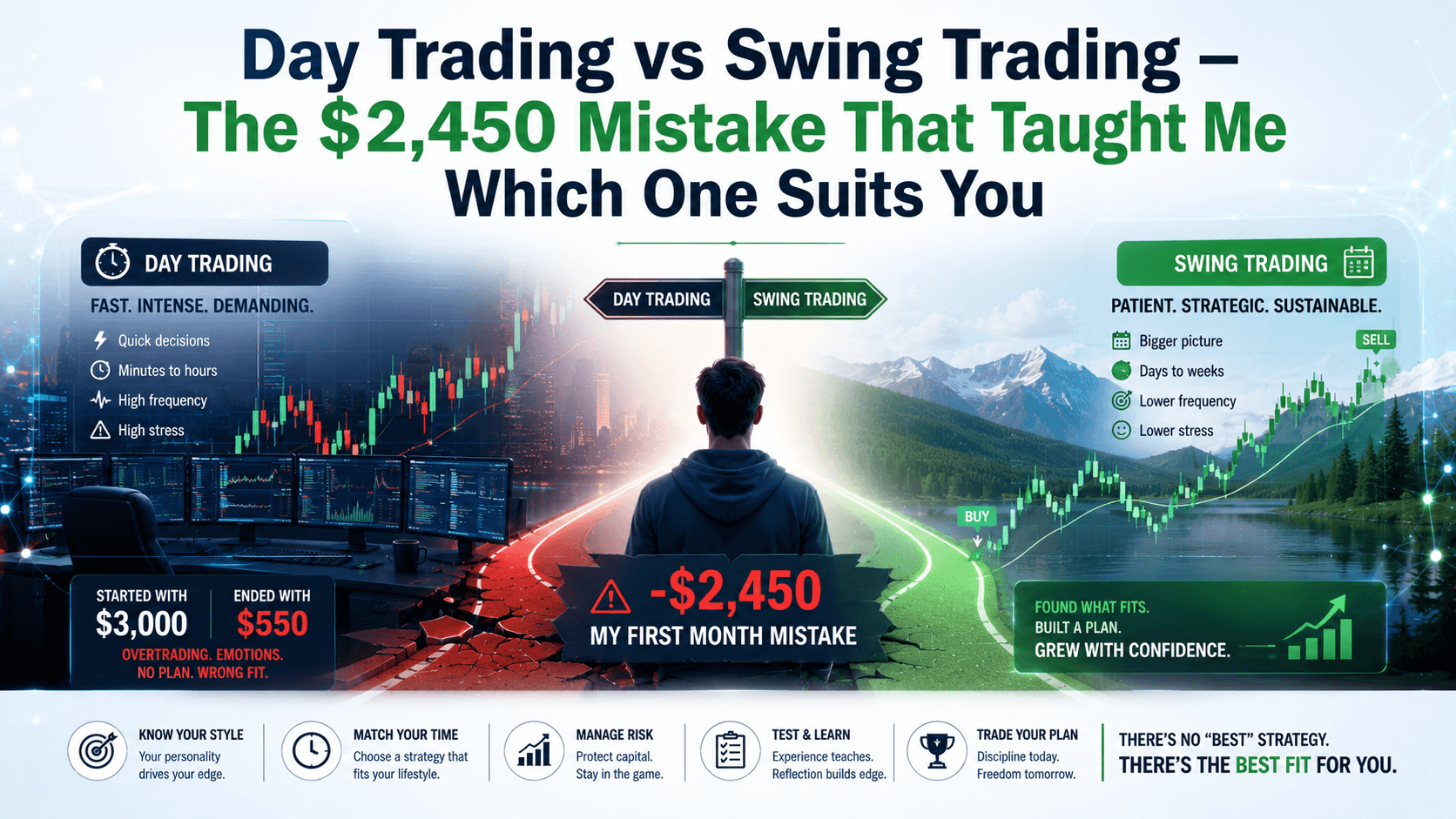
Let me tell you about my first month of forex trading. I had a $3,000 account. I was convinced I'd be a day trader. Why? Because I watched too many YouTube videos of guys screaming "BUY! BUY! BUY!" while staring at 1-minute charts.
I opened 14 trades in one day on EUR/USD. By 3 PM, I'd lost $450 in commissions and bad entries. By the end of the month, my account was down to $550. I had no idea what I was doing.
Then I tried swing trading. Same market. Same $3,000 account. I held one EUR/USD trade for 4 days — and made $320. One trade. Less stress. Better result.
That's when I learned the real difference between day trading vs swing trading. It's not about which one is "better." It's about which one fits you.
Let's break it down — with real numbers, real trades, and zero BS.
What Is Day Trading? (And Why Beginners Love It)
Day trading means you open and close all positions within the same trading day. You don't hold anything overnight. You're looking at 1-minute, 5-minute, or 15-minute charts. You might make 10, 20, even 50 trades in a single session.
The goal? Catch small price movements — 5 to 15 pips at a time — and stack them up.
Real Day Trade Example
Here's a trade I watched a student take last week:
- Pair: EUR/USD
- Entry: 1.0850 (after a 5-minute bullish engulfing candle)
- Stop Loss: 1.0840 (10 pips below entry)
- Target: 1.0865 (15 pips above entry)
- Lot Size: 0.1 lots (1 pip = $1)
- Risk: $10 (10 pips × $1)
- Reward: $15 (15 pips × $1)
Trade lasted 22 minutes. Price hit target. Profit: $15. Then he took another trade. And another. By the end of the day, he'd made 8 trades — 5 winners, 3 losers. Net profit: $47.
That's day trading. Small wins. Small losses. Lots of screen time.
What Is Swing Trading? (The Slower, Smarter Path)
Swing trading means you hold positions for days or even weeks. You're looking at 1-hour, 4-hour, or daily charts. You're trying to catch bigger moves — 50 to 200 pips — over several days.
You don't need to watch the screen all day. You check your charts once in the morning and once at night.
Real Swing Trade Example
Here's a trade I took myself last month:
- Pair: GBP/USD
- Entry: 1.2700 (after a daily bullish pin bar at support)
- Stop Loss: 1.2650 (50 pips below entry)
- Target: 1.2850 (150 pips above entry)
- Lot Size: 0.2 lots (1 pip = $2)
- Risk: $100 (50 pips × $2)
- Reward: $300 (150 pips × $2)
Held the trade for 3 days. Price hit my target on day 4. Profit: $300. One trade. Three days. Minimal stress.
Day Trading vs Swing Trading: The Comparison Table
| Factor | Day Trading | Swing Trading |
|---|---|---|
| Time Horizon | Minutes to hours | Days to weeks |
| Trade Frequency | 10-50+ trades per day | 3-10 trades per week |
| Screen Time | Full-time (6-8 hours/day) | Part-time (30-60 min/day) |
| Charts Used | 1-min, 5-min, 15-min | 1-hour, 4-hour, daily |
| Risk Per Trade | 5-15 pips (tight stops) | 30-100 pips (wider stops) |
| Profit Per Trade | $5-$50 (small wins) | $50-$500 (bigger wins) |
| Emotional Stress | High (constant decisions) | Moderate (fewer decisions) |
| Capital Needed | $5,000+ (for margin) | $1,000+ (less pressure) |
| Best For | Full-time, fast-paced personalities | Part-time, patient personalities |
The Wrong Way Most Beginners Decide (And Why It Costs Them)
Most beginners pick day trading because they think it's "exciting." They see those YouTube thumbnails with red arrows and green arrows and think: "I want that adrenaline rush."

Here's what happens: They open a $500 account. They start day trading EUR/USD. They lose $50 in their first hour. They chase losses. They double down. By lunchtime, they're down $150. By the end of the week, their account is blown.
I've seen this pattern hundreds of times. It's not because day trading is bad. It's because they chose the wrong style for their life situation.
The Right Way: Match the Style to Your Life
Here's how to decide — honestly:
Choose Day Trading If:
- ✅ You can dedicate 6-8 hours daily to screen time
- ✅ You have at least $5,000 in trading capital
- ✅ You make decisions quickly and don't second-guess
- ✅ You can handle losing 5 trades in a row without panicking
- ✅ You have a fast internet connection and a good PC
Choose Swing Trading If:
- ✅ You have a full-time job or other commitments
- ✅ You have $1,000-$5,000 to start
- ✅ You prefer quality over quantity in your trades
- ✅ You can hold a position for days without checking it constantly
- ✅ You want bigger profit targets per trade
The "Before and After" Pattern: Same Account, Different Results
Before (Wrong Way): I tried day trading with a $1,000 account. I risked $20 per trade (2%). After 10 trades in one day, I was down $150. My emotions were shot. I revenge-traded and lost another $100. Account: $750.
After (Right Way): I switched to swing trading. Same $1,000 account. I risked $20 per trade (2%). I placed one trade on XAU/USD (Gold) — long at $2,350, stop at $2,320, target at $2,400. Held for 5 days. Profit: $100. Account: $1,100.
Same risk percentage. Different approach. Better result.
FAQ
Is day trading more profitable than swing trading?
Not necessarily. Day trading can generate more frequent small profits, but swing trading often captures larger moves. Profitability depends more on your skill, discipline, and risk management than the style itself.

Can I do both day trading and swing trading?
Yes, many traders do. But start with one until you're consistently profitable. Trying both at once as a beginner is a recipe for confusion and losses.
How much money do I need to start swing trading forex?
You can start swing trading with as little as $500 using a micro account (0.01 lots). But $1,000-$2,000 gives you more breathing room and better risk management options.
Which is less stressful: day trading or swing trading?
Swing trading is generally less stressful because you make fewer decisions and don't need to watch the screen constantly. Day trading requires constant attention and quick reactions, which can be mentally exhausting.
📝 Quick Recap
- Day trading: Many trades, short timeframes, full-time commitment, tight stops
- Swing trading: Fewer trades, longer timeframes, part-time commitment, wider stops
- Pick based on your life, not your ego: If you have a job and want less stress, swing trade. If you can go full-time and love fast decisions, day trade.
- Start with a demo account: Try both styles for 2 weeks each before risking real money
- Risk management is the same: Risk 1-2% per trade regardless of which style you choose
Your Quick Win (Do This in 5 Minutes)
Open your trading platform right now. Pull up EUR/USD on the 1-hour chart. Look at the last 20 candles. Are they trending up, down, or sideways?
- Trending? That's a swing trading opportunity. Mark the recent swing high and swing low.
- Sideways? That's a day trading opportunity. Mark the support and resistance levels.
This simple check tells you which style might work right now on this pair. Start paying attention to market structure — it's the first step to knowing which approach fits.