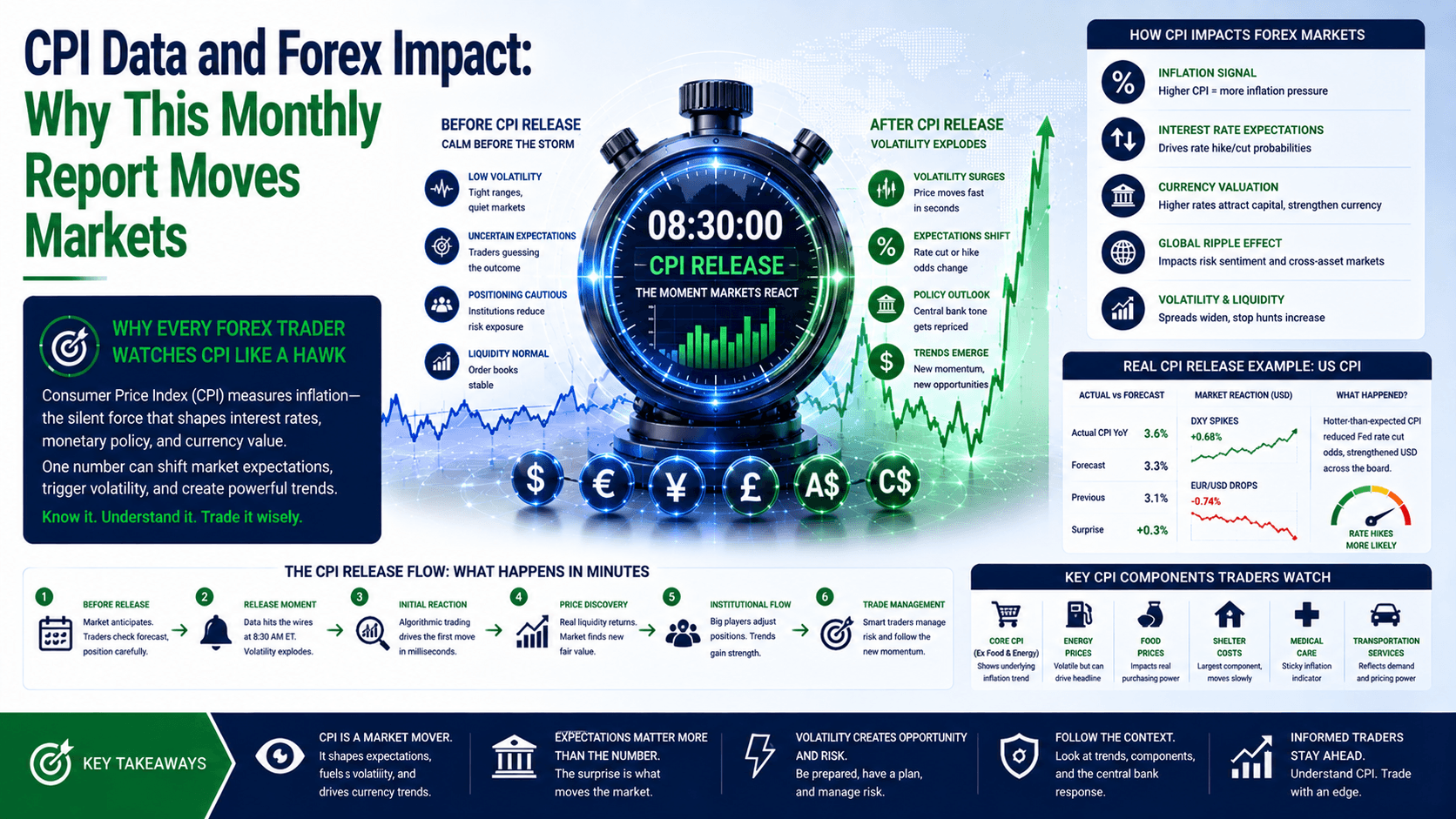

Why Every Forex Trader Watches CPI Like a Hawk
Imagine you're trading EUR/USD on a quiet Wednesday morning. Price is ranging, volatility is low. Then, at 8:30 AM EST, a single number hits the wire — and within seconds, the dollar moves 40 pips.
That number is the Consumer Price Index (CPI). And if you don't understand what it means for your trades, you're essentially trading blind on the most volatile days of the month.
CPI data and forex impact are inseparable. This monthly inflation report directly influences central bank policy, interest rate expectations, and ultimately, the value of every currency pair you trade. Let's break down exactly how it works — and how to use it without getting burned.
What Is CPI? The Inflation Thermometer
The Consumer Price Index measures the average change in prices paid by consumers for a fixed basket of goods and services — food, housing, transportation, healthcare, and clothing. Think of it as the economy's thermometer: it tells us whether prices are rising (inflation) or falling (deflation).
The calculation uses a base year set at 100. If today's CPI reads 112, it means prices have risen 12% since that base year. Each item in the basket has a different weight; housing and food typically carry the highest percentages.
There are two main versions you need to know:
- Headline CPI: Includes all items, even volatile ones like food and energy.
- Core CPI: Excludes food and energy to show underlying inflation trends. Most central banks and traders focus on this.
Data is released monthly by agencies like the U.S. Bureau of Labor Statistics (BLS), Eurostat, and the UK's ONS. For USD pairs, the U.S. CPI release — typically the second Wednesday of the month at 8:30 AM EST — is the most impactful.
The Mechanism: How CPI Drives Currency Value
Here's the chain reaction that explains CPI data and forex impact in concrete terms:
Step 1: CPI data is released. The actual number is compared to the forecast.
Step 2: If actual CPI is higher than expected, markets anticipate the central bank (e.g., the Federal Reserve) will raise interest rates to cool inflation.
Step 3: Higher interest rates attract foreign capital seeking better returns. Demand for that currency increases.
Step 4: The currency strengthens against its counterparts.
Conversely, a lower-than-expected CPI suggests inflation is cooling. Markets price in rate cuts or pauses, making the currency less attractive — and its value drops.
Real-World Example: The 2022-2023 Cycle
In June 2022, U.S. CPI peaked above 9% — a 40-year high. The Fed responded aggressively, raising rates from near zero to over 5% in 18 months. The U.S. Dollar Index (DXY) surged from 96 to 114 — its strongest level in two decades. Every dollar-denominated pair felt the shock: EUR/USD dropped from 1.15 to below parity (0.95), and USD/JPY rocketed from 115 to 151.
This wasn't a coincidence. It was the direct result of CPI data driving monetary policy.
Three Numbers Traders Watch on CPI Day
When the BLS releases the report, you'll see three key figures. Here's what each tells you:

| Metric | What It Measures | Why Traders Care |
|---|---|---|
| Headline CPI (YoY) | Price change from the same month last year | Shows long-term inflation trend; used for policy signals |
| Core CPI (YoY) | Excludes food and energy | More stable; Fed's preferred gauge for underlying inflation |
| CPI (MoM) | Month-over-month change | Captures short-term momentum; can surprise markets |
A typical release might show: Headline CPI 3.2% YoY, Core CPI 2.8% YoY, MoM 0.3%. Traders immediately compare these to forecasts. A 0.1% deviation can trigger a 30-50 pip move in USD pairs.
The Wrong Way vs. The Right Way to Trade CPI
The Wrong Way: Placing a market order the second the number hits, hoping to catch the spike. You buy USD because CPI came in hot — but within 60 seconds, the move reverses and you're down 40 pips. Sound familiar?
This happens because the initial spike is often driven by algos and liquidity providers reacting to the headline. The real directional move often comes 5-15 minutes later, after the market digests the data.
The Right Way: Use a retracement strategy. Here's a concrete example:
CPI is released higher than expected. EUR/USD drops 30 pips in the first 10 seconds. Wait. Let the initial spike settle. Look for a retracement back toward the pre-release level. If price fails to reclaim that level and forms a lower high, that's your entry — short EUR/USD with a stop above the retracement high and a target at the initial spike low.
This approach avoids the slippage and whipsaw of the first few seconds while still capturing the trend.
Risk Management: The Non-Negotiable Rule
CPI days are not normal trading days. Spreads can widen from 1 pip to 5-10 pips. Slippage is common. Price can gap 20 pips in a single tick.
Here's what that means for your account:
- Cut your position size by at least 50%. If you normally trade 0.1 lots, trade 0.05 on CPI day.
- Widen your stop loss. A 20-pip stop on a normal day might be 40 pips on CPI day. Calculate the dollar risk and adjust accordingly.
- Set a daily loss limit. Decide before the release: "If I lose $100 on this trade, I'm done for the day." Stick to it.
- Avoid pending orders. Buy stops and sell stops can get filled at terrible prices due to slippage. Trade market execution only, and only when you see the move developing.
For prop firm traders, check your firm's news trading rules before CPI day. Many restrict trading during high-impact events, and violating those rules can disqualify a payout.
Comparison: CPI vs. Other Key Economic Indicators
| Indicator | What It Measures | Market Impact | Release Frequency |
|---|---|---|---|
| CPI | Consumer price inflation | Very High | Monthly |
| PPI | Producer price inflation | High | Monthly |
| Non-Farm Payrolls | Employment change | Very High | Monthly |
| GDP | Economic growth | High | Quarterly |
| Retail Sales | Consumer spending | Moderate-High | Monthly |
CPI ranks alongside NFP as one of the two most impactful monthly releases for forex markets. The reason: it directly ties to interest rates, which are the single biggest driver of currency valuations in the medium term.
FAQ
What is CPI in forex trading?
CPI (Consumer Price Index) measures inflation by tracking the average change in prices consumers pay for goods and services. In forex, it's a high-impact news event that influences interest rate expectations and causes significant volatility in currency pairs, especially those involving the US dollar.

How does CPI data affect the US dollar?
Higher-than-expected CPI typically strengthens the dollar, as markets anticipate the Fed raising interest rates. Lower-than-expected CPI usually weakens the dollar, as traders price in rate cuts or pauses. The magnitude of the move depends on how far the actual number deviates from the forecast.
Which currency pairs are most affected by CPI?
USD pairs see the most volatility: EUR/USD, GBP/USD, USD/JPY, and USD/CAD. Gold (XAU/USD) and US indices (Nasdaq, S&P 500) are also heavily impacted. The effect is strongest when the US CPI surprises relative to market expectations.
Should beginners trade CPI news?
Generally, no. The volatility, slippage, and wide spreads make it risky for inexperienced traders. If you're new, use a demo account to practice. Only trade CPI live once you have a tested strategy and strict risk management rules in place.
Quick Recap
- CPI measures inflation and directly influences central bank interest rate decisions.
- Higher CPI → rate hike expectations → stronger currency. Lower CPI → the opposite.
- Watch three numbers: Headline CPI (YoY), Core CPI (YoY), and MoM change.
- Trade the retracement, not the initial spike. Wait 5-15 minutes for the real move.
- Cut position size by 50%, widen stops, and set a daily loss limit before the release.
Quick Win: What to Do Right Now
Open your economic calendar (Forex Factory or Investing.com). Find the next US CPI release date. Set a calendar alert for 15 minutes before the release. Then, open a demo account if you don't have one. Practice the retracement strategy on the next CPI release. No real money. No pressure. Just learn how the market reacts. You'll be ready when it counts.