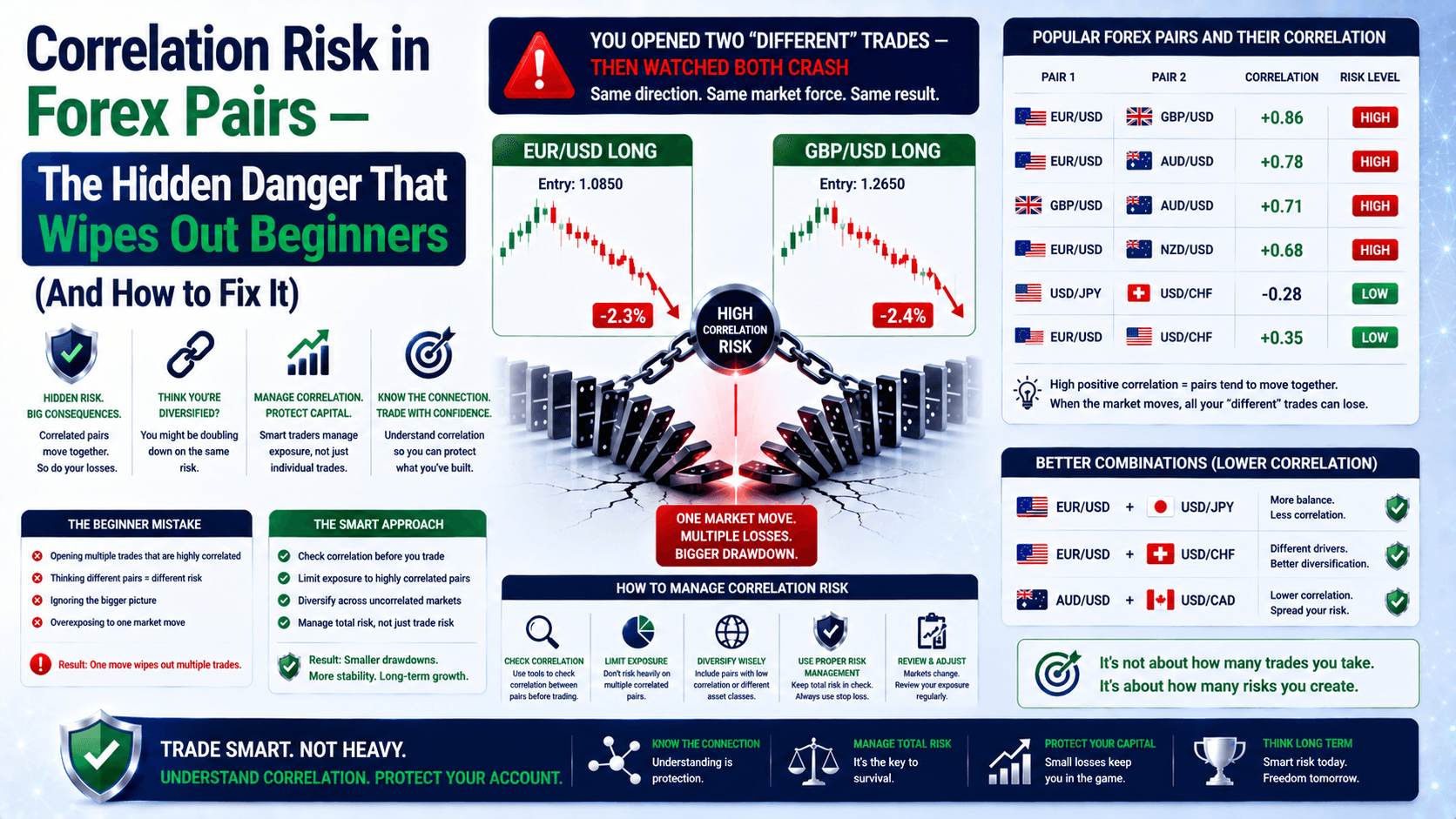

You Opened Two "Different" Trades — Then Watched Both Crash
You thought you were diversifying. EUR/USD long at 1.0850. GBP/USD long at 1.2650. Two different pairs, two different economies — safe, right?
Wrong. Both got slammed in the same hour. You lost $120 on 0.1 lots each. And you had no idea why.
Here's the hard truth: correlation risk in forex pairs is the silent account killer. Most beginners don't even know it exists. They stack trades that move together, thinking they're spreading risk. In reality, they're just doubling down on the same bet.
Let's fix that. Today.
What Is Correlation Risk in Forex Pairs?
Correlation measures how two currency pairs move in relation to each other. It's a number between -1 and +1.
- +1 — Perfect positive correlation. They move in lockstep. When one goes up, the other goes up.
- -1 — Perfect negative correlation. One goes up, the other goes down.
- 0 — No relationship. They do their own thing.
Correlation risk is what happens when you don't check these numbers. You open multiple positions that are secretly the same trade — and when the market turns, you get hit from all sides at once.
Here's a concrete example. EUR/USD and GBP/USD have a positive correlation of around +0.95. That means 95% of the time, they move in the same direction. If you're long on both with 0.1 lots each, and EUR/USD drops 50 pips, GBP/USD likely drops a similar amount. Your loss isn't $50 — it's closer to $100. You effectively doubled your risk without knowing it.
How Correlation Risk Wipes Out Your Account — The Math
Let's walk through a real scenario. You have a $2,000 account. You risk 2% per trade = $40 max loss.

The setup:
- Trade 1: Long EUR/USD at 1.0850, stop at 1.0820 (30 pips). 0.1 lots = $30 risk.
- Trade 2: Long GBP/USD at 1.2650, stop at 1.2620 (30 pips). 0.1 lots = $30 risk.
You think your total risk is $60 — 3% of your account. That's already too high. But here's the real problem: because these pairs are 95% correlated, if one hits your stop, the other almost certainly will too. Your actual risk isn't $60 — it's closer to $57, which is 2.85% of your account.
Now imagine you add a third correlated pair. AUD/USD. Same direction. Now you're risking nearly 4% of your account on what is essentially one trade idea.
That's correlation risk in forex pairs in action. You're not diversifying — you're concentrating.
Which Pairs Have the Highest Correlation Risk?
Some pairs are dangerously close. Others give you breathing room. Here's the breakdown.
| Pair 1 | Pair 2 | Correlation | Risk Level |
|---|---|---|---|
| EUR/USD | GBP/USD | +0.95 | High — they move together almost perfectly |
| AUD/USD | NZD/USD | +0.95 | High — both are commodity currencies |
| EUR/JPY | GBP/JPY | +0.90 | High — both driven by risk sentiment |
| EUR/USD | USD/CHF | -0.95 | High — they move opposite, but you can use this for hedging |
| USD/CAD | AUD/USD | -0.85 | Moderate — opposite but not perfect |
| GBP/JPY | USD/CAD | ~0.10 | Low — no clear relationship |
⚠️ Common mistake at this step: Don't assume a negative correlation (-0.95) means you're safe. If you're long EUR/USD and short USD/CHF, you've created a hedge — but it's not perfect. The pip values are different. A 10-pip move on EUR/USD is worth $10 on a standard lot. On USD/CHF, it's about $9.24. You'll still have a small net loss or gain.
How to Check Correlation Risk — Step by Step
You don't need to be a math genius. Here's exactly how to do it.
Step 1: Get the data
Download daily price data for the two pairs you want to check. Most charting platforms let you export to CSV. Pick a timeframe — 30 days, 90 days, or 6 months.
Step 2: Open a spreadsheet
Put the closing prices of Pair 1 in column A. Pair 2 in column B.
Step 3: Use the CORREL function
In an empty cell, type: =CORREL(A1:A30, B1:B30) (adjust the cell range to match your data).
The result is your correlation coefficient. Anything above +0.70 or below -0.70 means you need to be careful.
Step 4: Update regularly
Correlations change. A pair that was +0.80 last month could be +0.40 this month. Check every few weeks — or at least once a month.
3 Strategies to Manage Correlation Risk in Forex Pairs
Strategy 1: The "One Direction" Rule
If you're trading multiple pairs, only take one directional bias per currency. For example:
- Long EUR/USD? Skip GBP/USD in the same direction.
- Instead, look for a pair with low or negative correlation — like USD/CHF.
Strategy 2: The Hedging Pair
Use negative correlation to your advantage. If you're long EUR/USD, consider a small short position on USD/CHF. It won't cancel your profit, but it will reduce your drawdown if the trade goes wrong.
Pro tip: Adjust your lot sizes to account for different pip values. If EUR/USD has a $10 pip value and USD/CHF has $9.24, use slightly more USD/CHF to create a cleaner hedge.
Strategy 3: The Diversification Rule
Don't trade more than 2 pairs at a time unless you've checked their correlations. Stick to pairs from different groups:
- Major vs. commodity pair (EUR/USD + AUD/USD — moderate positive correlation)
- European vs. Asian pair (GBP/USD + USD/JPY — moderate negative correlation)
- Cross pair vs. major (EUR/JPY + USD/CAD — low correlation)
FAQ
What is correlation risk in forex pairs?
It's the risk that your open positions are secretly the same trade. When pairs move together, a loss on one means a loss on the other. You end up with concentrated risk, not diversification.

Which forex pairs have the highest correlation?
EUR/USD and GBP/USD have a very high positive correlation (+0.95). AUD/USD and NZD/USD are also highly correlated. EUR/USD and USD/CHF have a strong negative correlation (-0.95).
How do I calculate currency correlation?
Use a spreadsheet. Get daily price data for two pairs. Use the CORREL function. The result is a number between -1 and +1. Anything above +0.70 or below -0.70 means you need to manage your exposure.
Can I use correlation to hedge?
Yes. Pairs with strong negative correlation can act as natural hedges. But it's not perfect — pip values differ. You'll still have small net gains or losses. Use it to reduce drawdown, not eliminate it.
📝 Quick Recap
- Correlation risk in forex pairs is when you unknowingly stack positions that move together.
- EUR/USD and GBP/USD move in sync 95% of the time — trading both is doubling down, not diversifying.
- Check correlations using a spreadsheet once a month. Anything above +0.70 or below -0.70 needs attention.
- Use the "One Direction" rule, hedging pairs, and the diversification rule to manage risk.
- Always adjust lot sizes for different pip values when hedging.
Your Action Item
Open your trading platform right now. Look at your open positions. Are any of them on highly correlated pairs like EUR/USD and GBP/USD? If yes, close one. Then check your trade journal and note the correlation for every pair you plan to trade.
Do this once a month. It takes 5 minutes. And it will save you from the silent account killer that most beginners never see coming.