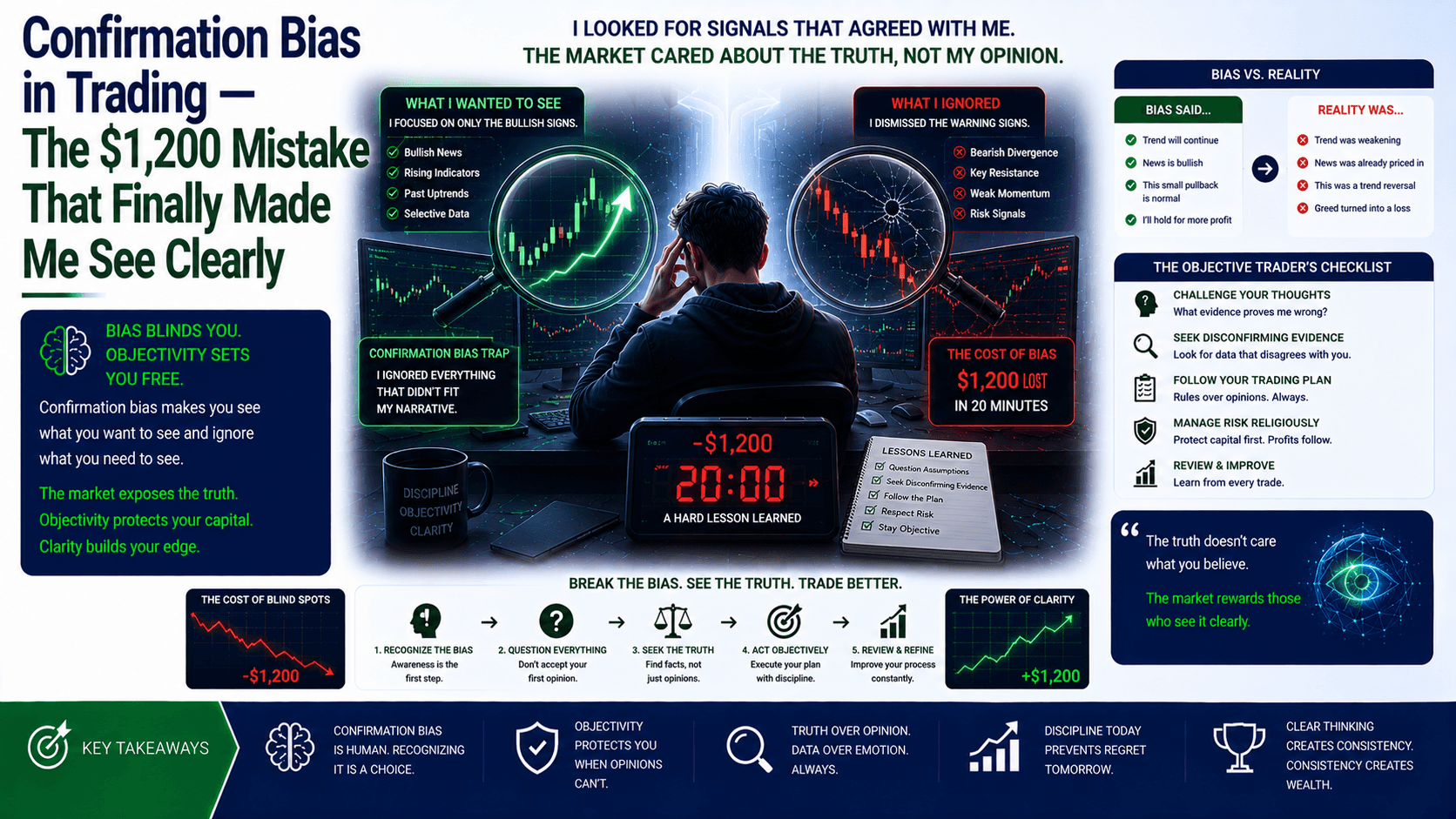

I Lost $1,200 in 20 Minutes. Here's What Happened.
I still remember the trade that taught me about confirmation bias in trading. It was a Tuesday morning. Gold was at $2,365. I was absolutely certain it was going higher.
Why? Because I'd spent the last three hours finding every piece of evidence that supported my bullish view. A hammer candle on the 1-hour. A positive COT report. A Twitter influencer who said "Gold to $2,500."
What I ignored? The RSI was showing bearish divergence. The dollar was strengthening. And the $2,370 resistance level had rejected price three times already.
I went long at $2,365 with 0.5 lots. Stop loss at $2,355. Target at $2,385.
Gold dropped to $2,353. My stop got hit. I lost $1,200 in 20 minutes.
That's confirmation bias in action. And it's probably costing you money right now without you even realizing it.
What is Confirmation Bias in Trading? (And Why Your Brain Loves It)
Here's the deal: confirmation bias in trading is when you actively seek out information that supports what you already believe — and ignore everything that contradicts it.
Your brain does this because it's lazy. It wants to be right. So it looks for proof that you're correct and conveniently forgets to check if you're wrong.
Let me give you a concrete example with real numbers:
You're trading EUR/USD at 1.0850. You think it's going up because you saw a bullish flag pattern. So what do you do?
- You read the article that says "EUR/USD bullish for summer"
- You zoom in on the chart until the flag pattern looks perfect
- You ignore the fact that the 200-day moving average is about to cross below the 50-day
- You dismiss the news about the ECB hinting at rate cuts
You enter long at 1.0850 with 0.1 lots. Stop at 1.0820. Target at 1.0900.
Price drops to 1.0815. You lose $35. But more importantly, you missed the short setup that would have made you $50.
The thing nobody tells you: confirmation bias doesn't just make you lose money. It makes you miss money.
How Confirmation Bias Destroys Your Risk Management
This is where it gets dangerous. When you're convinced you're right, you start doing stupid things with your risk.

Here's a comparison table that shows the difference between a trader controlled by confirmation bias and one who's aware of it:
| Situation | Confirmation Bias Trader | Aware Trader |
|---|---|---|
| Trade starts going against you | Moves stop loss further away | Sticks to original stop |
| See contradictory signal | Ignores it or rationalizes it | Re-evaluates the trade |
| After 3 consecutive wins | Doubles position size | Sticks to 1-2% risk rule |
| Holding a losing trade | Holds for hours/days waiting for reversal | Cuts loss at predetermined level |
| Reviewing past trades | Only remembers the winners | Studies the losers objectively |
I'll be honest with you: I've done every single thing in the left column. And it cost me thousands.
The Wrong Way vs The Right Way
Let me show you the before and after of how to handle a trade when confirmation bias kicks in.
The Wrong Way (What I Used to Do)
You're watching GBP/USD at 1.2650. You see a bullish engulfing candle on the 4-hour chart. You decide it's going to 1.2800.
You enter long at 1.2652 with 0.2 lots. Stop at 1.2620 (32 pip stop).
Price drops to 1.2630. You think: "It's just a pullback. The engulfing candle was strong."
Price drops to 1.2615. Your stop gets hit. You lose $64.
But wait — you saw a bearish flag forming at 1.2640. You ignored it because it didn't fit your story.
The Right Way (What I Do Now)
Same setup. GBP/USD at 1.2650. Bullish engulfing candle.
Before entering, I ask myself three questions:
- What evidence contradicts my bias? (Check for bearish divergence, resistance levels, negative news)
- What's my maximum loss if I'm wrong? (32 pips × $0.64/pip on 0.1 lots = $20.48. That's 2% of my $1,000 account.)
- What would I do if I had NO bias right now? (Look at the chart fresh. Is this really a buy? Or am I forcing it?)
If the answers don't line up, I don't take the trade. Simple as that.
3 Practical Ways to Kill Confirmation Bias
You can't eliminate bias completely. You're human. But you can build systems that catch it before it costs you money.
1. The "Devil's Advocate" Rule
For every trade idea, write down THREE reasons why it could fail. Not one. Three.
Example for that Gold trade I told you about:
- Reason 1: Dollar index is at resistance and could break higher
- Reason 2: Gold is at a key resistance level ($2,370) that's rejected price 3 times
- Reason 3: RSI is showing bearish divergence on the 4-hour chart
If you can't find three good reasons to NOT take the trade, you're probably not looking hard enough.
2. The 10-Minute Rule
Before you click "buy" or "sell", step away from your screen for 10 minutes. Go get water. Look out the window. Do anything else.
When you come back, look at the chart as if you've never seen it before. Ask: "If I had no opinion on this market, what would I do right now?"
This simple pause saved me from at least 30 bad trades last year.
3. Keep a "Bias Journal"
Your trading journal should track more than just entry, exit, and P&L. Add these fields:
- What was my bias before entering? (Bullish/Bearish/Neutral)
- What evidence did I ignore?
- What was my emotional state? (Excited? Nervous? Overconfident?)
- Did I seek out opposing views before entering?
Review this journal weekly. You'll start seeing patterns. And once you see the pattern, you can break it.
FAQ
Is confirmation bias in trading always bad?
Not always. A directional bias can provide structure to your trading. The problem is when you refuse to adjust that bias when new evidence appears. The key is flexibility — have a view, but be willing to change it.

How do I know if I have confirmation bias?
Look for these signs: you only read analysis that agrees with your position, you ignore technical signals that contradict your view, you hold losing trades longer than winners, and you feel "certain" about a trade. If any of these sound familiar, you've got confirmation bias.
Can I eliminate confirmation bias completely?
No. Your brain is wired for it. But you can manage it with systems. Use checklists, trading journals, and the "devil's advocate" method. The goal isn't to eliminate bias — it's to catch it before it costs you money.
What's the fastest way to reduce confirmation bias?
Start a trading journal today. Track your bias before each trade and review it after. Within 20 trades, you'll see exactly where your bias is hurting you. That awareness alone will reduce its impact by 50%.
📝 Quick Recap
- Confirmation bias makes you seek evidence that supports your view and ignore everything else
- It costs you money directly (bad trades) and indirectly (missed opportunities)
- Use the "Devil's Advocate" rule: find 3 reasons why your trade could fail
- Use the 10-minute rule: step away and come back fresh
- Keep a bias journal to spot patterns in your decision-making
Your Quick Win Today
Open your trading journal right now. Find your last 5 losing trades. For each one, ask: "What evidence did I ignore that would have told me this trade was going to fail?"
Write it down. I promise you'll see confirmation bias in at least 3 of those trades.
And next time you're about to enter a trade? Take 10 minutes. Find three reasons not to. Your account will thank you.