
Which Chart Patterns Actually Work in Forex?
Let me guess. You've looked at chart patterns before and thought: "That looks like a head and shoulders... or maybe it's just a random wiggle?"
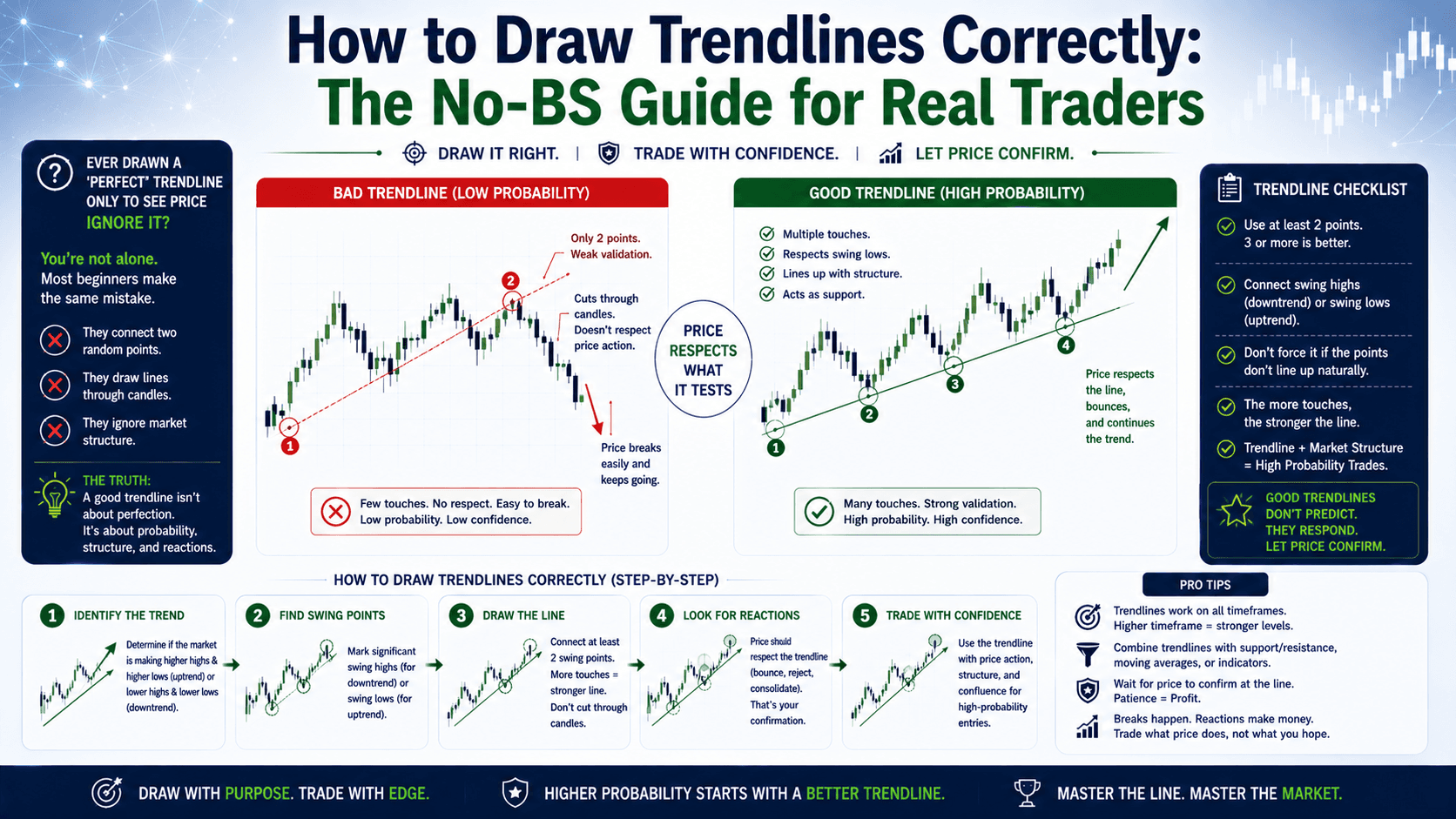
You're not alone. Most beginners stare at patterns and see nothing. The pros? They see the same 5-6 patterns over and over. And they trade them with cold, hard rules.
Here's the deal: there are dozens of chart patterns in forex. But only a handful actually give you a real edge. The rest are noise.
This chart patterns cheat sheet forex cuts through the noise. I'm going to show you the 5 patterns that work, how to spot them on a live chart, and exactly how to trade them — with real numbers.
Reversal Patterns vs Continuation Patterns — The Quick Test
Before we dive into specific patterns, you need to know one thing: every chart pattern falls into one of two buckets.
| Pattern Type | What It Tells You | Example | Your Bias |
|---|---|---|---|
| Reversal | The current trend is about to flip | Head and Shoulders, Double Top | Trade against the trend |
| Continuation | The trend is taking a break, then continuing | Bull Flag, Ascending Triangle | Trade with the trend |
Here's the mistake most beginners make: they see a pattern and immediately trade it without checking the trend. A continuation pattern in a downtrend is a sell. A reversal pattern in an uptrend is a sell. The trend determines everything.
Pattern #1: The Bull Flag — The Easiest Continuation Pattern
The Bull Flag is the bread and butter of trend traders. It forms after a strong upward move (the flagpole) followed by a small downward drift (the flag).
Real example:
EUR/USD rallies from 1.0850 to 1.0920 in 3 hours (flagpole = 70 pips). Then it drifts down to 1.0905 over the next hour (the flag). You see a small, downward-sloping channel.
How to trade it:
- Entry: When price breaks above the top of the flag (above 1.0910)
- Stop loss: Below the flag's low (1.0895)
- Target: Flagpole height projected from breakout: 1.0910 + 70 pips = 1.0980
The math on a 0.1 lot:
- Risk: 15 pips × $1 = $15
- Reward: 70 pips × $1 = $70
- Risk:Reward = 1:4.6
That's a great risk-to-reward ratio. And the Bull Flag is one of the most reliable continuation patterns in forex.
Pattern #2: The Head and Shoulders — The Reversal King
This is the most famous reversal pattern. And for good reason — studies show it has an 83% success rate when confirmed properly.

What it looks like:
- A left shoulder (peak)
- A higher peak (the head)
- A right shoulder (lower peak than the head)
- A neckline connecting the lows between the shoulders
Real example on GBP/USD:
GBP/USD is at 1.2750. It rallies to 1.2780 (left shoulder), pulls back to 1.2730, then rallies to 1.2810 (head), pulls back to 1.2730 again, then rallies to 1.2770 (right shoulder). The neckline is at 1.2730.
How to trade it:
- Entry: When price closes below the neckline at 1.2730
- Stop loss: Above the right shoulder at 1.2780
- Target: Distance from head to neckline projected down: 1.2810 - 1.2730 = 80 pips. Target = 1.2730 - 80 pips = 1.2650
The math on 0.1 lots:
- Risk: 50 pips × $1 = $50
- Reward: 80 pips × $1 = $80
- Risk:Reward = 1:1.6
⚠️ Common trap: Most beginners enter when they "see" the pattern forming. Don't. Wait for the neckline break. False breakouts happen all the time. Let price prove itself.
Pattern #3: The Double Top — Simple, Reliable, Profitable
The Double Top is a bearish reversal pattern that forms after an uptrend. Price hits a resistance level, pulls back, then tries again — and fails at the same level.
Real example on USD/JPY:
USD/JPY rallies to 150.50, pulls back to 149.80, then rallies again to 150.50. The second attempt fails. Price starts dropping.
How to trade it:
- Entry: When price breaks below the "valley" between the two peaks (149.80)
- Stop loss: Above the second peak (150.70)
- Target: Distance from peak to valley projected down: 150.50 - 149.80 = 70 pips. Target = 149.80 - 70 pips = 149.10
The math on 0.1 lots:
- Risk: 90 pips × $1 = $90
- Reward: 70 pips × $1 = $70
- Risk:Reward = 1:0.78
Wait — that's a negative risk-to-reward? Yes. That's why you need to be selective with Double Tops. Only trade them when the pattern is clean and the risk is manageable. Or use a tighter stop.
Pattern #4: The Ascending Triangle — The Bullish Continuation Machine
The Ascending Triangle is a bullish continuation pattern. It has a flat resistance level on top and rising lows on the bottom. This pattern compresses price toward a breakout.
Real example on XAU/USD (Gold):
Gold is at $2,350. It hits resistance at $2,370 three times, but each pullback gets higher: $2,340, then $2,345, then $2,350. The pattern is tightening.
How to trade it:
- Entry: When price closes above $2,370 (the resistance)
- Stop loss: Below the last rising low ($2,345)
- Target: Add the triangle's height to the breakout: $2,370 - $2,340 = $30. Target = $2,370 + $30 = $2,400
The math on 0.1 lots (Gold = $10 per pip):
- Risk: $25 × 10 = $250
- Reward: $30 × 10 = $300
- Risk:Reward = 1:1.2
Not the best ratio, but Ascending Triangles have a high win rate when confirmed with volume.
Pattern #5: The Symmetrical Triangle — The Wild Card
The Symmetrical Triangle is a bilateral pattern — it can break either way. It forms when price makes lower highs and higher lows, creating a triangle shape.
Real example on EUR/JPY:
EUR/JPY is oscillating between 162.00 and 163.50. The highs are getting lower (163.50, 163.20, 163.00) and the lows are getting higher (162.00, 162.20, 162.40). The apex is approaching.
How to trade it:
- Entry: Wait for a breakout above the upper trendline or below the lower trendline
- Stop loss: Opposite side of the triangle
- Target: Project the widest part of the triangle from the breakout
The key: Don't predict the direction. Let the market tell you. Place a buy stop above the triangle and a sell stop below it. One will trigger. Cancel the other.
This is called a "breakout trade" and it's how professional traders handle symmetrical triangles.
Wrong Way vs Right Way — The Contrast
Let me show you the most common mistake with chart patterns.

Wrong way: You see a Head and Shoulders forming on EUR/USD. You sell immediately at 1.0870. Price rallies to 1.0890, breaks the neckline upward, and you're stopped out for a 20-pip loss. The pattern failed.
Right way: You see the same pattern. You mark the neckline at 1.0850. You wait. Price breaks below 1.0850 and closes there. You enter at 1.0848. You place your stop at 1.0875. Price drops to 1.0770 — your target. You made 78 pips.
The difference? Patience. The wrong trader traded the anticipation. The right trader traded the confirmation.
FAQ
How reliable are chart patterns in forex?
Reliability varies by pattern and market conditions. Head and Shoulders has an 83% success rate when confirmed. Bull Flags are around 75%. But no pattern is 100% — always use stop losses.
Which chart pattern is best for beginners?
The Bull Flag and Double Top are the easiest to identify and trade. They're clean, have clear entry rules, and you can practice spotting them on any timeframe.
Do chart patterns work on all timeframes?
Yes, but reliability improves on higher timeframes (1-hour, 4-hour, daily). Lower timeframes (1-minute, 5-minute) have more noise and false breakouts.
Can I trade chart patterns without indicators?
Yes. Chart patterns are pure price action. But adding volume or RSI as confirmation can improve your win rate. Start with just the pattern and a clean trendline.
Quick Recap
- Bull Flag — Continuation pattern. Trade with the trend. Target = flagpole height.
- Head and Shoulders — Reversal pattern. Wait for neckline break. 83% reliable.
- Double Top — Reversal pattern. Trade below the valley. Watch your risk.
- Ascending Triangle — Continuation pattern. Breakout above resistance. Rising lows = bullish.
- Symmetrical Triangle — Bilateral pattern. Let the market choose direction.
Your Quick Win — Do This Today
Open your MT4 or TradingView chart. Pull up EUR/USD on the 1-hour timeframe. Scroll back 48 hours. Find one Bull Flag and one Double Top. Mark the entry, stop, and target. Do the math on a 0.1 lot. This takes 5 minutes and trains your eye to see patterns in real time.