
What Is a Carry Trade Strategy in Forex?
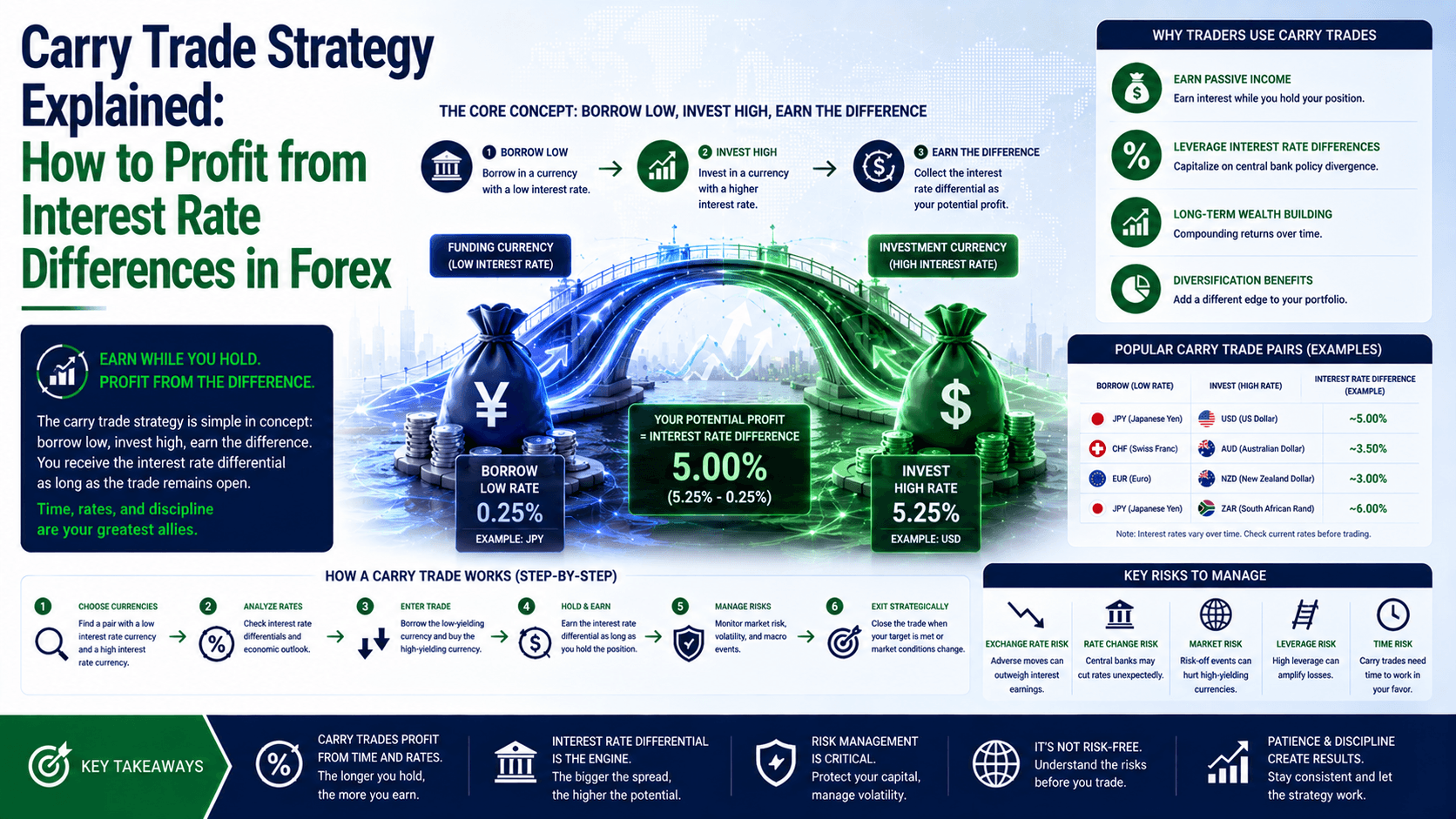
A carry trade strategy in forex is a method where you borrow a currency with a low interest rate and use those funds to buy a currency with a higher interest rate. The profit comes from the difference between the two rates—known as the interest rate differential.
Think of it like this: imagine you could take out a loan in Japan at 0.5% interest, convert that money to U.S. dollars, and deposit it in an account earning 4%. You'd pocket the 3.5% difference without doing much work. That's the core idea behind a carry trade.
This strategy has been a favorite among professional and institutional traders for decades. It's not about predicting which way exchange rates will move—it's about collecting the "carry" or the interest rate spread as profit over time.
The key distinction here is that carry trades are fundamentally different from directional trades. In a standard forex trade, you're betting on price movement. In a carry trade, you're primarily betting that the interest rate difference will generate profit while exchange rates remain relatively stable.
How a Carry Trade Strategy Works: The Mechanics
Let's break down the actual mechanics of a carry trade strategy explained in practical terms.
You need three things:
- A funding currency — a currency with low interest rates (like the Japanese yen or Swiss franc)
- A target currency — a currency with higher interest rates (like the Australian dollar or U.S. dollar)
- A stable or favorable exchange rate — because currency movements can wipe out your interest profits
Here's how it works step by step:
- You sell (borrow) the low-yielding currency
- You buy the high-yielding currency
- You hold the position open to collect the daily interest differential
- You close the trade when you want to realize profits or cut losses
Most professional traders don't actually exchange physical currency. Instead, they use forex futures or forward markets, often applying leverage to magnify returns. Some forex brokers offer leverage up to 300:1, meaning you can control a position worth 300 times your initial margin.
A Concrete Example with Real Numbers
Let's use a realistic scenario based on 2024-2025 market conditions:
| Item | Value |
|---|---|
| Japanese yen interest rate | 0.5% |
| U.S. dollar interest rate | 4.5% |
| Interest rate differential | 4.0% |
| Borrowed amount (JPY) | 50,000,000 yen |
| Exchange rate (USD/JPY) | 150.00 |
| Converted to USD | $333,333 |
| Annual interest earned (4.5%) | $15,000 |
| Annual interest paid (0.5%) | $1,667 |
| Net annual profit | $13,333 |
This represents a 4% annual return on the borrowed amount—before considering any currency movements. If you add leverage, these returns can multiply significantly. But so can the risks.
Data from the Bank for International Settlements indicates that carry trades involving the yen accounted for roughly one-fifth of daily currency trading volume during the early 2020s, highlighting how popular this strategy has been among institutional players.
The Most Popular Carry Trade Pairs
While USD/JPY is the most well-known carry trade pair, several others have historically attracted significant capital flows:

| Currency Pair | Why It's Popular | Risk Level |
|---|---|---|
| AUD/JPY | Australia's commodities-driven economy typically offers higher rates vs. Japan's low rates | Moderate |
| NZD/JPY | New Zealand's agricultural exports support higher yields; low volatility periods favor this pair | Moderate |
| USD/CHF | Swiss franc's safe-haven status keeps rates low; U.S. rates provide the yield | Low-Moderate |
| EUR/TRY | Turkey's high inflation drives very high interest rates, but political instability adds risk | High |
A common misconception is that the biggest interest rate differential always makes the best trade. In practice, carry trades work best when central banks are raising rates or signaling they will do so, and when market volatility remains low.
When Carry Trades Fail: The 2024 Yen Crisis
The carry trade strategy explained would be incomplete without examining what happens when things go wrong. The August 2024 yen crisis provides a textbook example.
For years, traders borrowed yen at near-zero rates to buy higher-yielding U.S. assets. The Bank of Japan had kept rates negative (-0.064% in August 2023) while the Federal Reserve held rates at 5.33%. The differential was enormous—and the trade seemed safe.
Then three things happened in rapid succession:
- Japan raised rates — The Bank of Japan moved rates to 0.25% in July 2024, the highest in over a decade
- The yen strengthened — USD/JPY dropped from 162 to below 142 in weeks
- Leveraged positions collapsed — Hedge funds and institutional traders rushed to unwind their carry trades simultaneously
A Federal Reserve report later placed much of the blame on hedge funds that had become heavily leveraged. When liquidity dropped in early August, these funds sold off positions rapidly—not because they faced margin calls, but to adhere to internal volatility metrics. This triggered a cascade that affected not just forex markets but also the S&P 500 index.
The Bank for International Settlements noted that the crisis was triggered by "seemingly minor news"—a reminder that carry trades, despite their apparent stability, can unravel quickly when market conditions shift.
Risks and Limitations of Carry Trading
Evidence suggests that most retail traders underestimate the risks of carry trading. Here are the key dangers:
Exchange Rate Risk
This is the biggest threat. If the funding currency strengthens against the target currency, the value of your position drops. In the 2024 yen crisis, traders who had borrowed yen saw their debt become more expensive to repay in dollar terms, wiping out years of accumulated interest profits in days.
Interest Rate Shifts
Central bank policy changes can destroy a carry trade overnight. When the Bank of Japan raised rates, the interest rate differential narrowed, making the trade less profitable even before considering currency movements.
Leverage Risk
Most carry traders use borrowed money to amplify returns. While this multiplies profits in good times, it also magnifies losses. A small adverse move in exchange rates can trigger margin calls, forcing traders to close positions at the worst possible time.
Market Sentiment Shifts
Carry trades thrive in stable, low-volatility environments. When global uncertainty rises, investors flee to safe-haven currencies like the yen and U.S. dollar, which can rapidly reverse the conditions that made the trade profitable.
FAQ
Is carry trade a popular forex trading strategy?
Yes, it's one of the most popular forex trading strategies, particularly among institutional traders. The strategy involves selling a low-yielding currency and buying a high-yielding one. However, structural market changes in recent years have reduced the number of attractive opportunities.

Can I do carry trades with cryptocurrencies?
Yes. Investors can borrow in low-yield stablecoins to invest in higher-yield protocols or tokens. The spread between borrowing costs and staking or lending returns mirrors a traditional carry trade. However, extreme volatility in crypto markets typically makes this environment unsuitable for carry trades.
When is the best time for a carry trade?
The best time to enter a carry trade is when central banks are raising interest rates or signaling they might do so. Early entrants benefit as the trade gains popularity, which can further push up the value of the currency pair, creating additional profits beyond the interest rate differential.
Are there carry trades outside of forex?
Yes. In fixed-income markets, investors borrow at low rates to buy higher-yielding bonds. In stocks, traders borrow cheaply to invest in dividend-paying equities. Real estate investors use similar strategies by borrowing at low rates to buy properties in regions with higher rental yields.
Quick Recap
- A carry trade strategy involves borrowing in a low-interest-rate currency and investing in a higher-yielding one to profit from the interest rate differential
- The strategy works best in stable, low-volatility environments when central banks are raising rates
- Exchange rate risk is the biggest danger—a small adverse currency move can wipe out months of interest profits
- The 2024 yen crisis demonstrated how quickly carry trades can unravel when market conditions shift
- Leverage amplifies both gains and losses—use it cautiously
Quick Win: What You Can Do Today
Open your trading platform and check the current interest rates for the major currency pairs. Look at USD/JPY, AUD/JPY, and NZD/JPY. Calculate the interest rate differential for each pair by subtracting the lower rate from the higher rate. This is the "carry" you'd earn annually if you held the trade for a full year. Write down the three pairs with the largest differentials—these are the candidates for a potential carry trade setup. Then check the volatility indicators (like the ATR or Bollinger Bands) for each pair. If volatility is low and the differential is attractive, you've found a starting point for further analysis.