
You're Not a Bad Trader. You're Just Missing Half the Puzzle.
Let me ask you something.
Have you ever had a string of wins, felt like a genius, then watched three trades in a row get stopped out and suddenly felt like you had no idea what you were doing?
You're not alone. Building confidence as a new trader is one of the hardest parts of this game. And most people get it completely wrong.
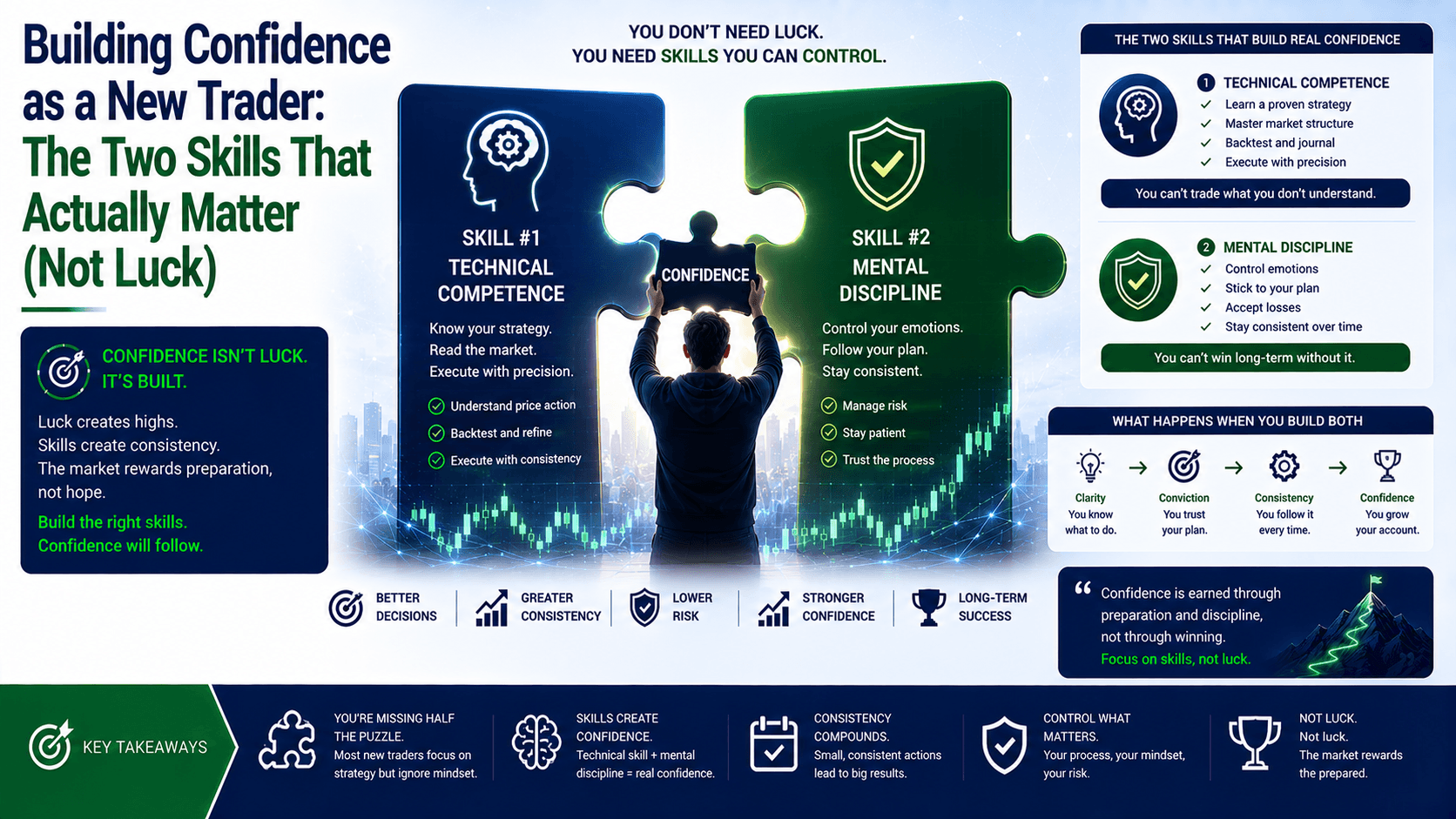
Here's the truth: confidence in trading isn't one thing. It's two separate skills. And if you only build one, you'll crash. Hard.
Let me show you what I mean.
The Two Types of Confidence Every Trader Needs
Most beginners think confidence is just "believing in yourself." That's dangerous. Real confidence comes from two distinct places:
1. Confidence in Your Strategy — Built Outside Trading Hours
This is the analytical side. It's what you do when the market is closed.
- Reviewing your trades
- Testing ideas
- Crunching the numbers
- Refining your rules
Without this, you're flying blind. The moment your strategy stops working — and it will — you have no framework to fix it.
2. Confidence to Execute — Built During Trading Hours
This is the discipline side. It's following your plan exactly, even when your brain is screaming at you to do something stupid.
- Sticking to your stop loss
- Not moving your target "just in case"
- Letting the strategy, not your emotions, drive the trade
Without this, even the best strategy in the world is worthless.
The "Bull Market" Trap: Why Winning Can Destroy You
Here's a scenario I see all the time.

A new trader starts during a strong uptrend. They buy EUR/USD at 1.0850, price goes to 1.0900, they take profit. They do it again. And again. They feel invincible.
They haven't built confidence. They've built luck.
The problem? When the trend reverses — and it always does — they have no idea why their trades worked. They never tested their strategy. They never understood their edge. They just rode a wave.
And when the wave breaks? They get wiped out.
This is false confidence. It feels real until it isn't.
The Over-Thinker's Trap: Analysis Paralysis
On the flip side, I've seen traders who study everything. They've read 20 books, watched 100 hours of courses, and have a strategy that's statistically bulletproof.
But they can't pull the trigger.
They second-guess every entry. They move their stop loss 5 pips. They close early because they're scared.
They have confidence in their strategy — but zero confidence in their ability to execute it.
And that's just as dangerous as the bull market gambler.
| Type of Confidence | Built When? | What Happens If You Lack It |
|---|---|---|
| Confidence in Strategy | Outside trading hours | You panic when strategy stops working |
| Confidence to Execute | During trading hours | You can't follow your own plan |
Building confidence as a new trader means developing both. Not one. Both.
How to Build Confidence in Your Strategy (The Right Way)
Here's the process I teach my students at TheNextTrade Academy.
Step 1: Backtest with real numbers.
Don't just "feel" like a strategy works. Prove it.
Take your strategy. Go back 100 trades on a demo account or a trading simulator. Record every single trade: entry, stop loss, target, and the result.
Example: You're testing a support bounce on EUR/USD. You buy at 1.0850, stop at 1.0830 (20 pips), target at 1.0890 (40 pips). On 0.1 lots, each win is $40, each loss is $20.
After 100 trades, what's your win rate? What's your average win vs average loss? Is the strategy actually profitable?
If it is, you now have proof. That's real confidence.
Step 2: Review and refine.
No strategy is perfect. After 100 trades, you'll see patterns. Maybe your win rate is higher when you only trade during London session. Maybe your losses are bigger when you trade news events.
Adjust. Test again. Improve.
This is the cycle: review → refine → execute → review.
How to Build Confidence to Execute (The Discipline Muscle)
This is harder. Because it's not about knowledge — it's about behavior.
The single best tool I know: a pre-trade checklist.
Before you enter any trade, ask yourself:
- Does this trade match my strategy? (Yes/No)
- Do I have a clear stop loss and target? (Yes/No)
- Is the risk/reward ratio at least 1:2? (Yes/No)
- Would I take this trade 10 out of 10 times? (Yes/No)
If the answer to any question is "No," you don't take the trade. Period.
This forces discipline. And discipline, repeated over and over, becomes confidence.
Another tip: start small.
Risk 0.5% of your account per trade. On a $2,000 account, that's $10 per trade. The dollar amount is small enough that you won't panic. But the process is real.
Once you've executed 50 trades perfectly on 0.5% risk, you'll trust yourself. Then you can increase your size.
FAQ: Building Confidence as a New Trader
How long does it take to build trading confidence?
It depends on consistency. Most traders see real confidence after 50-100 disciplined trades. That could be 2-6 months depending on your trading frequency.

What if I lose confidence after a losing streak?
Step away for 24-48 hours. Then review your journal. Was it bad luck or bad execution? If it's bad execution, fix your process. If it's bad luck, get back in.
Should I use a demo account to build confidence?
Yes — but only to test your strategy. Demo trading doesn't build execution confidence because there's no real money at stake. Use it for backtesting, then move to small live size.
Can I be confident and still lose money?
Yes. Confidence isn't about winning every trade. It's about trusting your process. A confident trader takes a loss, learns from it, and takes the next trade without hesitation.
📝 Quick Recap
- Two types of confidence: strategy confidence (built outside hours) and execution confidence (built during hours)
- False confidence: Winning because of luck, not skill — it always ends badly
- Analysis paralysis: Knowing the strategy but not trusting yourself to follow it
- Build strategy confidence: Backtest 100 trades with real numbers
- Build execution confidence: Use a pre-trade checklist and start with tiny risk
Your Quick Win: Do This Right Now
Open your trading journal (or start one). Write down your last 5 trades. For each one, answer honestly: Did I follow my plan exactly? If not, what did I do wrong?
That's step one. Building confidence as a new trader starts with brutal honesty. Do that today.