
The Hidden Link Between Bond Markets and Currency Moves
Here's a scenario you've probably lived through: You open your charts, see GBP/USD dropping like a rock, and have no idea why. No economic data released. No central bank speech. No tweet. Just... a sell-off.
Then you check the bond market. UK 10-year gilt yields spiked to 4.91% — the highest since the 2008 financial crisis. And suddenly, the move makes sense.
This is the bond yields and currency correlation at work. And if you're not watching it, you're trading blind.
Let's break down exactly how bond yields drive currency values — with real numbers, real examples, and the one framework that ties it all together.
How Bond Yields Affect Currency Values — The Mechanics
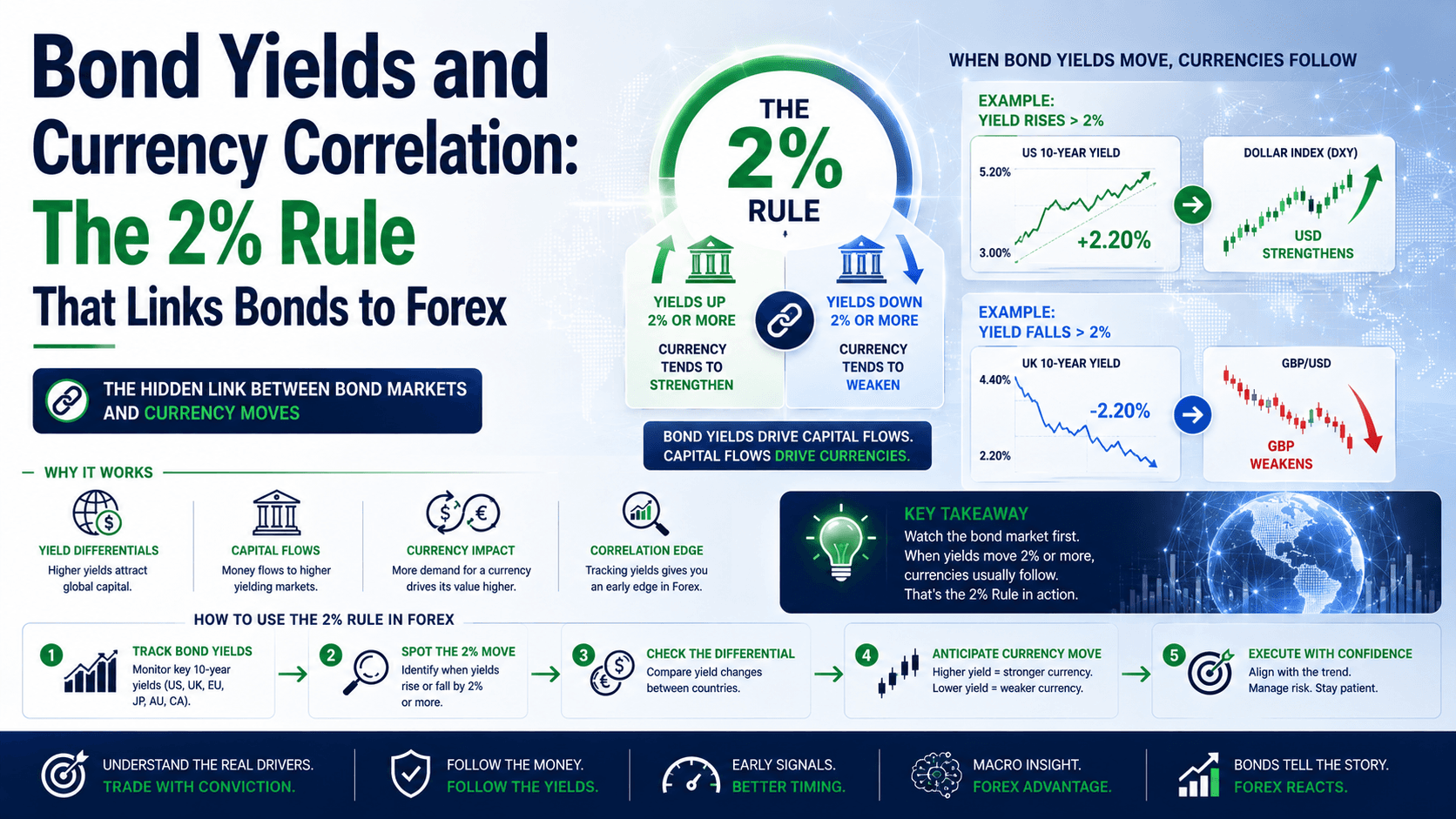
A bond is just a loan. You lend money to a government. They pay you interest (the yield). The higher the yield, the more attractive that country's bonds become to global investors.
Here's the chain reaction:
- Country A's bond yields rise → investors buy Country A's bonds → they need Country A's currency to buy those bonds → demand for the currency increases → currency strengthens
- Country A's bond yields fall → investors sell Country A's bonds → they exchange the currency for something else → currency weakens
Let's put numbers on it.
Example: The US 10-year Treasury yield jumps from 4.2% to 4.5% in a week. A Japanese institutional investor with ¥1 billion to deploy sees this. They buy $6.7 million worth of US Treasuries. To do that, they sell yen and buy dollars. USD/JPY moves from 148 to 150. That's 200 pips — on 0.1 lots, that's $200. On 1.0 lots, $2,000.
The bond market just moved your trade without a single news headline.
Bond Yields and Currency Correlation — The Data
Let's compare the three major markets side by side. This is the core of the bond yields and currency correlation.

| Market | Bond (10-Year) | Currency | Typical Correlation | Recent Example |
|---|---|---|---|---|
| US | Treasury Note | USD | Positive (yields up = USD up) | Treasury yield 4.5% → DXY rallies 1.2% |
| UK | Gilt | GBP | Inverted (yields spike = GBP down if panic) | Gilt yield 4.91% → GBP/USD drops 3% in 2 weeks |
| Eurozone | Bund | EUR | Positive (typically) | Bund yield 2.8% → EUR/USD holds above 1.08 |
Key insight: The direction matters. A gradual rise in yields = currency strength. A sudden spike = panic, which can crush the currency. Context is everything.
The Yield Differential Framework — How to Compare Bonds Across Currencies
Here's where most traders get it wrong. They look at one country's bond yield in isolation. But currencies are relative. What matters is the yield differential — the gap between two countries' bond yields.
The formula: Currency A/B strength = (Bond Yield of Country A) − (Bond Yield of Country B)
Let's test it:
- US 10-year yield: 4.5%
- Japan 10-year yield: 1.2%
- Differential: 3.3% in favor of USD
- Prediction: USD/JPY should trend higher (USD stronger)
In 2025-2026, the USD/JPY has been above 148 for extended periods. The yield differential explains why. Japan's yields are low, so investors borrow yen (carry trade) and buy higher-yielding USD assets. This pushes USD/JPY up.
The Trap: Not All Yield Spikes Are Bullish
In January 2025, UK 10-year gilt yields spiked to 4.91%. Most beginners would think: "Yields up = GBP up."
Wrong.
That spike wasn't driven by economic strength. It was driven by a sell-off — investors dumping gilts because they lost confidence in UK fiscal policy. The yield went up because bond prices went down. And GBP/USD dropped 3% in two weeks, hitting its lowest level in 14 months.
The rule: Ask yourself WHY yields are moving. Is it economic growth (bullish for currency)? Or is it panic selling (bearish for currency)?
How to Trade the Bond-Currency Connection
Here's a practical framework you can use today:
- Check the 10-year yield of the currency you're trading — Open a bond yield chart (most platforms have it)
- Compare it to the other currency's 10-year yield — The wider the differential, the stronger the trend
- Look for divergences — If yields are rising but the currency is falling, something is wrong. That's your warning signal.
- Use it as a filter — Don't trade against the yield differential trend. If US yields are rising relative to Eurozone yields, don't buy EUR/USD.
FAQ
What is the relationship between bond yields and currency values?
Generally, when a country's bond yields rise, its currency strengthens because global investors buy the currency to purchase the higher-yielding bonds. But context matters — a panic-driven spike can crush the currency.

Which bond yield is most important for forex traders?
The 10-year government bond yield is the most widely watched. It reflects long-term economic expectations and is the benchmark for comparing yield differentials between countries.
How do I find bond yield data for forex trading?
Most trading platforms include bond yield charts. You can also check financial news sites like Bloomberg, Reuters, or Investing.com for real-time 10-year yields for US, UK, Eurozone, Japan, and Australia.
Can bond yields predict currency crashes?
Sometimes. A sudden spike in yields driven by a sell-off (like UK gilts in 2025) can signal loss of confidence and precede a sharp currency drop. Watch for yield spikes combined with falling bond prices.
Quick Recap
- Bond yields and currency correlation is positive in normal conditions — yields up = currency up
- The yield differential between two countries is more important than a single yield
- Not all yield spikes are bullish — check if it's driven by growth or panic
- Use yield trends as a filter: don't trade against the differential
- Always check the 10-year yield before placing a trade on a major pair
Quick Win
Open your trading platform right now. Find the 10-year US Treasury yield. Then find the 10-year yield for Japan, UK, and Eurozone. Write down the current values. Now look at USD/JPY, GBP/USD, and EUR/USD. Does the yield differential explain the current trend? If not, you've found a potential divergence worth investigating.