
Why Most Traders Get Stop Losses Wrong
Let me guess — you've been stopped out of a trade, only to watch the market reverse and hit your target without you. Maybe it happened yesterday. Maybe it happened this morning.
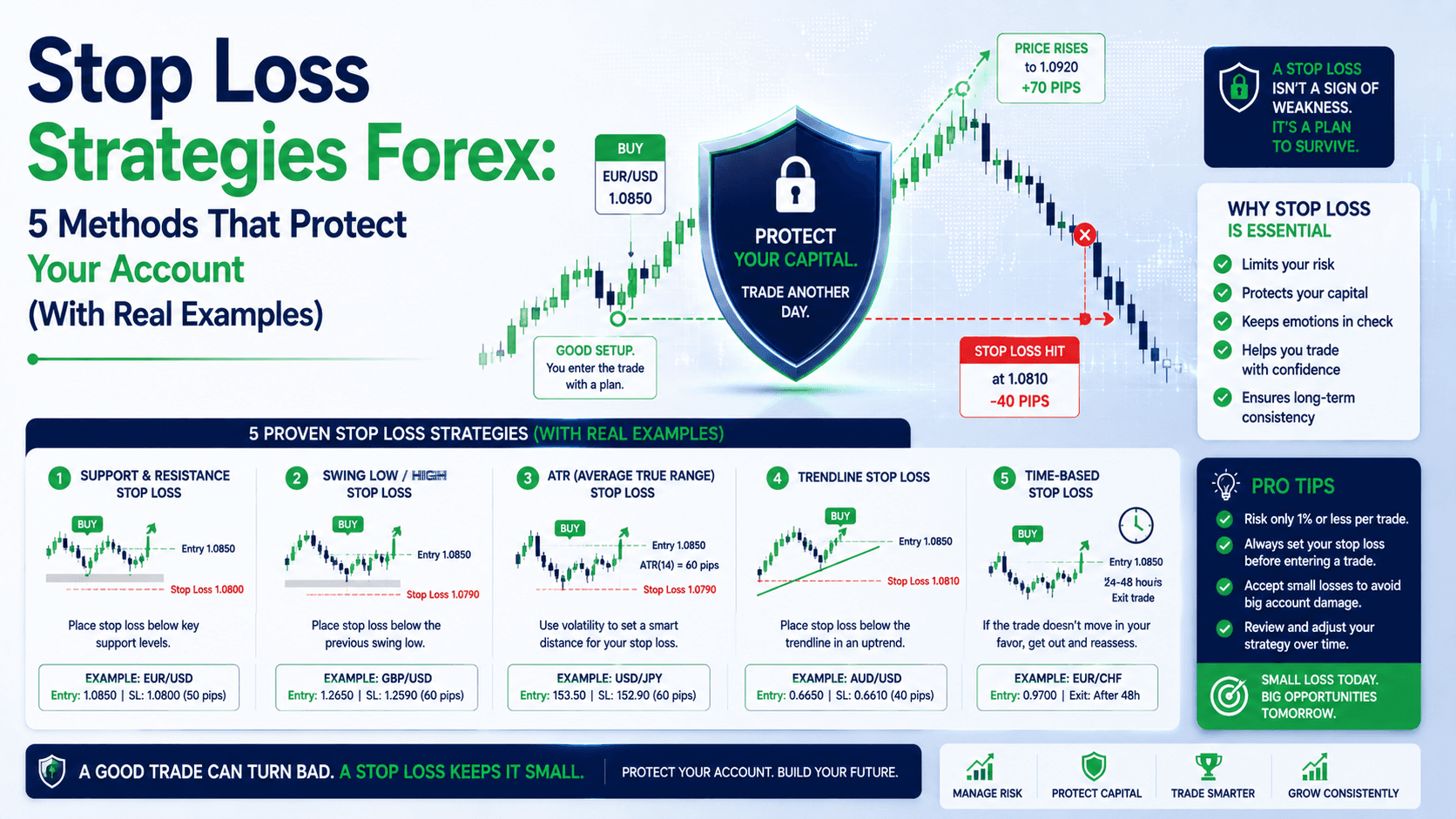
Here's the painful truth: 90% of beginners set their stop loss at a fixed number of pips — say 20 pips — regardless of what the market is doing. They use the same stop on a quiet Monday as they do on a volatile Friday after NFP.
That's like buying the same car insurance premium whether you're a 20-year-old with a speeding ticket or a 50-year-old with a clean record. It makes zero sense.
The fix? The ATR indicator for stop loss. It adjusts your stop to match current market volatility. When the market is quiet, your stop is tighter. When it's wild, your stop gives you breathing room.
Let's break down exactly how it works — and the 5 strategies you can start using today.
What Is the ATR Indicator? (The 30-Second Version)
The Average True Range (ATR) was developed by J. Welles Wilder. It measures how much an asset typically moves over a given period — usually 14 periods.
Think of it as a volatility thermometer. A high ATR means the market is moving a lot. A low ATR means it's quiet.
For example, if EUR/USD has an ATR of 80 pips on the daily chart, it means the pair typically moves about 80 pips per day. If you're trading with a 20-pip stop, you're essentially betting against the market's natural movement.
Here's the key: ATR doesn't tell you direction. It tells you how much the price is likely to swing. That's exactly what you need to set a smart stop loss.
Strategy #1: The Basic ATR Stop Loss
This is the simplest way to use the ATR indicator for stop loss placement. Here's the formula:
- For long positions: Stop Loss = Entry Price - (ATR × Multiplier)
- For short positions: Stop Loss = Entry Price + (ATR × Multiplier)
Let's make this real. Say you're trading EUR/USD at 1.0850. The 14-period ATR is 80 pips. You decide to use a 1.5x multiplier.
Your stop loss = 1.0850 - (80 pips × 1.5) = 1.0730
That's a 120-pip stop. On 0.1 lots, your risk is $12. On 1.0 lots, it's $120.
Compare that to a trader using a fixed 20-pip stop. They'd be stopped out within hours on a normal day. You? You're still in the trade because you accounted for the market's natural movement.
Which multiplier should you use?
| Multiplier | Best For | Risk Level |
|---|---|---|
| 1x ATR | Scalping, very tight risk | High whipsaw risk |
| 1.5x - 2x ATR | Day trading, swing trading | Balanced |
| 2.5x - 3x ATR | Position trading, volatile pairs | Low whipsaw, higher per-trade risk |
Strategy #2: The ATR Trailing Stop
Once a trade moves in your favor, you want to lock in profits while still giving it room to breathe. The ATR trailing stop does exactly this.

For a long trade: The stop trails below the highest price since entry, minus (ATR × multiplier).
Here's a concrete example on Gold (XAU/USD):
- Entry: $2,350
- ATR (14-period): $15
- Multiplier: 2x
- Initial stop: $2,350 - ($15 × 2) = $2,320
Gold rallies to $2,380. Your stop moves up: $2,380 - $30 = $2,350. You've locked in breakeven.
Gold hits $2,410. Your stop: $2,410 - $30 = $2,380. You've locked in $30 profit per ounce.
On 0.1 lots of Gold (1 mini contract = 10 ounces), that's $300 profit locked in. On a standard 1.0 lot (100 ounces), it's $3,000.
The beauty? You never have to guess when to exit. The market tells you.
Strategy #3: The ATR Chandelier Exit
The Chandelier Exit takes the trailing stop concept further by using the highest high or lowest low over a lookback period.
For long trades: Stop = Highest High of last X periods - (ATR × Multiplier)
For short trades: Stop = Lowest Low of last X periods + (ATR × Multiplier)
This is particularly effective in strong trending markets. The stop "hangs" from the price extremes like a chandelier, giving you room to ride the trend without getting shaken out.
Recommended settings:
- Lookback period: 14-21 periods
- Multiplier: 2-3x ATR
- Best for: Swing trading and position trading
Strategy #4: The ATR Percentage Stop
Not all assets move the same way. A 50-pip stop on EUR/USD might be tight, but on GBP/JPY it could be suicide. The ATR Percentage Stop solves this by using a percentage of ATR rather than a fixed multiplier.
Formula: Stop Distance = ATR × (Percentage / 100)
Example: If ATR is 100 pips and you use 30%, your stop distance is 30 pips. If ATR drops to 60 pips, your stop tightens to 18 pips.
This is ideal for traders who trade multiple pairs. Each pair gets a stop that's proportional to its own volatility.
| Trading Style | Recommended ATR % | Example on EUR/USD (ATR=80) |
|---|---|---|
| Scalping | 10-15% | 8-12 pips |
| Day trading | 20-30% | 16-24 pips |
| Swing trading | 50-100% | 40-80 pips |
Strategy #5: The Market Volatility ATR Stop
This is the most advanced strategy — and the one I use most often. Instead of a fixed multiplier, you adjust the multiplier based on broader market conditions.
When volatility is low (ATR is below its 20-period average), use a tighter multiplier like 1.5x. When volatility spikes (ATR above its 20-period average), widen to 2.5x or 3x.
Here's the logic: In quiet markets, you don't need as much breathing room. In volatile markets, you need more — but you also adjust your position size to keep risk constant.
Let's run the numbers:
- You have a $5,000 account. You risk 2% per trade = $100.
- Quiet market: ATR = 40 pips, multiplier 1.5x = 60-pip stop. Position size: $100 / (60 pips × $1 per pip on 0.1 lots) = 0.17 lots.
- Volatile market: ATR = 120 pips, multiplier 2.5x = 300-pip stop. Position size: $100 / (300 pips × $1 per pip) = 0.03 lots.
Notice what happened: Your dollar risk stayed the same ($100), but your position size adjusted. This is professional-level risk management.
Which Strategy Should You Use?
| Your Style | Best Strategy | Why |
|---|---|---|
| Scalper | Basic ATR Stop (1x) | Tight stops, fast trades |
| Day Trader | ATR Percentage Stop (20-30%) | Adapts to intraday volatility |
| Swing Trader | ATR Trailing Stop (2x) | Rides trends, locks profits |
| Position Trader | Chandelier Exit (3x) | Wide stops for big moves |
| Multi-Asset | Market Volatility ATR Stop | Adjusts to each market's behavior |
FAQ
What is the best ATR multiplier for stop loss?
Most traders use between 1.5x and 3x ATR. A 2x multiplier is a good starting point — it gives enough room to avoid whipsaws without excessive risk. Test it on your preferred timeframe and adjust.

Does the ATR indicator work for all timeframes?
Yes. ATR works on any timeframe from 1-minute to monthly charts. Just match the ATR period to your trading timeframe. Use 7-10 periods for short-term trading, 14-21 for swing trading.
Can I use ATR stop loss with any trading pair?
Absolutely. ATR adjusts to each instrument's volatility automatically. A 2x ATR stop on EUR/USD will be different in pips than on USD/JPY or Gold, but the logic is the same — you're giving the trade room to breathe.
How do I calculate ATR stop loss manually?
Take the current ATR value (most platforms show it), multiply by your chosen multiplier, then subtract from entry price for long trades or add for short trades. Example: Entry 1.0850, ATR 80 pips, multiplier 2x = 160-pip stop at 1.0690.
📝 Quick Recap
- Fixed pips stops ignore market volatility — use the ATR indicator for stop loss instead
- Basic ATR Stop: Simple formula that adapts to market conditions
- ATR Trailing Stop: Locks in profits while riding trends
- Chandelier Exit: Best for strong trending markets
- ATR Percentage Stop: Proportional risk across different assets
- Market Volatility ATR Stop: Adjusts multiplier based on broader volatility
Your Quick Win (Do This Today)
Open your chart right now. Pick EUR/USD on the 1-hour timeframe. Add the ATR indicator (default 14 periods). What's the current value?
Now look at your last 3 losing trades. How many pips were your stops? If they were smaller than 1.5x the ATR, you were likely getting stopped out by normal market noise.
Set a 2x ATR stop on your next trade. See what happens. The market might finally give you the room you need.