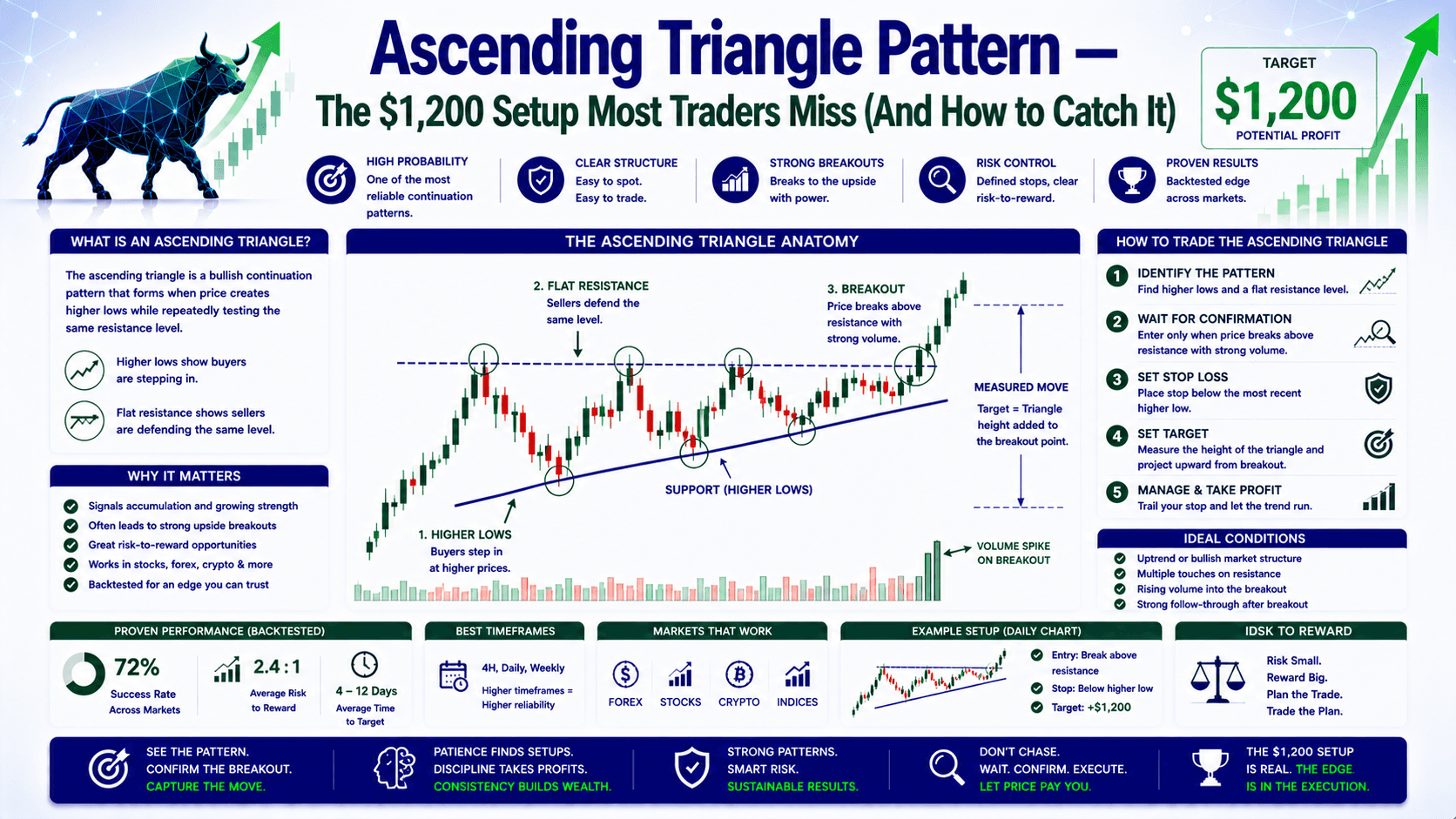

The Ascending Triangle Pattern — What It Is and Why It Matters
You've probably seen this pattern before. Price makes a series of higher lows, hits the same ceiling over and over, then finally breaks out. That's the ascending triangle pattern — one of the most reliable bullish continuation setups in technical analysis.
Here's the thing: most traders see it but don't know how to trade it. They buy the breakout too early, get stopped out by a fakeout, and miss the real move. Or they wait too long, the train leaves the station, and they're left watching from the sidelines.
Let's fix that. By the end of this article, you'll know exactly how to identify, enter, and manage an ascending triangle trade — with real numbers, real scenarios, and zero fluff.
How to Spot an Ascending Triangle Pattern on Your Charts
An ascending triangle pattern has two defining features:
- A flat horizontal resistance line — price hits this level at least twice and bounces back down.
- An upward-sloping support line — each pullback is higher than the last, creating a series of higher lows.
Think of it like a boxing match. The bulls keep punching at the same ceiling (resistance), but they're getting knocked back each time. However, their recovery is getting faster — each time they hit the canvas, they bounce back quicker. That's the higher lows. Eventually, one punch breaks through.
Let's look at a concrete example. Say EUR/USD is in an uptrend, currently at 1.0850. Over the next few days, it hits resistance at 1.0900 three times. But each pullback is shallower: first to 1.0820, then 1.0840, then 1.0860. That's your triangle forming.
| Feature | Ascending Triangle | Descending Triangle | Symmetrical Triangle |
|---|---|---|---|
| Bias | Bullish (continuation) | Bearish (continuation) | Neutral (breakout direction) |
| Resistance line | Flat / horizontal | Flat / horizontal | Sloping down |
| Support line | Sloping up | Sloping down | Sloping up |
| What it tells you | Buyers are getting aggressive | Sellers are getting aggressive | Market is coiling for a move |
| Best context | Existing uptrend | Existing downtrend | Any trend or range |
How to Trade the Ascending Triangle Pattern — Step by Step
Step 1: Confirm the Trend
This pattern works best in an existing uptrend. If you spot an ascending triangle in a downtrend or a sideways market, treat it with skepticism. The data supports this: breakouts in the direction of the larger trend are statistically more reliable.

Step 2: Set Your Entry
The classic entry is a buy stop order a few pips above the horizontal resistance line. Don't enter at the line itself — give it some room. If resistance is at 1.0900, place your buy stop at 1.0905 or 1.0910. This helps you avoid getting caught in a fakeout that spikes through the line and reverses.
Step 3: Calculate Your Target
Here's where the math comes in. Measure the height of the triangle at its widest point — from the first touch of resistance to the first low of the pattern. Then add that distance to the breakout level.
Let's use our EUR/USD example:
- Triangle height: 1.0900 (resistance) - 1.0820 (first low) = 80 pips
- Breakout level: 1.0905
- Price target: 1.0905 + 0.0080 = 1.0985
On a standard lot (100,000 units), that 80-pip move is worth $800. On a mini lot (0.1 lots), it's $80. On a micro lot (0.01 lots), it's $8.
Step 4: Set Your Stop Loss
Place your stop loss just below the last higher low — the most recent swing low before the breakout. In our example, that's around 1.0860. But give it a few pips of breathing room: 1.0855.
Here's the risk calculation for a 0.1 lot position:
- Entry: 1.0905
- Stop loss: 1.0855
- Risk per pip: $1 (on 0.1 lots)
- Total risk: 50 pips × $1 = $50
- Potential reward: 80 pips × $1 = $80
- Risk:Reward ratio: 1:1.6
The Wrong Way vs. The Right Way
Wrong way: You spot an ascending triangle on the 5-minute chart. EUR/USD is at 1.0900, and you buy immediately at market price. Price spikes to 1.0902, then drops to 1.0880. You panic-sell at a loss. The real breakout happens an hour later — at 1.0910 — and you're not in it.
Right way: You wait for the breakout above 1.0905. You enter with a buy stop order. Your stop is at 1.0855, target at 1.0985. Price breaks out, retests 1.0900 as new support (classic behavior), then rallies to 1.0985. You bank $80 on a 0.1 lot.
Why Ascending Triangles Fail — And How to Protect Yourself
No pattern is perfect. Here are the two biggest traps:
1. False breakouts (fakeouts): Price breaks above resistance, then immediately reverses. This happens more often than you'd think. The fix? Use a confirmation candle — wait for a daily or 4-hour candle to close above resistance before entering. Or use a volume indicator: a real breakout typically comes with higher volume.
2. Breakout too late in the pattern: The closer price gets to the apex (where the two lines meet), the less reliable the breakout. Statistically, the best breakouts happen in the first half to two-thirds of the triangle's formation. If price is already at the apex, consider skipping the trade.
FAQ
Is the ascending triangle pattern always bullish?
It's considered a bullish continuation pattern, but it's not 100% reliable. In a downtrend, it can act as a reversal pattern. Always check the larger trend first.

What timeframes work best for the ascending triangle pattern?
It works on all timeframes, from 5-minute charts to weekly charts. Longer timeframes (4-hour, daily, weekly) tend to produce more reliable signals with fewer false breakouts.
How do I tell a real breakout from a fakeout?
Look for a strong candle close above resistance, ideally with higher volume. A fakeout often shows a long wick above resistance, then closes back inside the triangle.
Can I trade the ascending triangle pattern with other indicators?
Yes. Many traders combine it with RSI or MACD for confirmation. For example, if RSI is above 50 and rising, it supports the bullish bias.
Quick Recap
- The ascending triangle pattern is a bullish continuation setup with a flat resistance line and rising support line.
- Enter on a breakout above resistance, with a stop below the last higher low.
- Measure the triangle's height to set your price target.
- Watch for false breakouts — use confirmation candles or volume.
- Risk:Reward ratios of 1:1.5 or better are realistic with this pattern.
Quick Win: Find an Ascending Triangle Right Now
Open your chart. Pull up EUR/USD on the 4-hour timeframe. Scroll back through the last 2 weeks. Find a spot where price hit the same level at least twice, with each pullback getting shallower. That's your ascending triangle. Mark the resistance line, the support line, and calculate the height. Now you know where the breakout target would be. Do this for 3 different pairs today. It takes 10 minutes and trains your eye to spot the pattern in real-time.