
I Still Remember the Trade That Cost Me Everything
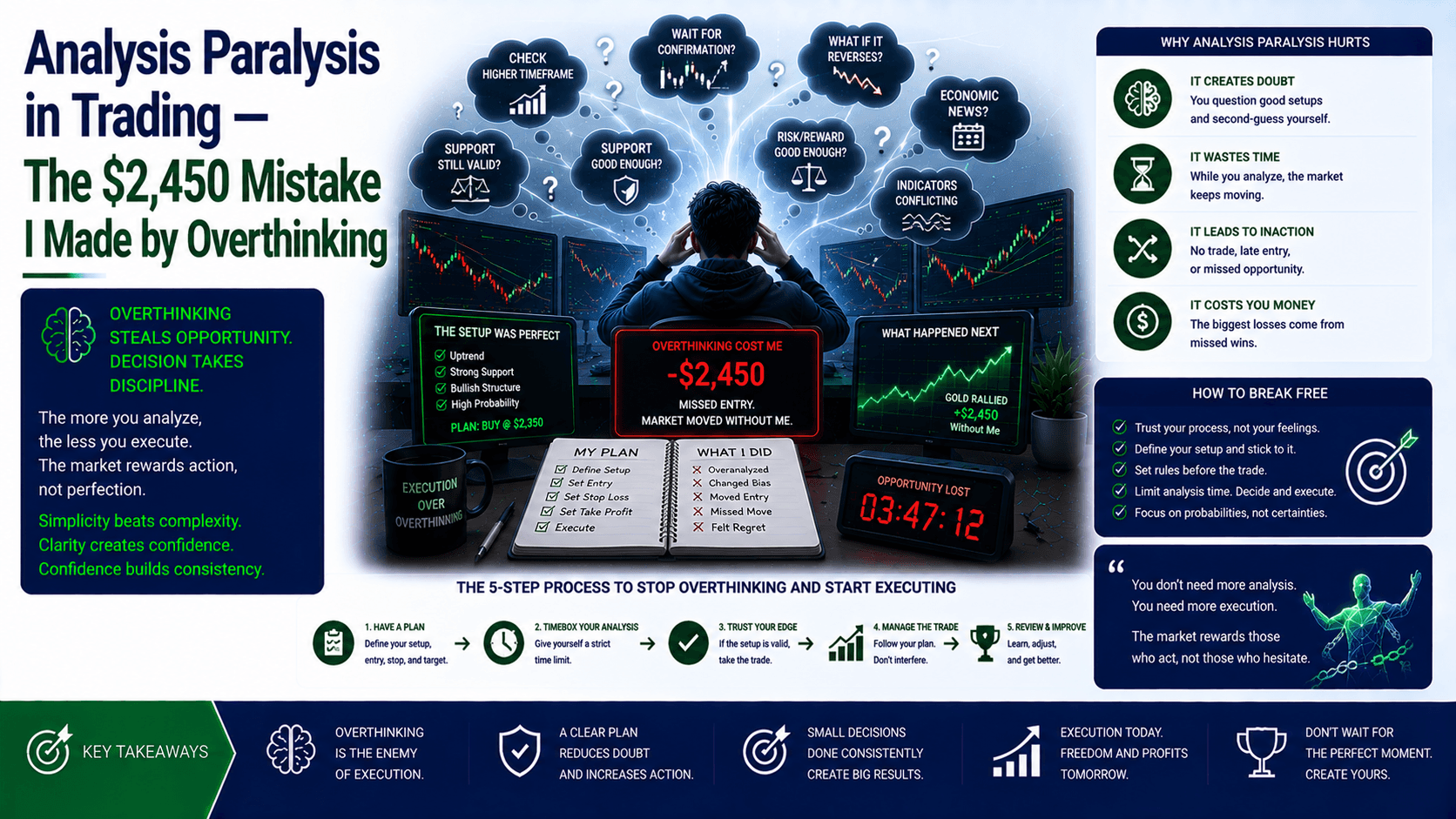
It was a Tuesday morning. Gold was sitting at $2,350. I'd been watching it for three hours. The setup was textbook: a clean rejection candle at a key resistance level, RSI showing bearish divergence, volume confirming the move.
I had everything I needed. But I didn't pull the trigger.
"Let me check the news calendar." Nothing major. "Let me look at the 4-hour chart." Still looked good. "What about the weekly pivot?" Fine. "Maybe I should wait for one more candle."
By the time I decided to take the trade, Gold had dropped 30 pips. I chased it. Got in late. Got stopped out for a loss of $180.
That missed entry? It would've been a $2,450 winner.
That's analysis paralysis in trading. And it's cost me more than any bad trade ever did.
What Is Analysis Paralysis in Trading? (And Why It's More Dangerous Than a Bad Trade)
Analysis paralysis in trading is when you overthink a setup to the point where you never actually take the trade. Or you take it too late. Or you take it with so little confidence that you exit at the first sign of a pullback.
It's the opposite of FOMO trading. But here's the thing nobody tells you:
Analysis paralysis is actually more expensive than impulsive trading.
Why? Because impulsive trades eventually teach you lessons. You lose money, you feel the pain, you adjust. But analysis paralysis? The damage is invisible. You never see the P&L of the trades you didn't take. So you never learn.
Here's what it looks like in practice:
- Endless confirmation seeking: Adding indicator after indicator, hoping for certainty that never comes
- Decision deferral: "I'll wait for a better setup" — that never materializes
- Missed entries: Getting the direction right but never pulling the trigger
- Late entries: Finally getting in after the best entry price is gone
- Strategy hopping: Switching systems every week because nothing feels reliable enough
The Real Reason You Can't Pull the Trigger
I'll be honest with you: analysis paralysis is almost always fear of losing dressed up as caution.

The logic goes: "If I analyze enough, I can avoid bad trades." But that's a dead end. Losing trades are built into every profitable strategy. You can have a 60% win rate and still be profitable. That means 40% of your trades will lose. Period.
The thing nobody tells you is this: analysis paralysis comes from a deeper fear of being wrong. For many traders, the psychological pain of being wrong is greater than the financial pain of missing a good trade. So they avoid the risk of being wrong by simply not deciding.
I used to think I was being "careful." I wasn't. I was being afraid.
The Paradox of Information
Research on decision-making shows a counterintuitive finding: beyond a certain point, more information actually makes decisions worse, not better.
Each additional data point introduces noise that can contradict existing signals. Checking one more indicator, reading one more analyst opinion, or waiting for one more candle often reduces your conviction rather than increasing it.
The traders who execute consistently aren't the ones with the most information. They're the ones who've decided what information is sufficient and ignore the rest.
The Hidden Cost of Analysis Paralysis — Let's Do the Math
Let me show you what this costs in real numbers.
Say you have a strategy with a 60% win rate and a 1:2 risk-to-reward ratio. Over 100 trades, here's what you'd expect:
- 60 winners at +2R each = +120R
- 40 losers at -1R each = -40R
- Net expectancy: +80R
Now let's say analysis paralysis causes you to skip 20% of those trades. And the trades you skip are the ones that look "uncertain" — which often means the ones that would've been winners (because losers usually look obvious in hindsight).
If you skip just 10 winning trades out of those 60, you're losing 20R of potential profit. On a $1,000 account with 1% risk per trade, that's $200 in missed gains.
Over a year? That's thousands of dollars. Money you would've made if you'd just pulled the trigger.
How to Overcome Analysis Paralysis in Trading — 5 Steps That Worked for Me
I've been trading for over a decade. I still fight this. But here's what actually works:
1. Build a Binary Checklist
Define 3-5 clear, objective criteria for your setup. If all of them are met, you take the trade. No room for subjective "feel."
Here's my personal checklist for Gold:
- Price at a key support or resistance level
- Clear rejection candle (wick at least 2x the body)
- RSI between 30-70 (not overbought or oversold)
- No major news event within 30 minutes
All four met? I take the trade. Missing one? I pass. No deliberation. No second-guessing.
2. Set a Time Limit
Give yourself a hard limit on analysis time. I use 3 minutes. When the timer goes off, I decide: take the trade or move on. No more analysis after the timer.
This forces you to work with the information you have — which is always enough if your criteria are solid.
3. Track Your Missed Trades
This one is huge. Log every setup you spotted but didn't trade, including why you passed. Track what actually happened.
I started doing this and discovered something shocking: I was skipping trades that would've been winners 65% of the time. My "caution" was costing me money.
After tracking for a month, calculate your "hesitation cost." That number represents the opportunity cost of your analysis paralysis in hard dollars. For many traders, it's larger than their actual trading losses.
4. Separate Analysis from Execution
Do your homework before the market opens. Build your watchlist. Identify key levels. Then during market hours, your only job is execution: did the setup hit your criteria? Yes or no.
This separation works because analysis is a calm, deliberate activity while execution requires speed and decisiveness. Mixing them in real-time is where paralysis starts.
5. Start Small
If the fear of being wrong is too intense at your normal position size, trade smaller until execution feels comfortable. A 0.01 lot trade you actually take is worth more to your development than a 0.5 lot trade you imagine taking.
Scale up gradually as your execution confidence grows.
Comparison: Analysis Paralysis vs. Impulsive Trading
| Factor | Analysis Paralysis | Impulsive Trading |
|---|---|---|
| Root cause | Fear of being wrong | Fear of missing out |
| Cost | Missed opportunities (invisible) | Immediate losses (visible) |
| Learning curve | Hard to learn from — damage is hidden | Easy to learn from — pain is immediate |
| Typical result | Good analysis, no execution | Bad analysis, poor execution |
| Fix | Binary checklist + time limits | Pause + review criteria |
FAQ
How do I know if I have analysis paralysis in trading?
Common signs: you're often right about direction but never in the trade, you keep adding indicators looking for certainty, you watch setups play out without being in them, and you consistently get into moves late even though you spotted them early.

What causes analysis paralysis in trading?
The root cause is usually fear of being wrong disguised as caution. Other factors include information overload, perfectionism, and overcorrection from past trading mistakes.
How can I track the cost of analysis paralysis?
Start logging every setup you see but don't trade, along with why you passed and what actually happened. Most traders who track this are surprised at how many profitable opportunities they're letting go.
Can analysis paralysis be cured?
It's not cured — it's managed. Even experienced traders fight this. The key is building systems (checklists, time limits, pre-market prep) that make execution automatic regardless of how you feel.
📝 Quick Recap
- Analysis paralysis is overthinking to the point of inaction — and it's more expensive than bad trades
- The root cause is fear of being wrong, not careful analysis
- Track your missed trades to see the real cost in dollars
- Build a binary checklist with 3-5 criteria — if all met, take the trade
- Set time limits and separate analysis from execution
Your Quick Win Today
Open your trading journal right now. Look at the last 10 trades you took. For each one, note how long you spent analyzing before entering. If any took more than 5 minutes, that's analysis paralysis in action.
Now look at the last 5 setups you spotted but didn't trade. What happened to them? If they would've been winners, that's your hesitation cost. Write it down. Let that number motivate you to pull the trigger next time.