The One Habit That Separates Profitable Traders from Everyone Else
Ask any consistently profitable trader what their #1 tool is. It's not an indicator. It's not a course. It's not a signal group. It's a trading journal. Every single one of them keeps a detailed record of their trades — not because they enjoy paperwork, but because the data doesn't lie.
Your memory lies. Your ego lies. Your feelings lie. But your journal? It shows you exactly where you're making money, where you're losing it, and WHY.
What Is a Trading Journal?
A trading journal is a systematic record of every trade you take — including the data, the reasoning, and the emotion behind each decision. It's your personal performance database.
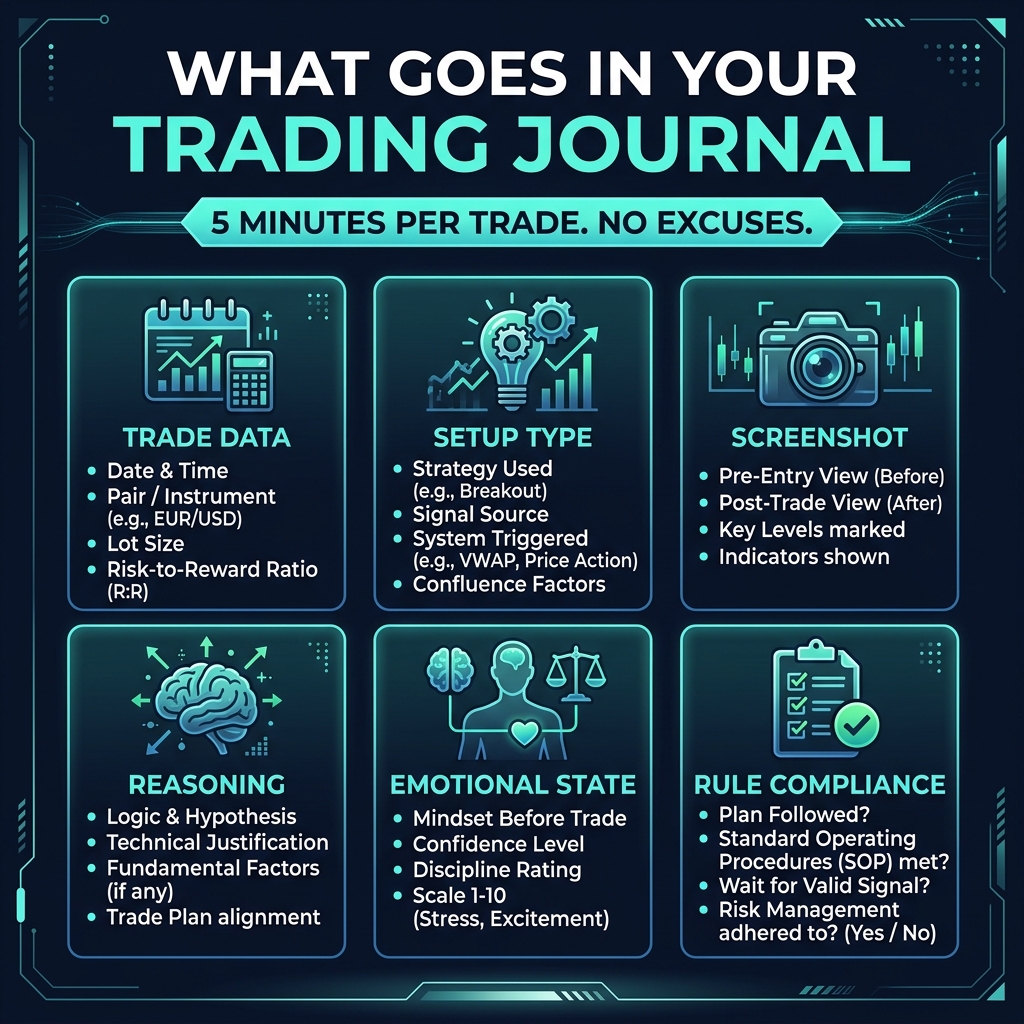
What Goes in Your Journal
| Category | Data Points | Why It Matters |
|---|---|---|
| Trade Data | Date, pair, direction, entry, SL, TP, result, R:R | The raw performance numbers |
| Setup Type | Which system setup triggered the trade | Reveals which setups are most profitable |
| Screenshot | Chart at time of entry with annotations | Visual record prevents false memories |
| Reasoning | Why you took (or didn't take) the trade | Shows if you're following rules or improvising |
| Emotional State | How you felt before, during, and after | Identifies emotional patterns that lead to mistakes |
| Rule Compliance | Did you follow every rule? If not, which one broken? | The most important column — tracks discipline |
Why Most Traders Resist Journaling (And Why They're Wrong)
| Excuse | Reality |
|---|---|
| "It takes too long" | 5 minutes per trade. That's less time than the trade itself lasted. |
| "I remember my trades" | No you don't. After 2 weeks, you'll remember winners and forget losers. |
| "I know what I did wrong" | You think you know. The journal shows you what you ACTUALLY did wrong — often different. |
| "Journaling is boring" | Losing money is more boring. Profitable traders find journaling fascinating because it reveals patterns. |
| "My strategy works — I don't need one" | IF it works, the journal will prove it. If it doesn't, the journal will save you. |
What Your Journal Reveals — Real Patterns
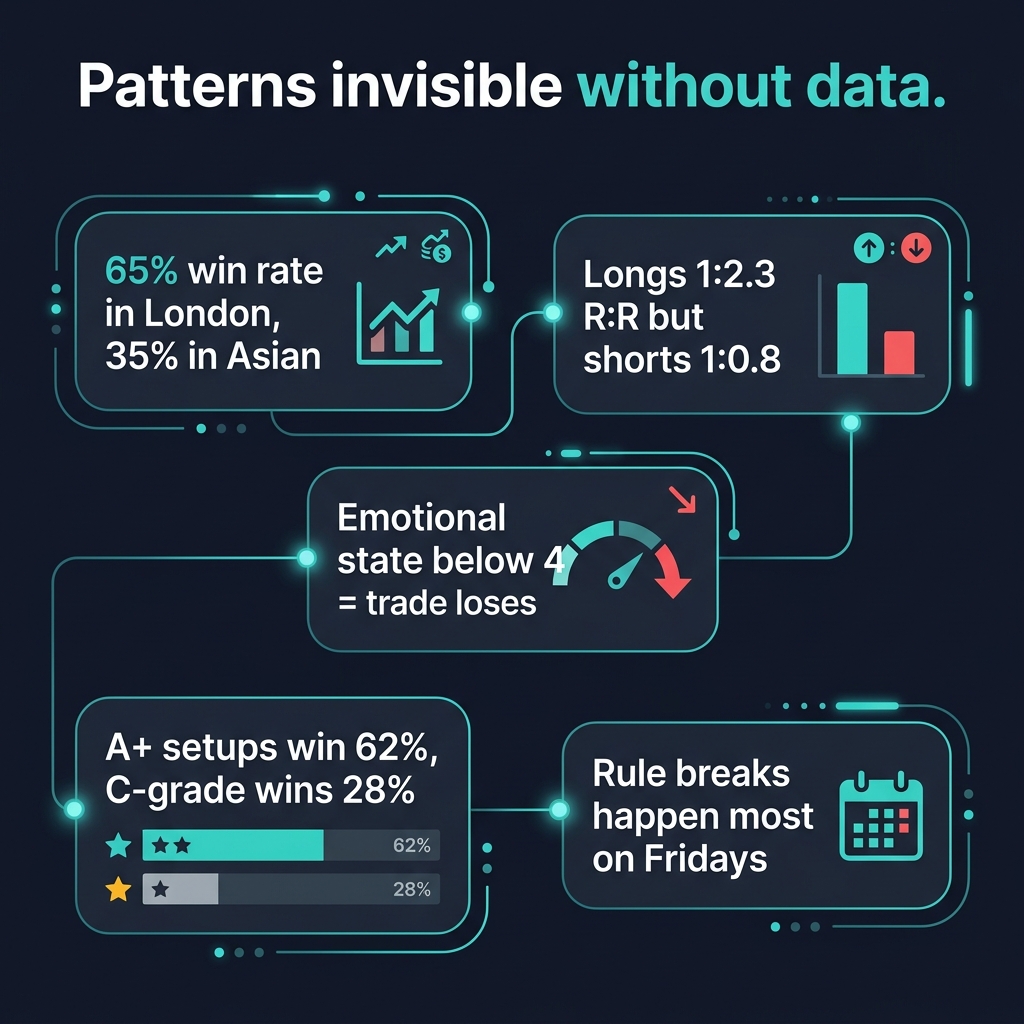
After 50-100 trades, your journal will reveal insights you NEVER would have found without it:
- "I win 65% of my London session trades but only 35% of Asian session trades." → Stop trading Asian session.
- "My long trades have a 1:2.3 R:R but my shorts are only 1:0.8." → Go long-only until you fix your short entries.
- "Every time I rate my emotional state below 4/10, the trade loses." → Don't trade when you're stressed.
- "My 'A+ setup' wins 62% of the time. My 'C-grade' setups win 28%." → Only take A+ setups.
- "I break my rules on Fridays more than any other day." → Stop trading Fridays, or reduce size.
These patterns are invisible without data. Your brain can't track 100 variables across 100 trades. Your journal can.
Choosing Your Journal Format
| Format | Pros | Cons | Best For |
|---|---|---|---|
| Spreadsheet (Excel/Sheets) | Free, customizable, can calculate metrics | Requires discipline to update | Most traders — especially starting out |
| Dedicated app (Edgewonk, TradeZella) | Auto-imports trades, analytics built-in | Costs money ($20-50/month) | Serious traders who want automation |
| Notion/Obsidian | Flexible, supports screenshots and notes | Setup time, no auto-metrics | Traders who love organization |
| Physical notebook | Forces reflection, no distractions | Hard to analyze data, no search | Supplementary — not primary journal |
Recommendation: Start with a spreadsheet. It's free, it works, and you can always upgrade later. The best journal is the one you actually use.
Quick Recap
- A trading journal is a systematic record of every trade — data, reasoning, emotions, and rule compliance
- It takes 5 minutes per trade — no excuses
- After 50-100 trades, it reveals patterns you can't see any other way
- The most important column is rule compliance — did you follow your system?
- Start with a spreadsheet — it's free and effective
- The journal is not optional — it's the #1 tool of profitable traders
🎯 Your Action Step
Create your trading journal right now. Open Google Sheets or Excel. Create columns for: Date, Pair, Direction, Entry, SL, TP, Result, R:R, Setup Type, Emotional State (1-10), Rule Compliance (Yes/No), and Notes. Log your next 10 trades in this format. After 10 trades, look at the data — can you spot any patterns? You'll be surprised how quickly the data starts talking to you.