There's No "Best" Approach — Only the One That Fits YOU
You've now seen all three lenses: Technical, Fundamental, and Sentiment. The question everyone asks next is: "Which one should I use?"
The honest answer? All of them — but in different proportions depending on your trading style, personality, and time commitment.
This lesson helps you discover which mix works best for you.
The Three Lenses at a Glance
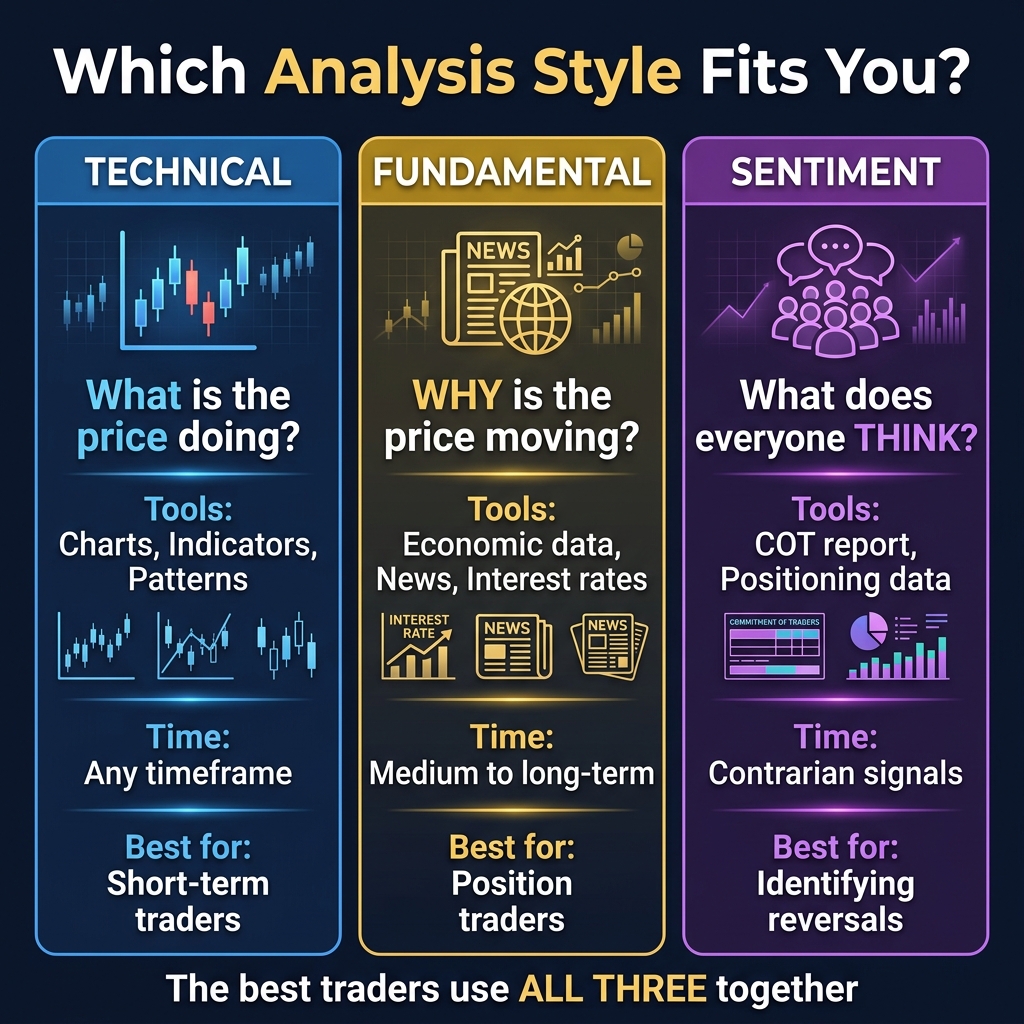
| Analysis Type | Core Question | Time Required | Best For |
|---|---|---|---|
| Technical | "What is price doing?" | Low — charts only | Scalpers, day traders |
| Fundamental | "Why is price moving?" | Medium — research needed | Swing & position traders |
| Sentiment | "What does the crowd think?" | Low — check positioning data | Contrarian traders |
Match Your Style to Your Life
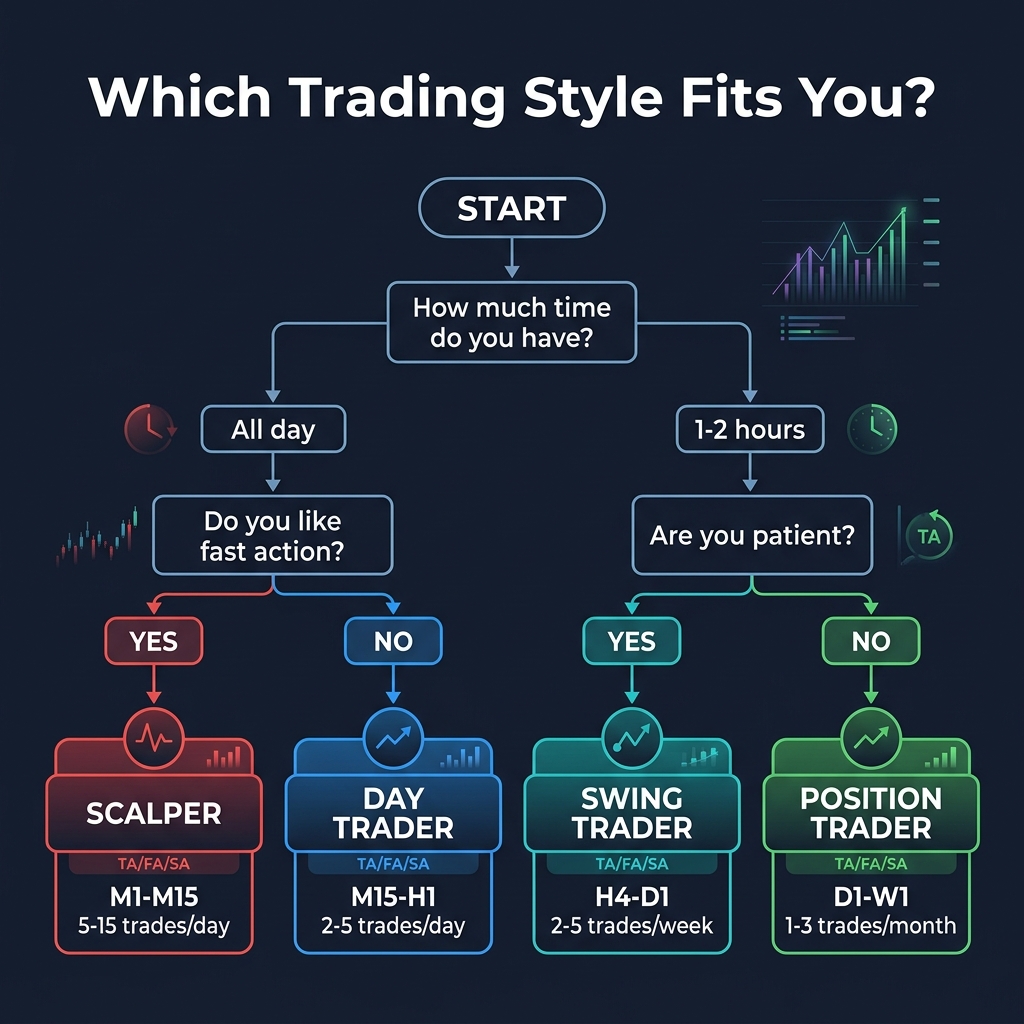
The "I Have 30 Minutes a Day" Trader
Best mix: 70% Technical + 20% Fundamental + 10% Sentiment
Check the daily chart, mark key levels, check the economic calendar for today's events. Set your trades and walk away. This is swing trading or position trading.
The "I'm Watching Charts All Day" Trader
Best mix: 90% Technical + 5% Fundamental + 5% Sentiment
You're a day trader or scalper. Charts are your world. Just know when major news events are coming so you don't get blindsided.
The "I Love Understanding the Big Picture" Trader
Best mix: 40% Technical + 50% Fundamental + 10% Sentiment
You enjoy reading about central bank decisions, economic data, and macroeconomic trends. Use TA to time your entries and exits within the fundamental direction.
The "I Want to Fade the Crowd" Trader
Best mix: 50% Technical + 20% Fundamental + 30% Sentiment
You're a contrarian. You check positioning data, wait for extremes, and use TA to find precise entry points against the crowd.
Self-Assessment: 5 Questions to Find Your Style
- How much time can you dedicate daily? Less than 1 hour → lean fundamental/swing. Multiple hours → lean technical/day trading.
- Do you prefer rules or judgment? Rules → technical. Judgment → fundamental.
- Are you patient? Very patient → position trading (FA-heavy). Impatient → scalping (TA-heavy).
- Do you handle stress well? No → longer timeframes (less stress). Yes → shorter timeframes (more action).
- Are you a contrarian by nature? Yes → add sentiment analysis to your toolkit.
The Professional's Secret: Convergence
The highest-probability trades happen when all three lenses align:
🎯 Example: EUR/USD is at a major support level (TA), the ECB just signaled rate hikes (FA bullish), and 80% of retail traders are short (SA contrarian bullish). When all three say "buy" → that's a high-conviction trade.
You don't always get all three. But when you do, increase your confidence (not your position size — that's still governed by risk management).
Quick Recap
- ✅ There's no single "best" analysis method — use the mix that fits your lifestyle
- ✅ Scalpers → mostly TA. Swing traders → TA + FA. Position traders → mostly FA.
- ✅ Convergence of all three lenses = highest-probability trades
- ✅ Be honest about your time, patience, and personality
- ✅ Start with one approach and gradually add layers
🎯 Your Action Step
Answer the 5 self-assessment questions above honestly. Write down your answers. Based on your profile, which trading style sounds most natural? Scalper, day trader, swing trader, or position trader? You'll need this answer for the rest of your trading journey.
Next module: → Your First Charts — Chart Types, Timeframes, and Reading Candlesticks