The Fast Lane of Trading
While swing traders wait days for a single trade to play out, scalpers open and close positions in minutes — sometimes seconds. They don't care about the big picture or long-term trends. They care about one thing: capturing small, consistent profits from tiny price movements, over and over again.
Scalping is the most intense, demanding, and fast-paced style of trading. It's not for everyone — but for those built for speed, it offers the fastest feedback loop and the most trading opportunities of any style.
How Scalping Works
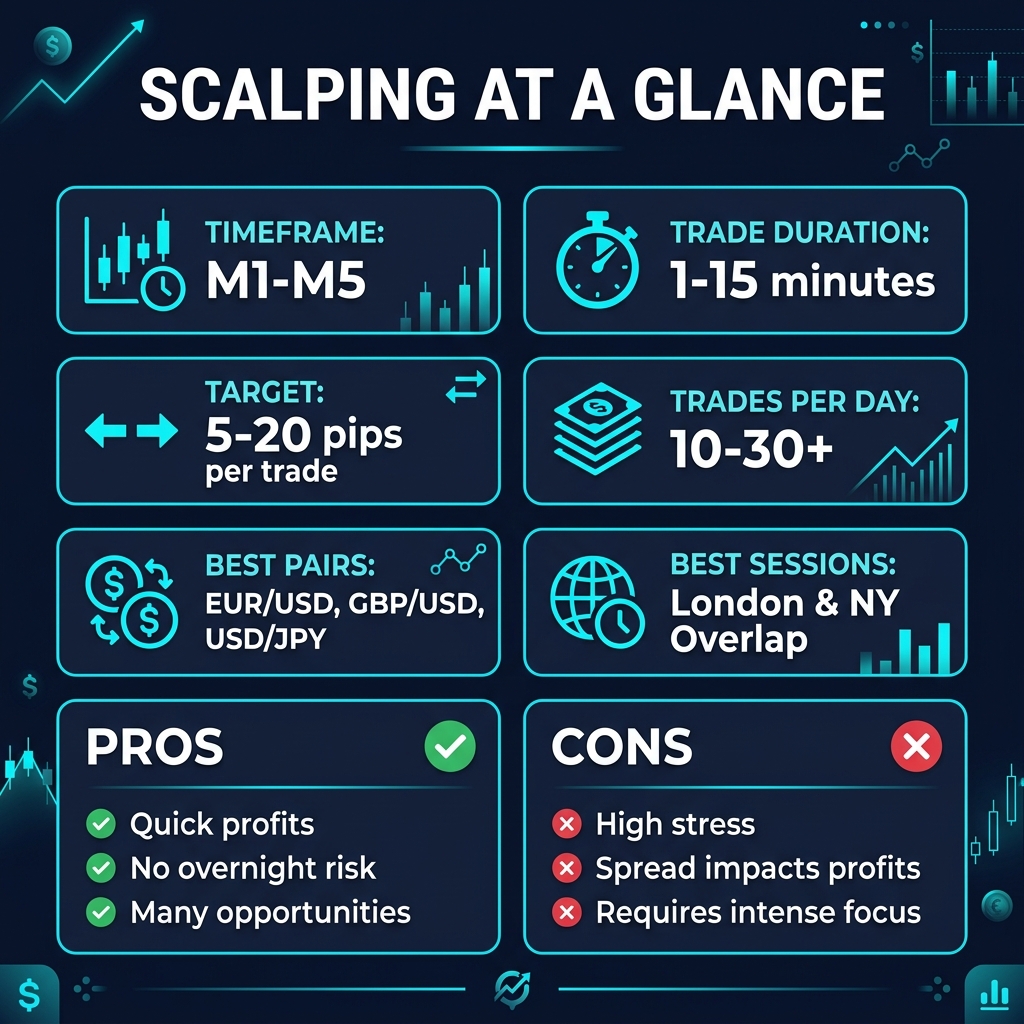
Scalpers trade on the M1 to M5 timeframes, holding positions for 1 to 15 minutes. The goal isn't a 100-pip winner — it's capturing 5 to 20 pips per trade, repeatedly.
Here's the math that makes scalping work:
| Metric | Swing Trader | Scalper |
|---|---|---|
| Trades per day | 0-1 | 10-30+ |
| Pips per trade | 80-200 | 5-20 |
| Hold time | Days to weeks | 1-15 minutes |
| Daily pip potential | 0-200 | 50-200+ |
| Screen time | 20-30 min/day | 2-4 hours focused |
| Overnight risk | Yes | None |
A scalper making just 8 pips per trade at 15 trades per day = 120 pips/day. At 0.5 lots, that's $600/day. The numbers add up fast — if your win rate stays above 60%.
What You Need to Scalp Successfully
1. The Right Broker
Scalping lives and dies by spreads and execution speed. A 2-pip spread on a 5-pip target means you're giving up 40% of your profit to the broker. You need:
- Ultra-tight spreads: 0.0-0.5 pips on EUR/USD (ECN/Raw account)
- Fast execution: Under 50ms — no requotes
- No restrictions: Some brokers ban scalping — check their terms
2. The Right Pairs
Scalp only highly liquid pairs with tight spreads:
- EUR/USD — tightest spreads, most liquid
- GBP/USD — volatile enough for good moves
- USD/JPY — clean price action, tight spreads
- EUR/GBP — slower, good for beginners
3. The Right Session
Scalping in the Asian session is like fishing in an empty pond. You need volatility:
- London open (8:00-10:00 GMT): Fresh momentum, clear moves
- London/NY overlap (13:00-16:00 GMT): Maximum volatility, most opportunities
- Avoid: Asian session (too quiet) and last hour of NY (spreads widen)
4. The Right Mindset
Scalping requires machine-like discipline. You'll take 15+ trades per session. One emotional mistake (moving a stop, revenge trading, doubling down) can wipe out your entire day of gains. If you can't handle rapid-fire decisions without emotions, scalping will destroy your account faster than any other style.
A Simple Scalping Setup
Here's a basic scalping strategy to get started (we'll cover advanced setups in the next lesson):
The EMA Crossover Scalp
- Chart: M5 on EUR/USD during London session
- Indicators: 9 EMA and 21 EMA
- H1 trend filter: Only take trades in the direction of the H1 trend
- Buy signal: 9 EMA crosses above 21 EMA + H1 is bullish
- Sell signal: 9 EMA crosses below 21 EMA + H1 is bearish
- Entry: On the close of the crossover candle
- Stop loss: 8-10 pips (or below the recent swing)
- Target: 10-15 pips or next S/R micro-level
Quick Recap
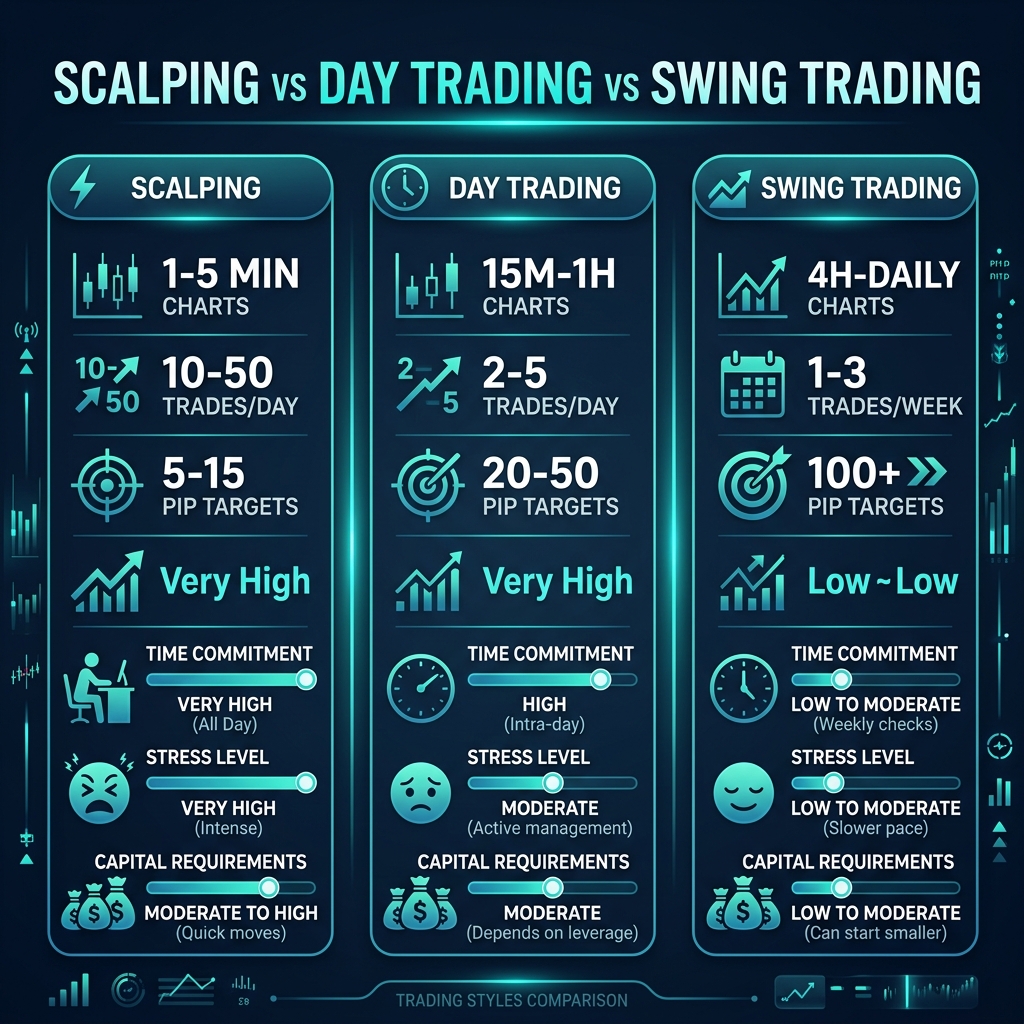
- Scalping captures 5-20 pips per trade on M1-M5 timeframes
- Requires tight spreads, fast execution, and liquid pairs
- Best during London and London/NY overlap
- High profit potential but demands intense focus and discipline
- Not suitable for part-time traders or those who can't handle rapid decisions
🎯 Your Action Step
Open EUR/USD on M5 during the next London session. Add the 9 EMA and 21 EMA. Watch for crossovers — just observe, don't trade yet. Count how many crossover signals appear in 2 hours. How many would have been winners (price moved 10+ pips in your direction)? How many would have been losers? This observation exercise shows you the reality of scalping frequency.