Your System Is Your First Employee — Make Sure It Works Harder Than You Do
Here's the difference between a gambler and a trader: a system. A gambler walks into the market with a feeling. A trader walks in with a rulebook. The system removes you — your ego, your fear, your greed — from the equation. It doesn't care if you slept badly, if you're on a losing streak, or if your favorite YouTuber said "BUY NOW."
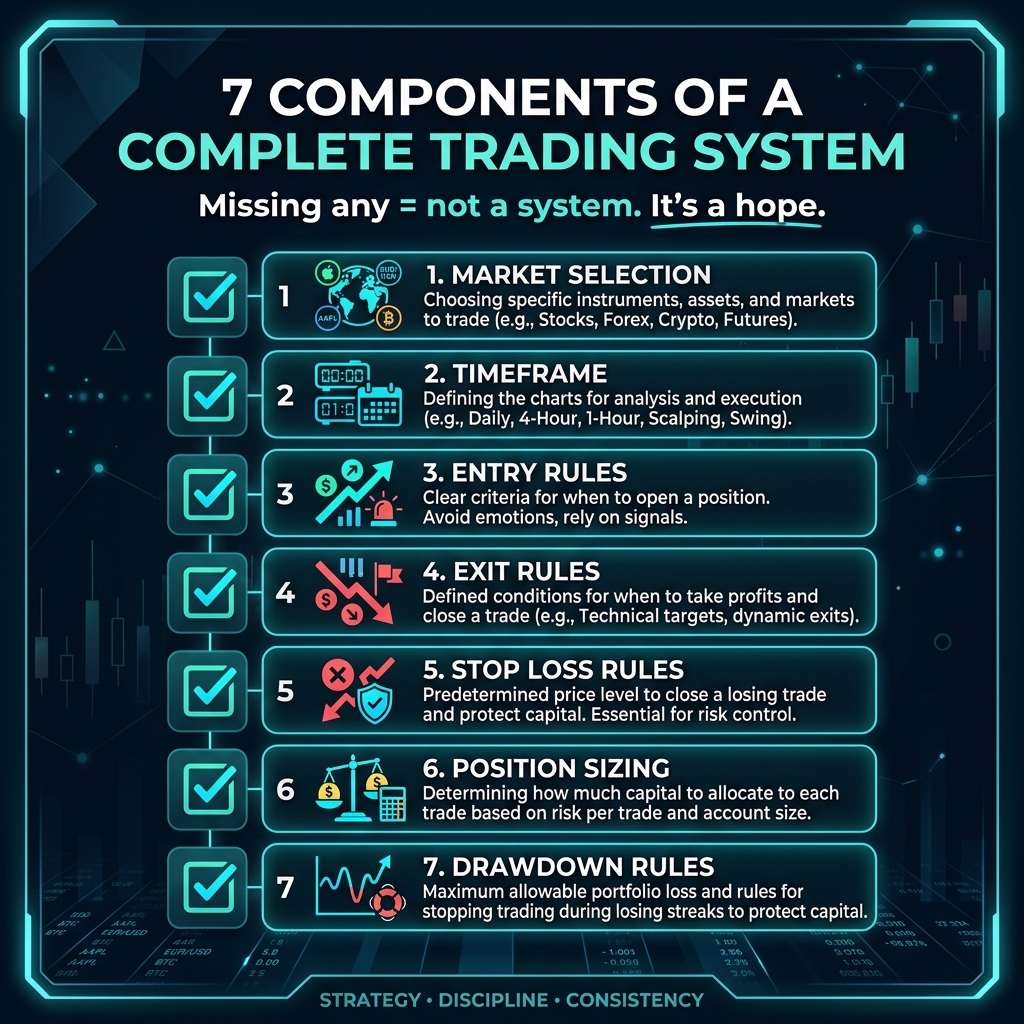
This lesson defines exactly what a trading system is, why you need one, and the non-negotiable components every system must have.
What Is a Trading System?
A trading system is a complete set of rules that tells you:
- When to enter a trade (and when NOT to)
- Where to place your stop loss
- Where to take profit
- How much to risk per trade
- What to do when things go wrong
A system is not one indicator. It's not a strategy you saw on TikTok. It's a complete framework that covers every decision you'll face in a trade — from entry to exit, from position sizing to drawdown management.
System vs Strategy — What's the Difference?
| Component | Strategy | System |
|---|---|---|
| Scope | Just entry + exit logic | Entry + exit + risk + psychology + rules for everything |
| Example | "Buy when RSI crosses above 30" | When, where, how much, what if, and when to stop |
| Decision-making | Still requires judgment | Minimizes judgment — rules handle most decisions |
| Consistency | Varies with mood | Same execution regardless of emotions |
Why You Need a System (Not Just Skills)
You might be the best chart reader in the world, but without a system you'll still lose money. Here's why:
- Emotions destroy consistency: After 3 losses, you'll widen your stop. After a big win, you'll over-leverage. A system removes these decisions from your emotional brain.
- You can't improve what you can't measure: Without fixed rules, you can't tell if your STRATEGY is broken or if YOU are broken. A system lets you separate the two.
- Scalability: A system can run 100 trades with the same execution quality. Your emotions can't.
- Longevity: Traders who last 10+ years ALL have systems. Those who rely on "feel" burn out in months.
The 7 Non-Negotiable Components of a Trading System
| # | Component | What It Defines | Example |
|---|---|---|---|
| 1 | Market Selection | Which pairs/instruments you trade | EUR/USD, GBP/USD, and XAU/USD only |
| 2 | Timeframe | Which charts you analyze and trade from | H4 for analysis, H1 for entry |
| 3 | Entry Rules | Exact conditions required to enter a trade | Price at S/R + RSI divergence + bullish engulfing |
| 4 | Exit Rules | When and how you exit (TP, trailing, manual) | TP1 at 1:1 R:R, TP2 at 1:2, trail remainder |
| 5 | Stop Loss Rules | Where your stop goes — always | Below the swing low + 5 pips buffer |
| 6 | Position Sizing | How much you risk per trade | 1% of account per trade, max 3 positions |
| 7 | Drawdown Rules | What happens when you're losing | After 3% weekly drawdown, cut size to 0.5% and review |
If your system is missing any of these 7, it's not a system — it's a hope.
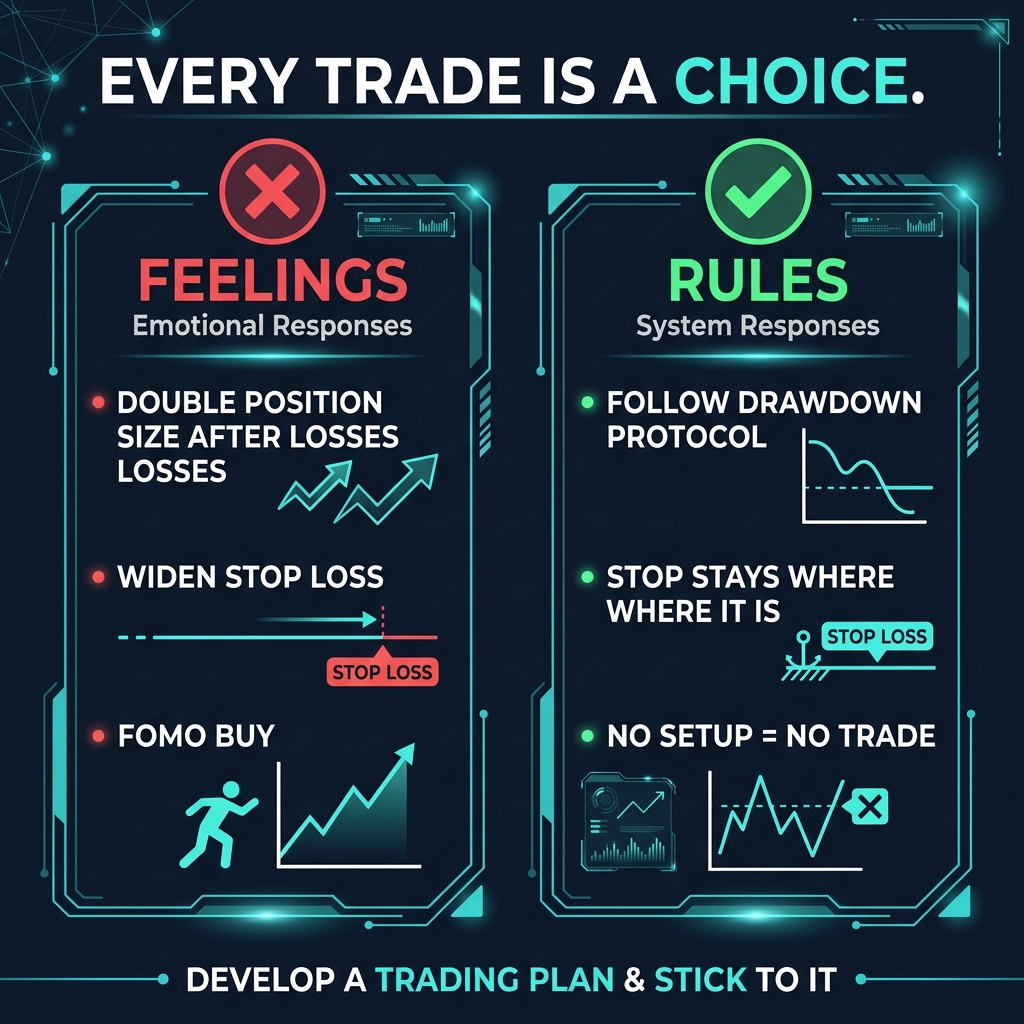
Rules vs Feelings — The Decision Framework
Every trade presents you with a choice: follow your rules or follow your gut. Here's how professional traders handle this:
| Situation | Emotional Response | System Response |
|---|---|---|
| 3 losses in a row | "I need to make it back — double position size" | "My drawdown rule says cut to 0.5%. Follow the rule." |
| Price is 5 pips from your stop | "I'll widen my stop — it'll come back" | "Stop stays where it is. If it hits, I take the loss." |
| Everyone on Twitter says buy | "FOMO — I should jump in" | "Does this meet my entry criteria? No? Then no trade." |
| Trade is +50 pips in profit | "Let it run forever — I'm a genius!" | "TP1 hit. Close 50%, trail the rest. Done." |
| New indicator looks amazing | "I should add it to every chart" | "Backtest it first. If it improves results, add it." |
Quick Recap
- A trading system is a complete rulebook — not just an entry signal
- It covers 7 components: market, timeframe, entry, exit, stop, sizing, and drawdown
- Systems exist to remove emotion from decision-making
- You can't improve what you can't measure — systems make improvement possible
- Every decision has two paths: rules or feelings — professionals always choose rules
- A good system doesn't need to be complex — it needs to be complete and consistent
🎯 Your Action Step
Open a blank document and write down your current trading rules for all 7 components. If you can't fill in a component, put "MISSING" next to it. Be brutally honest. Most traders will find 3-4 gaps. Those gaps are where your money is leaking. This lesson series will help you fill every one of them.