The Tool That Protects Your Profits Automatically
Imagine this: you're in a trade that's up 50 pips. You want to lock in some profit, but you also think price could go even higher. What do you do? Close and miss the next 100 pips? Hold and risk giving back all 50?
A trailing stop solves this dilemma. It's a dynamic stop loss that moves with your trade as it goes in your favor — automatically locking in more and more profit — but never moves against you.
It's like a safety net that gets higher and higher as you climb.
How a Trailing Stop Works
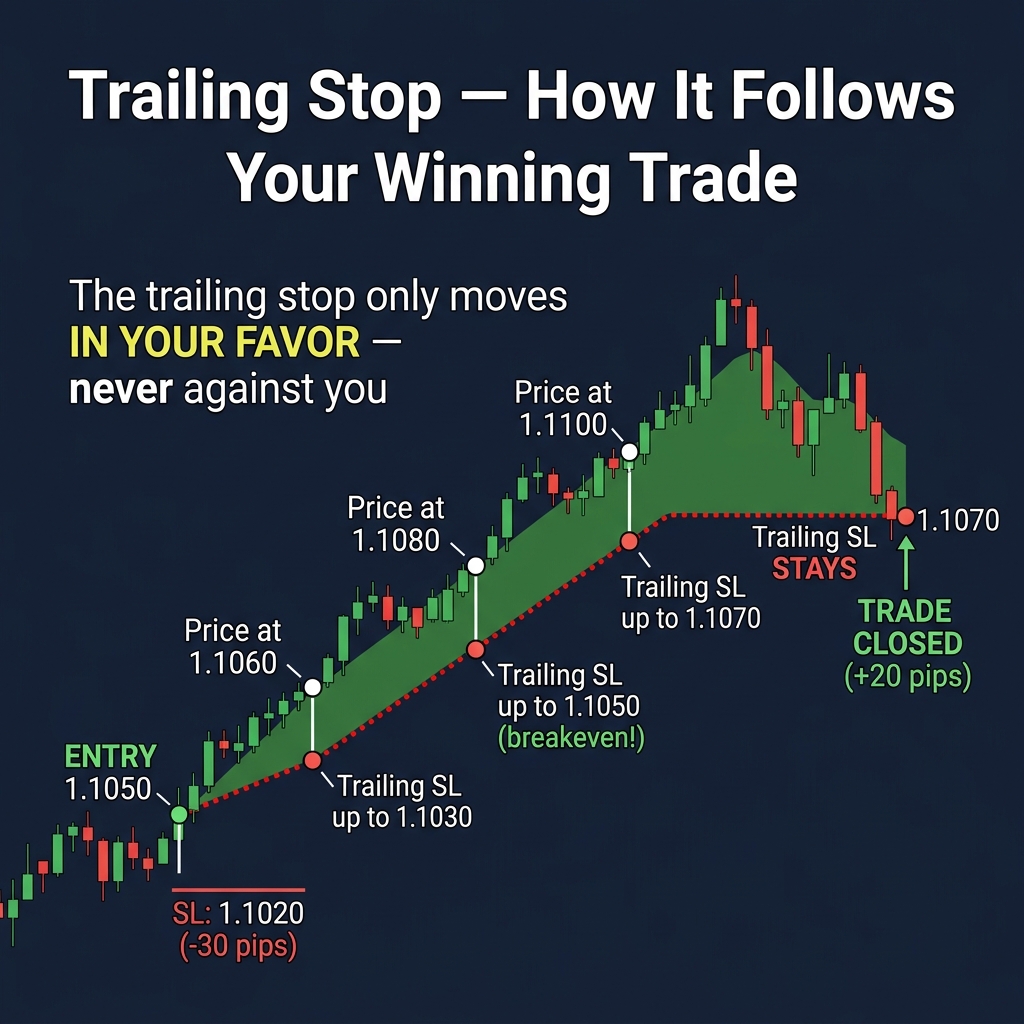
Here's a real example of a 20-pip trailing stop on a buy trade:
| Price Moves To | Trailing SL At | Locked Profit |
|---|---|---|
| Entry: 1.1050 | 1.1030 (-20 pips) | None yet |
| 1.1060 (+10) | 1.1040 | Risk reduced |
| 1.1080 (+30) | 1.1060 (+10 locked!) | +10 pips guaranteed |
| 1.1100 (+50) | 1.1080 (+30 locked!) | +30 pips guaranteed |
| Price reverses ↓ | 1.1080 (stays put!) | SL doesn't move back |
| Price hits 1.1080 | CLOSED | +30 pips profit |
The key rule: a trailing stop only moves in your favor. When price goes up on a buy trade, the trailing stop follows. When price reverses, the stop stays where it is — protecting your profit.
3 Types of Trailing Stops
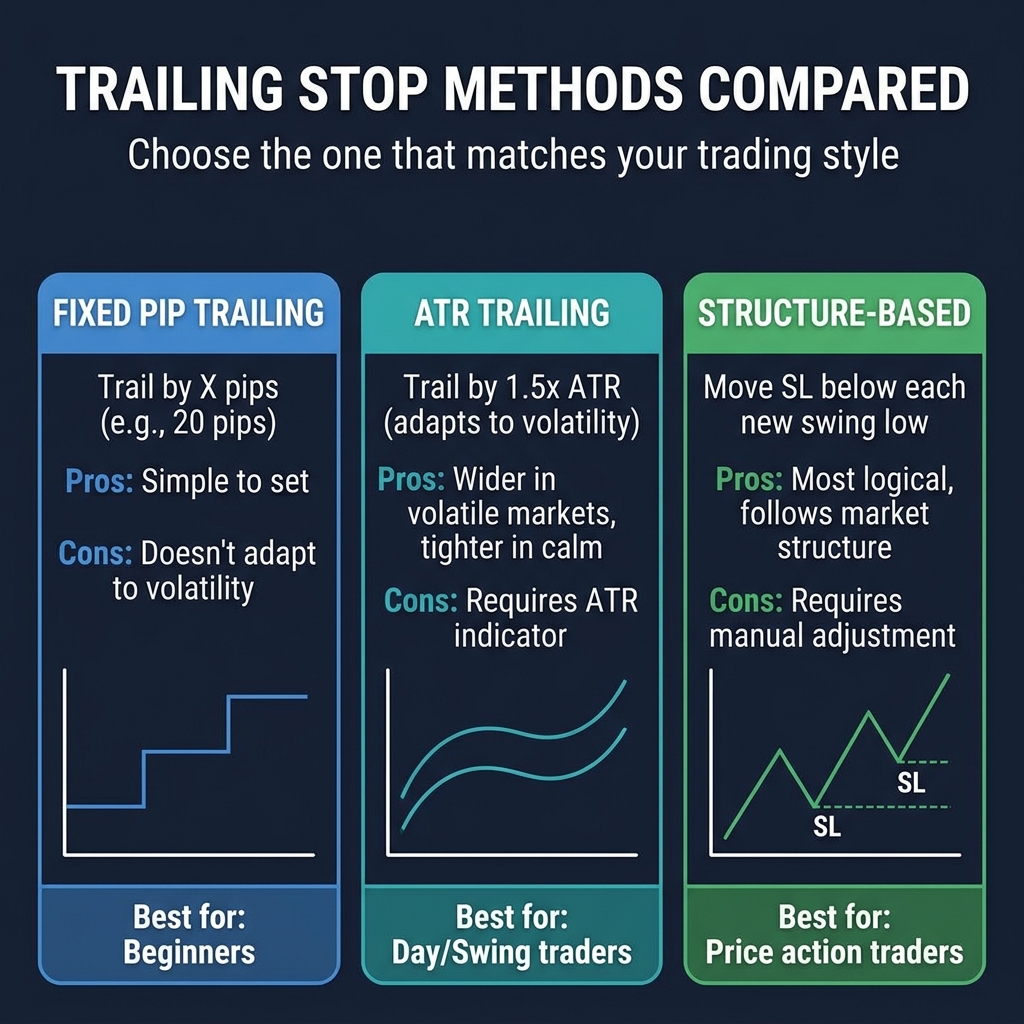
1. Fixed Pip Trailing Stop
Set your trailing distance (e.g., 20 pips) and the platform does the rest automatically. Every time price moves 20 pips in your favor, the stop follows by 20 pips.
Pros: Set it and forget it. Most platforms support this natively.
Cons: Doesn't adapt to volatility. A 20-pip trail in a volatile market gets triggered by noise.
2. ATR Trailing Stop
Use the ATR (Average True Range) to set your trailing distance. Example: trail at 1.5× ATR. In a calm market (ATR = 10 pips), your trail is 15 pips. In a volatile market (ATR = 30 pips), your trail widens to 45 pips.
Pros: Automatically adapts to market conditions.
Cons: Requires ATR indicator and manual calculation (unless using an EA).
3. Structure-Based Trailing
Manually move your stop loss below each new swing low (for buy trades) or above each new swing high (for sell trades). This follows the market's natural structure.
Pros: Most logical — based on actual price action.
Cons: Requires active monitoring and manual adjustment.
When to Use (and NOT Use) a Trailing Stop
| Use Trailing Stop When | Don't Use When |
|---|---|
| Strong trending market | Choppy, sideways/ranging market |
| You want to let winners run | You have a specific fixed target |
| You can't watch charts constantly | Price is near a major reversal zone |
| Swing trading (H4/D1) | Very short-term scalping |
⚠️ Warning: Trailing stops perform poorly in choppy, ranging markets. Price bounces up and down, triggering your trail prematurely. Only use trailing stops in trending conditions.
Quick Recap
- ✅ A trailing stop moves with your profit but never moves against you
- ✅ Three types: fixed pip, ATR-based, structure-based
- ✅ Best in trending markets — poor in choppy/ranging conditions
- ✅ Combines the best of both worlds: protecting profits + letting winners run
- ✅ Start with fixed pip trailing on your platform, then graduate to ATR or structure
🎯 Your Action Step
On your next demo trade, set up a 20-pip trailing stop. Watch how it follows price as the trade moves in your favor. Notice how it protects your profit when price eventually reverses. This hands-on experience is worth more than any theory.
Next module: → Risk-Reward Ratio & Trade Math