The Invisible Battle in Your Head
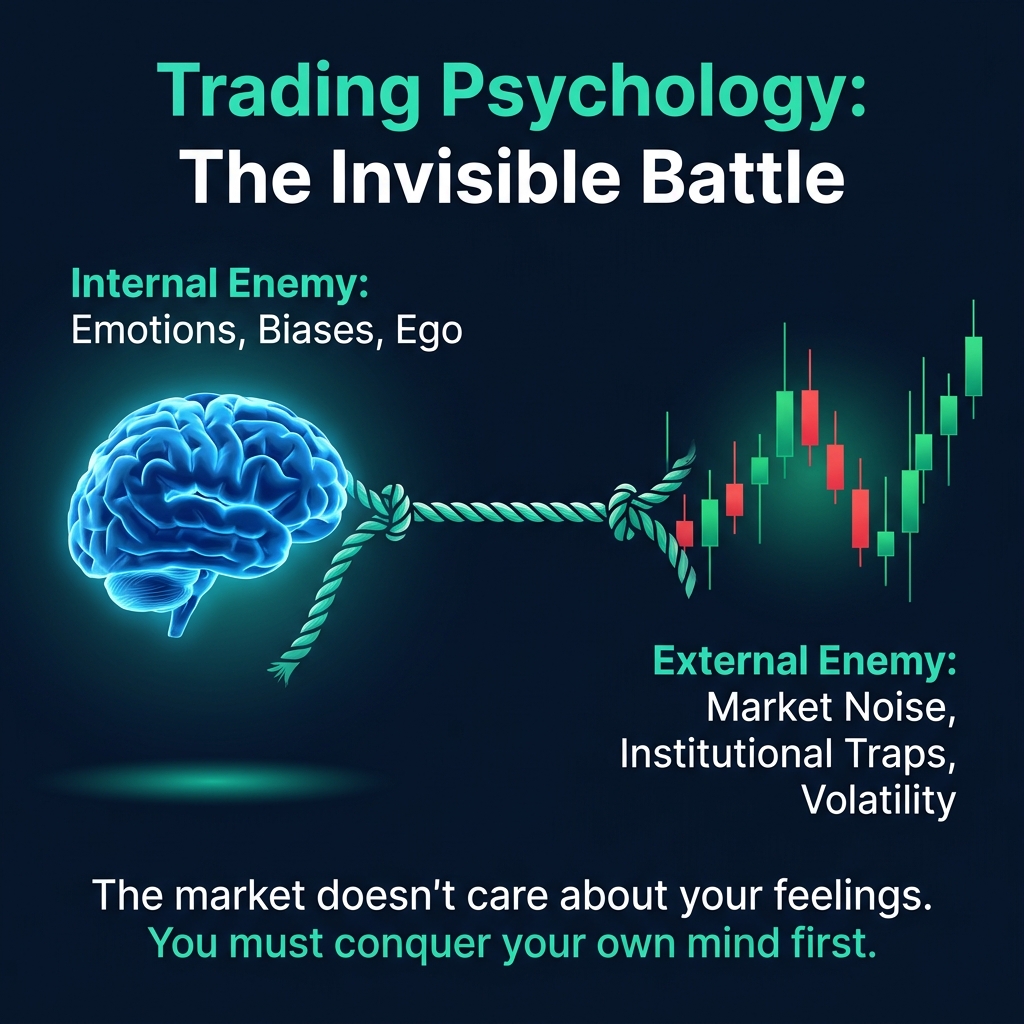
This lesson isn't about chart patterns or indicators. It's about the invisible battle happening inside your head every single time you click that buy button — and how to finally win it.
The market isn't your real opponent — you are. Every trade is a battle between disciplined logic and emotional chaos, and only one can win.
A Familiar Scenario
You take a trade based on your setup. It's perfect — textbook entry, proper stop-loss, great risk-reward ratio. The trade moves in your favor immediately. You're up $200, then $300, then $400.
Your target is $500, and price is almost there. But then it starts pulling back. Now you're up $350. Then $300. That little voice in your head starts whispering: "Take the profit. Lock it in. What if it reverses and you lose it all?"
You exit at $280. Satisfied. Relieved.
Then you watch — absolutely helpless — as the market continues to your original target and beyond. You left $220 on the table because of fear.
The Flip Side
You take another trade. This time it goes against you immediately. Your stop-loss is at $100, but the position is only down $50. That same voice returns: "It'll come back. Just give it more room. You don't want to take a loss for nothing."
You hold. The loss grows to $150, then $300, then $500. Now you're angry. Now you're desperate. You finally exit at $600, taking six times the loss you originally planned.
This is the psychological warfare of trading. And if you think your strategy alone will save you from this, you're wrong. The mindset required for trading success isn't something most people naturally possess — it's something you must deliberately build.
Greed: When Enough Is Never Enough
Fear and greed aren't just feelings — they're puppeteers pulling your strings. Greed shows up in subtle ways. It's not just the obvious stuff like overleveraging or taking massive position sizes.
Greed is the voice that says:
- "This setup is so good, I should double my normal position size."
- "I'm up $1,000 today, I can make it $2,000 with one more trade."
- "That stock is moving — I need to get in NOW even though it doesn't fit my rules."
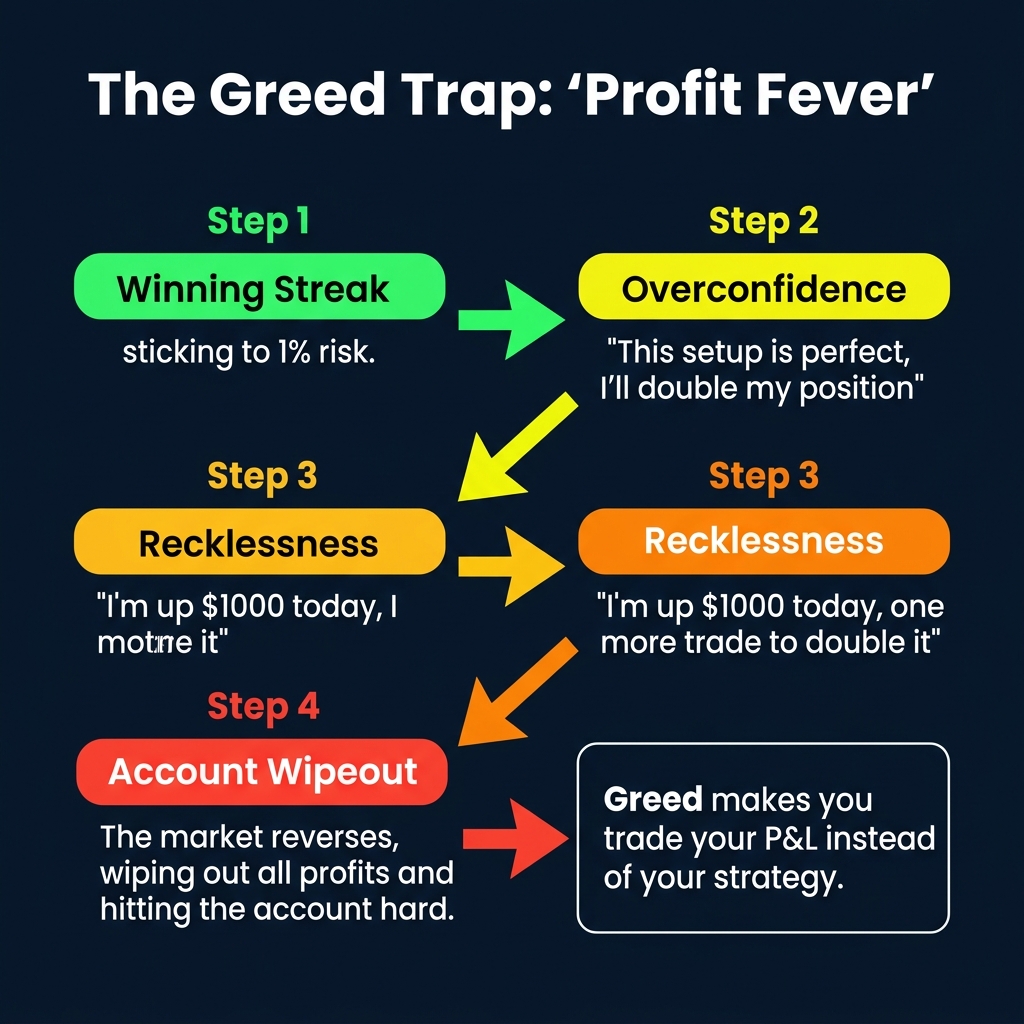
We call this "profit fever." You start chasing. You abandon your plan. You start trading your P&L (Profit & Loss) instead of trading your strategy.
Here's what greed looks like in practice: You have a $25,000 account and a rule that you never risk more than $250 per trade (1%). You're up $800 for the day — feeling confident. You spot an opportunity. It's not quite your setup, but it's close enough. You take the trade with double the size. The trade goes against you fast. You're down $1,200 before you can blink. One trade just wiped out your entire day and then some.
That's greed. And it's killed more accounts than a bad strategy ever could.
Fear: The Dream Killer
Fear is greed's evil twin. While greed makes you overextend, fear makes you underperform.
The insidious thing about fear? It feels like prudence. It feels like you're being smart and protective. But you're not protecting yourself — you're sabotaging your edge over the market.
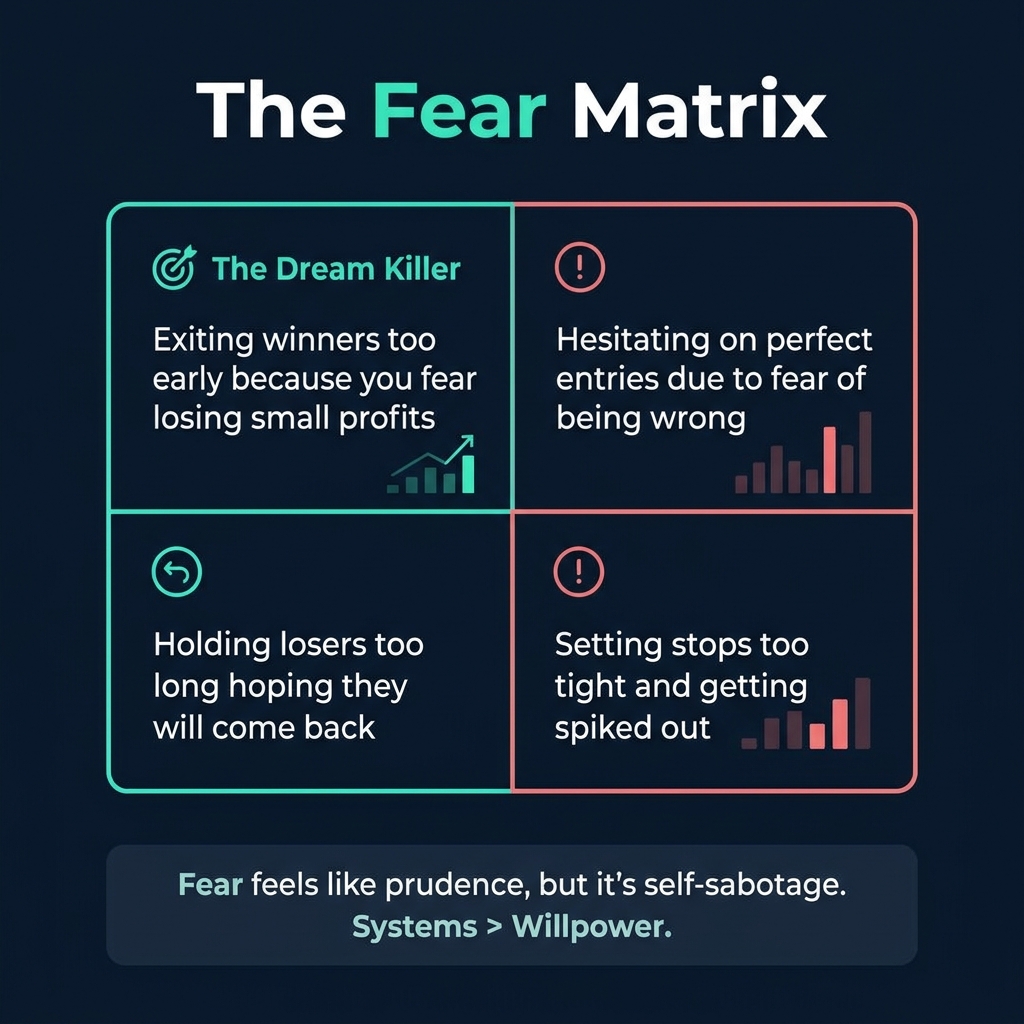
Fear causes you to:
- Exit winning trades way too early: You can't bear the thought of giving back unrealized profits.
- Avoid taking valid setups: You're scared after a previous loss, so you skip the next trade (which usually ends up being the winner).
- Hesitate on entry: You wait for "extra confirmation" until you miss the move entirely and enter at a terrible price.
- Set stops too tight: Because you can't handle the thought of losing full amount, you place stops where normal market noise will trigger them.
The Marcus Story
Consider a trader named Marcus. His strategy was solid, with a win rate of 58% in backtesting. But in live trading? He was barely breaking even.
Why? He was exiting winners at 60–70% of his target, convinced the trade would reverse. Meanwhile, he'd let losers run past his stop because he was afraid of "being wrong." His actual win rate dropped to 48%, and his average winner became smaller than his average loser. Marcus wasn't losing because his strategy was bad. He was losing because fear had hijacked his execution.
Systems Over Willpower
Managing fear and greed in trading requires systems, not just willpower. You need to understand that these emotions are completely normal. Professional traders feel them too. The difference is that professionals have processes to override them.
- ✅ Use hard stops: Place them in your platform, not in your head.
- ✅ Pre-define your rules: Calculate your risk and target exactly before you enter.
- ✅ Accept the loss upfront: The moment you enter the trade, mentally accept that the money at risk is already gone.
- ✅ Track your emotional state: Grade your psychological execution alongside your technical execution.
🎯 Your Action Step
Review your last 10 closed trades. Identify at least one trade where you let fear (exiting too early, moving your stop closer) or greed (forcing a trade, moving your target further away) influence your decision. Write down exactly what triggered that emotion, and what system you can implement tomorrow to prevent it from happening again.