Don't Put All Your Eggs in One Basket — Even in Trading
As you grow as a trader, you'll naturally want to diversify. Trading multiple accounts isn't just for institutional traders — retail traders use it to separate strategies, manage risk across systems, and access prop firm capital while growing personal accounts simultaneously.
This lesson shows you how to structure multiple trading accounts strategically, avoid the pitfalls, and build a real trading portfolio.
Why Trade Multiple Accounts?
| Reason | Benefit | Example |
|---|---|---|
| Strategy separation | Each strategy has its own P&L — easy to evaluate performance | Account A: swing trading. Account B: gold scalping. |
| Risk isolation | A blow-up in one account doesn't affect others | Aggressive strategy on small account, conservative on main account |
| Prop + personal | Trade prop firm capital AND grow your own account | $100K prop account + $5K personal account |
| Timeframe separation | Avoid conflicting signals between different timeframes | Account A: D1 swing trades. Account B: H1 day trades. |
| Psychological safety | Knowing your "safe" account is protected reduces pressure on the aggressive one | 80% capital in conservative, 20% in aggressive |
The Portfolio Approach to Trading
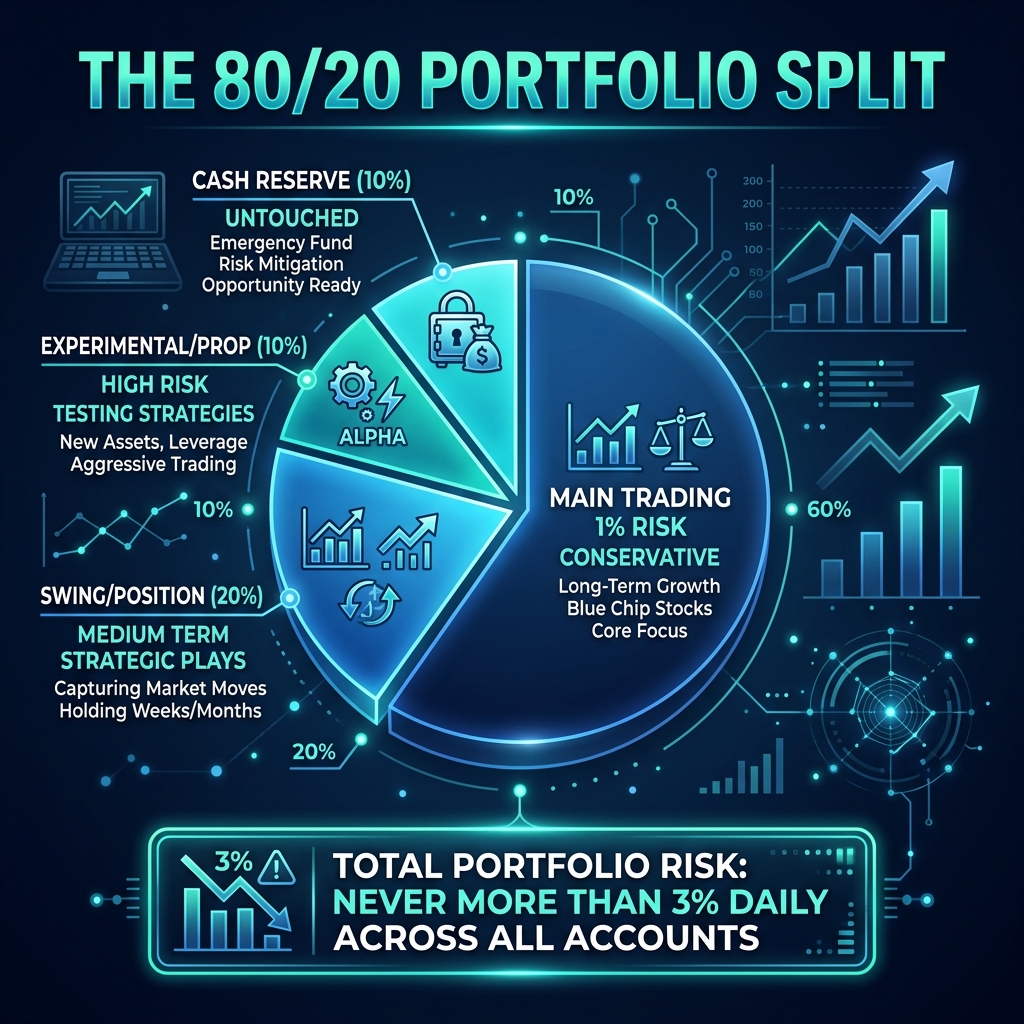
The 80/20 Split
Most professional traders use a version of this allocation:
- 80% — Core account: Conservative, proven strategy, main income generator. Risk: 0.5-1% per trade.
- 20% — Growth account: Higher risk, testing new strategies, or prop firm challenges. Risk: 1-2% per trade.
Advanced Portfolio Structure
| Account | Purpose | % of Capital | Risk Level |
|---|---|---|---|
| Main trading | Primary strategy, consistent returns | 60% | Conservative (1%) |
| Swing/position | Longer-term macro trades | 20% | Moderate (1%) |
| Prop firm | Using firm's capital for leverage | Challenge fees only | Per firm rules |
| Experimental | Testing new strategies, learning | 10% | Higher (2%) |
| Reserve | Cash buffer — not traded | 10% | None — emergency fund |
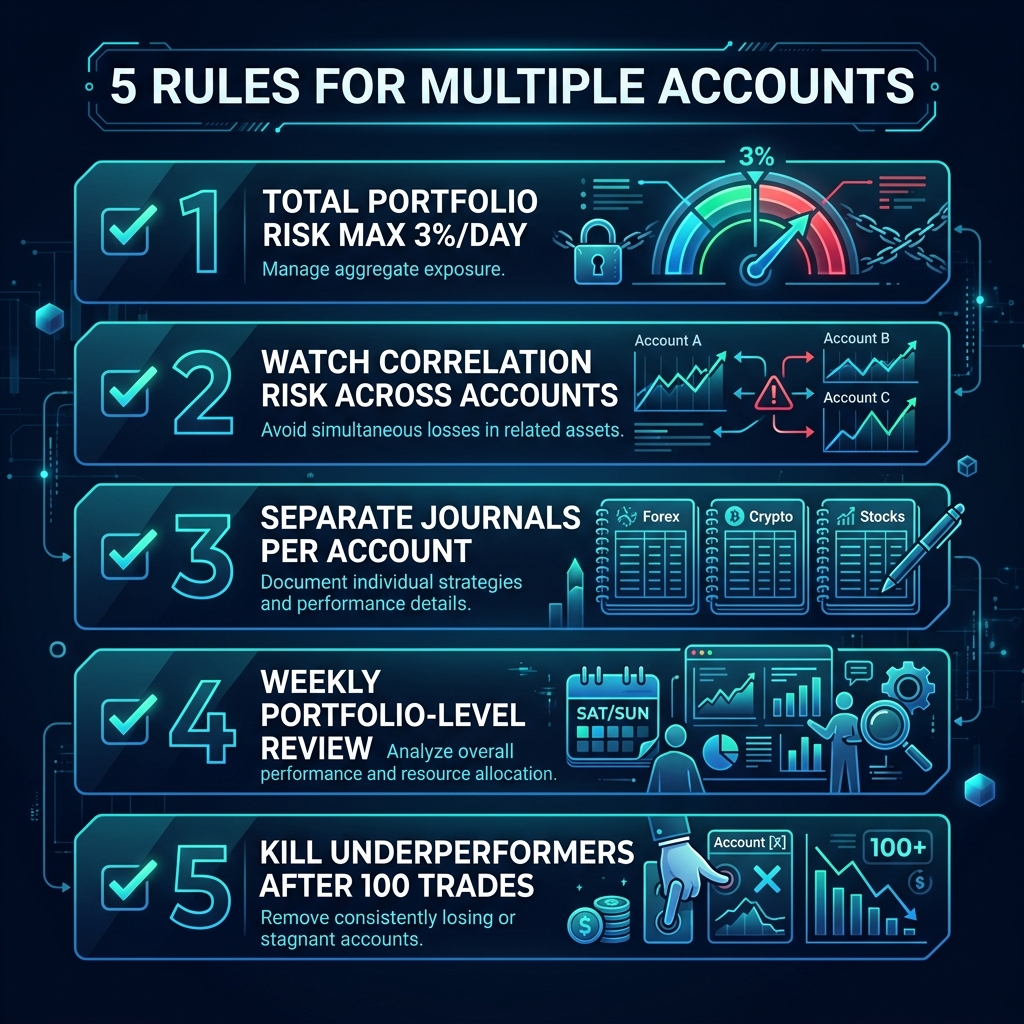
Rules for Managing Multiple Accounts
- Total portfolio risk: Never risk more than 3% of your TOTAL capital across all accounts in a single day
- Correlation awareness: If Account A is long EUR/USD and Account B is long GBP/USD, you're effectively double-exposed to USD weakness
- Separate journals: Each account gets its own journal. Never mix performance data.
- Weekly portfolio review: Look at ALL accounts together. Total P&L, total exposure, total drawdown.
- Kill underperformers: If an account's strategy has negative expectancy after 100 trades, close it and reallocate
Quick Recap
- Multiple accounts let you separate strategies, isolate risk, and combine prop + personal trading
- Use the 80/20 split: 80% conservative core, 20% growth/experimental
- Keep total daily risk under 3% across ALL accounts
- Watch for correlation risk — same-direction trades across accounts multiply your exposure
- Each account needs its own journal and performance tracking
- Always keep a 10% cash reserve — untouched emergency buffer
🎯 Your Action Step
Map out your ideal account structure. Even if you only have one account today, sketch the portfolio you want in 12 months. How would you divide your capital? What strategies would each account run? What risk level for each? This exercise forces you to think like a portfolio manager — which is exactly what professional traders are.