The Safest Way to Trade News — Let Everyone Else Go First
Directional traders bet before the news. Straddle traders set traps on both sides. But the wait-and-react strategy does something far more conservative: it waits for the chaos to end, reads the aftermath, and then enters the trade.
No prediction needed. No spread spikes. No whipsaws. You trade the reaction, not the event. This is how the majority of consistently profitable news traders operate.
Why "Wait and React" Works Better for Most Traders
- Spreads normalize: 15-30 minutes after the release, spreads return to normal levels
- Initial spike settles: The knee-jerk reaction often reverses partially before the real move begins
- True direction reveals itself: The market needs time to digest the full picture (headline + details + revisions)
- Your analysis is better: You can see the actual numbers, not guess
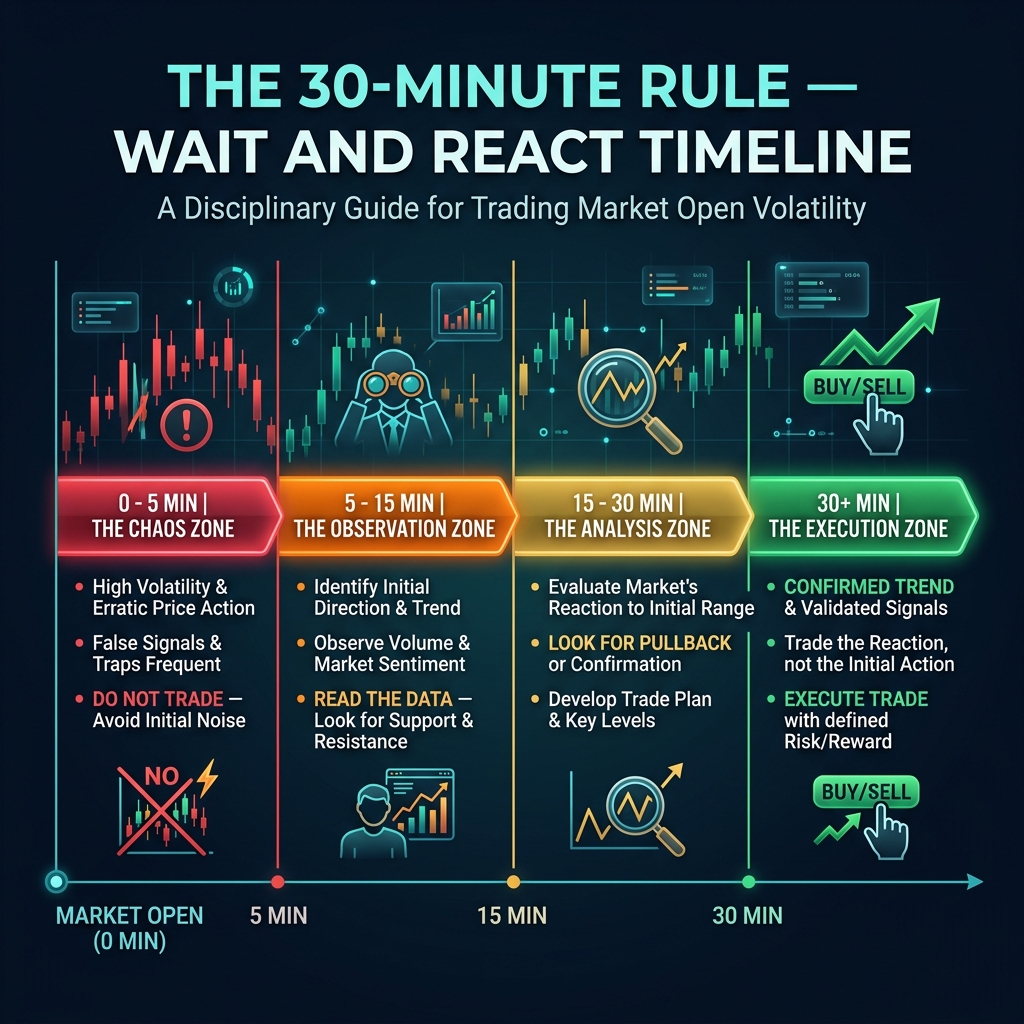
The 30-Minute Rule
After a high-impact release, apply the 30-minute rule:
- Minutes 0-5: Chaos. Massive spike, spreads blow out, possible whipsaw. Do NOT trade.
- Minutes 5-15: Initial reaction settles. Market starts processing the details (wage growth, revisions, statement language). Observe only.
- Minutes 15-30: Direction becomes clearer. Spreads normalize. The first pullback often begins. This is your entry window.
- Minutes 30+: If a clear direction is established and price pulls back to a level — enter the trade
The Wait-and-React Trade Setup
Step 1: Watch the Release (Don't Touch Anything)
Note the actual vs forecast numbers. Did it beat or miss? By how much? Check all components (for NFP: jobs + wages + revisions).
Step 2: Identify the Theme
- Clear beat: Data significantly better than expected → strong momentum expected
- Clear miss: Data significantly worse than expected → weakness expected
- Mixed signals: Some components beat, others miss → uncertain. No trade.
Step 3: Wait for the Pullback
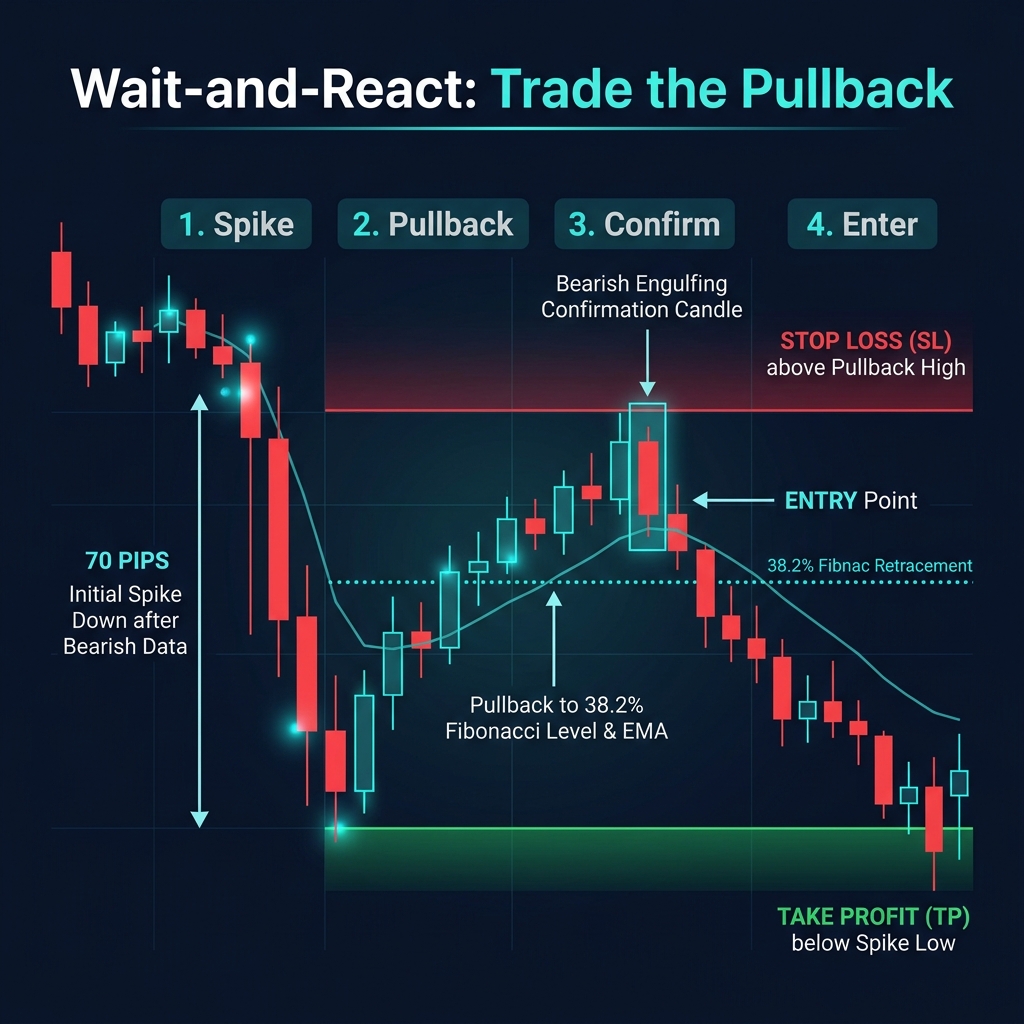
After the initial spike, price almost always pulls back 30-50% of the move. This pullback is your entry. It's like waiting for a wave to pull back before surfing the next one.
Step 4: Enter on the Pullback to a Key Level
- Look for the pullback to land on a support/resistance level, moving average, or Fibonacci level
- Wait for a confirmation candle (bullish engulfing, pin bar, etc.) at that level
- Enter with stop loss below the pullback low and target the initial spike high (or beyond)
Example: Wait-and-React on NFP
| Component | Detail |
|---|---|
| Release | NFP: Expected 180K, Actual 250K (strong beat) — wages also beat |
| Initial Reaction | USD surges, EUR/USD drops from 1.0900 to 1.0830 (70 pips in 5 min) |
| Pullback | EUR/USD bounces back to 1.0860 (38.2% Fibonacci of the drop) — H1 EMA also at this level |
| Confirmation | Bearish engulfing forms at 1.0860 — sellers stepping back in |
| Entry | Short EUR/USD at 1.0855 |
| Stop Loss | 1.0885 (30 pips — above pullback high) |
| Take Profit | 1.0790 (65 pips — below initial spike low) |
| R:R | 1:2.2 ✅ |
When to NOT Trade After News
- Mixed results: Headline beats but details miss — market will chop. Stay out.
- No clear move: Data in line with forecast — no edge. Don't force a trade.
- No pullback: Price goes straight without pulling back — you missed it. Don't chase.
- Multiple releases the same day: When NFP and CPI clash with ECB or BoE, the signals can conflict. Sit on your hands.
Quick Recap
- Wait-and-react is the safest news trading strategy — you trade the reaction, not the event
- Apply the 30-minute rule: don't enter until the initial chaos settles
- Wait for a pullback to a key level + confirmation candle
- Only trade when the data is clearly bullish or clearly bearish — no mixed signals
- This method avoids spread spikes, whipsaws, and emotional entries
- R:R is typically 1:2 or better because you enter at a better price than the spike traders
🎯 Your Action Step
On the next NFP or CPI day, do not trade. Instead, observe the release live and practice the wait-and-react framework on paper. Note: (1) the actual vs forecast, (2) the initial spike size, (3) where price pulled back to, (4) whether a confirmation candle appeared. Write down what your theoretical entry, SL, and TP would have been. Track this for 3 releases before trading it live.