The Market Never Stops Evolving — Neither Should You
Congratulations. You've reached the final lesson of the Trader Mindset Academy. You now possess knowledge that 95% of retail traders will never have. But here's the truth they don't tell you at graduation: the real education starts now.
Markets change. Strategies that work today may not work in 2 years. New instruments emerge. Regulations shift. Technology evolves. The traders who survive decades — not just months — are the ones who never stop learning and adapting.
Why Strategies Stop Working
| Reason | What Happens | How to Detect |
|---|---|---|
| Market regime change | A trending market becomes choppy, or vice versa. Your trend-following system stops producing. | Win rate drops 15%+ from backtest. Profit factor falls below 1.2. |
| Crowding | Too many traders learn the same strategy → the edge gets arbitraged away | Setups that used to work start getting stopped out more frequently |
| Structural changes | New regulations, algorithm dominance, spread changes, trading hour adjustments | Execution quality degrades. Slippage increases. |
| You changed | Your psychology, risk tolerance, or available screen time shifted | Rule compliance drops. You start modifying the system unconsciously. |
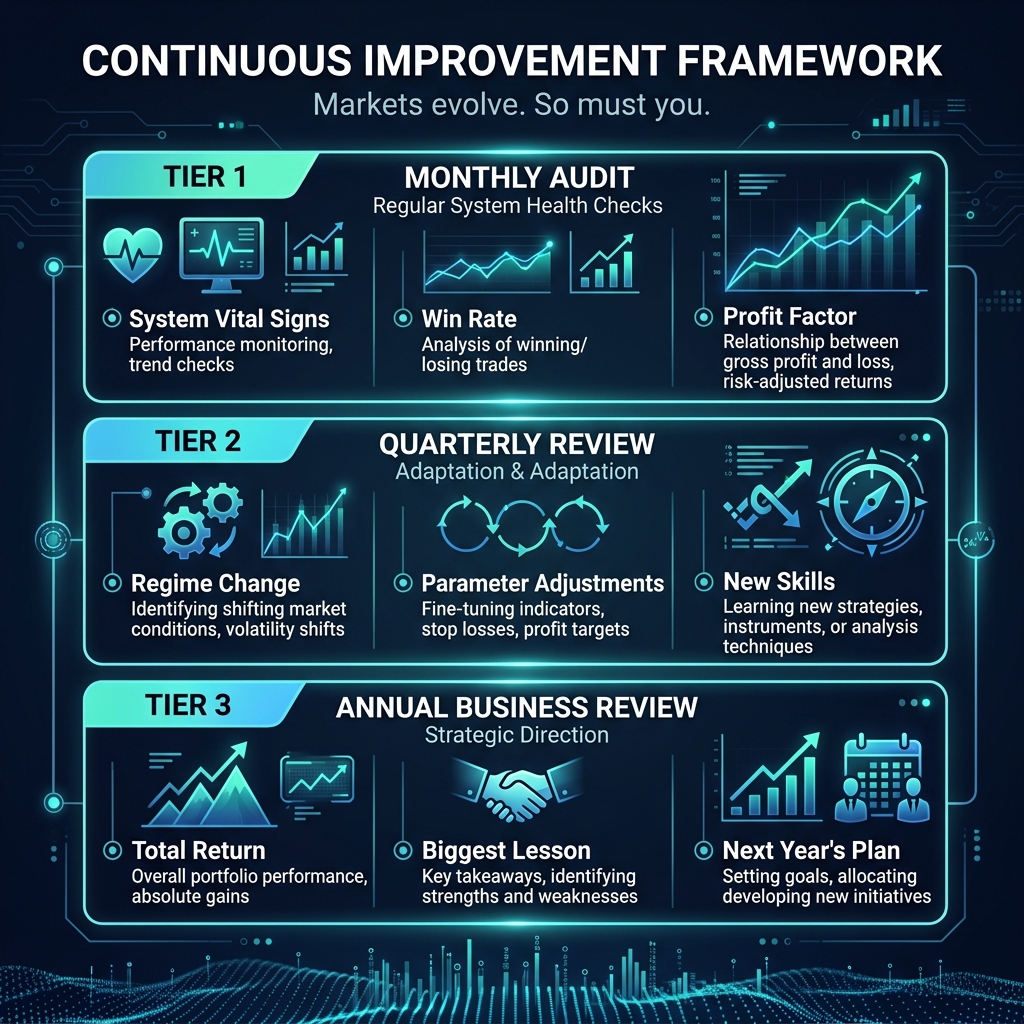
The Continuous Improvement Framework
1. Monthly System Audit
Every month, check your system's vital signs:
- Is the win rate still within 10% of my backtest?
- Is the profit factor still above 1.5?
- Is the max drawdown within acceptable limits?
- Am I still comfortable with the system's behavior?
2. Quarterly Strategy Review
Every 3 months, ask the strategic questions:
- Has the market regime changed? (trending → ranging or vice versa)
- Are my results degrading quarter-over-quarter?
- Should I adjust parameters, or is temporary underperformance normal?
- What new skills should I develop in the next quarter?
3. Annual Trading Business Review
Once a year, zoom all the way out:
- What was my total return this year? Am I on track for my career goals?
- What was my biggest lesson learned?
- What do I need to learn next year that I don't know yet?
- Should I add new instruments, strategies, or income streams?
What to Learn Next
| Topic | Why It Matters | When to Learn |
|---|---|---|
| Order flow / market microstructure | Understand HOW prices move, not just where | After 1 year of profitable trading |
| Options / derivatives | Hedge positions, generate income, express market views differently | After mastering spot forex |
| Macroeconomics | Deeper understanding of what drives currencies at the fundamental level | Ongoing — always valuable |
| Programming (Python/MQL) | Automate backtesting, build custom indicators, create EAs | When you want to scale or automate |
| Portfolio theory | Diversification, correlation management, optimal allocation | When managing multiple accounts/strategies |
The Trader's Growth Mindset
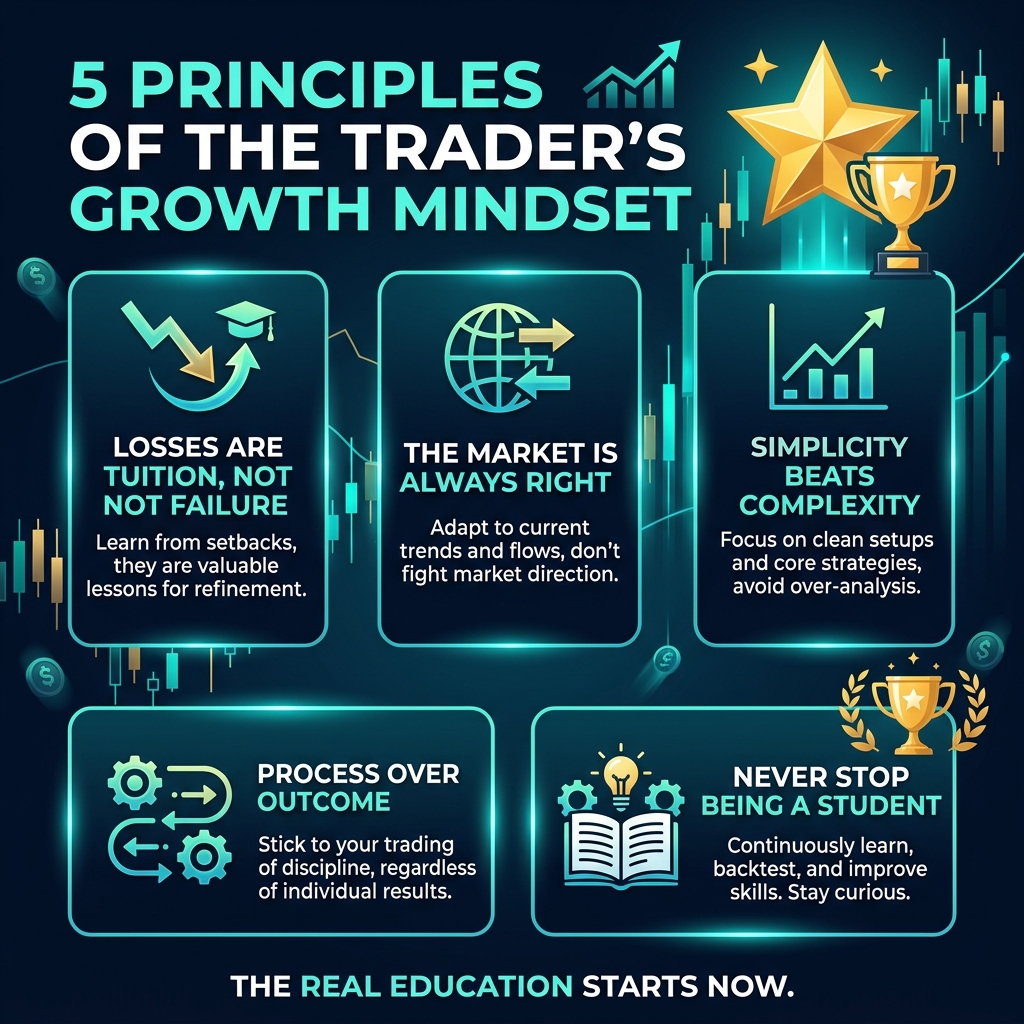
Adopt these 5 principles for lifelong trading success:
- Losses are tuition, not failure. Every losing trade teaches you something — IF you journal and review it.
- The market is always right. When your analysis conflicts with price, price wins. Always.
- Simplicity beats complexity. The best traders use simple systems executed with extraordinary discipline. Don't complicate what works.
- Process over outcome. A good trade is one where you followed your rules — regardless of whether it won or lost.
- Never stop being a student. The day you think you've "figured out" the market is the day it humbles you.
A Final Word
You came into this Academy as a beginner. You're leaving with a complete education: price action, indicators, risk management, trading psychology, system building, macro analysis, gold trading, and a career roadmap.
But knowledge alone doesn't make money. Execution does. The gap between knowing and doing is where most traders live forever. Don't be one of them.
Take your trading plan. Follow your rules. Journal every trade. Review your performance. Adapt when the data tells you to. And most importantly — be patient. The market rewards discipline over intelligence, consistency over brilliance, and patience over aggression.
You have everything you need. Now go trade.
Quick Recap
- Markets evolve — strategies that work today may not work forever
- Build a 3-tier review system: monthly audit, quarterly review, annual business assessment
- Keep learning: order flow, options, macroeconomics, programming, portfolio theory
- 5 growth mindset principles: losses are tuition, market is always right, simplicity wins, process over outcome, never stop learning
- Knowledge doesn't make money — execution does
- Be patient. Be disciplined. Be consistent. You have everything you need.
🎯 Your Final Action Step
Write a letter to yourself. Date it one year from today. Describe where you are now as a trader, what you've learned, and where you want to be in 12 months. Seal it. Open it next year. You'll be amazed at how far you've come — or humbled by how much further you need to go. Either way, the letter will be the most honest conversation you'll ever have about your trading journey.