Learn From Others' Pain — So You Don't Have to Feel It Yourself
Every beginner trader makes mistakes. But most of the mistakes are exactly the same — the same 10 traps that have been destroying accounts since markets began. The difference between a trader who survives and one who doesn't isn't talent — it's whether they learn these lessons from a textbook or from their bank account.
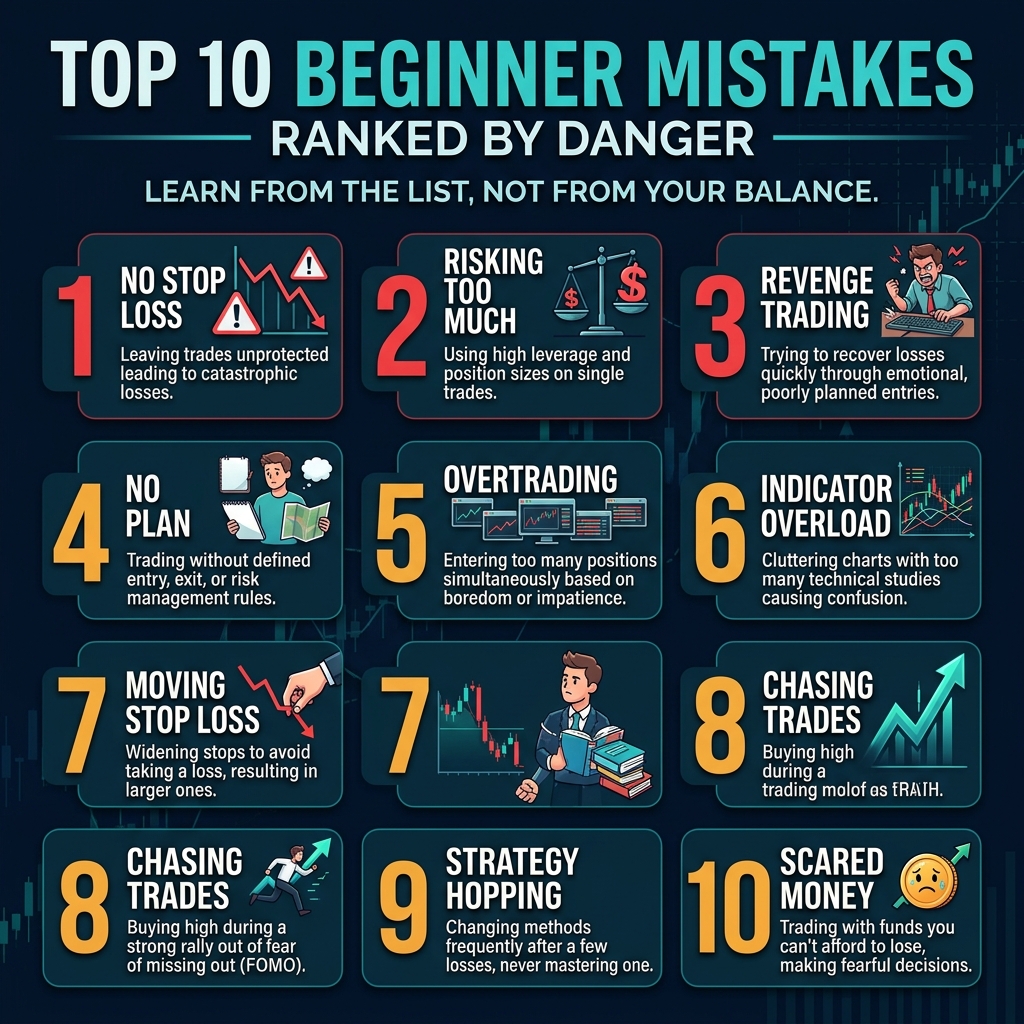
Here are the 10 most common beginner mistakes, ranked by account-destruction potential. Study them. Memorize them. And when you catch yourself doing any of them — stop immediately.
Mistake #1: No Stop Loss
The single most destructive habit in trading. "I'll close it manually when it gets bad" is the fastest path to a blown account.
- Why beginners do it: They don't want to "lock in" a loss. They hope the trade comes back.
- What happens: A 30-pip loss becomes 100, then 300, then margin call. One trade wipes out months of profits.
- The fix: ALWAYS set a stop loss BEFORE entry. Make it a rule you never break — Rule #5 from your trading plan.
Mistake #2: Risking Too Much Per Trade
Betting 5-10% of your account on a single trade is gambling, not trading.
- Why beginners do it: They want to "make real money" fast. Small position sizes feel pointless.
- What happens: Three bad trades = 30% drawdown. Psychologically devastating and mathematically almost impossible to recover from.
- The fix: 1% per trade. Maximum. At 1%, you survive 10 consecutive losses with 90% of your account intact.
Mistake #3: Revenge Trading
Taking an impulsive trade immediately after a loss to "make back" what you lost.
- Why beginners do it: Emotional pain of a loss triggers urgency to "fix" it right now.
- What happens: The revenge trade is bigger, sloppier, and almost always a loser. Now you've doubled your loss.
- The fix: After a losing trade, step away for 15-30 minutes. Only take the next trade if it genuinely meets your system's criteria.
Mistake #4: Trading Without a Plan
Opening charts and "seeing what happens" is not a strategy.
- Why beginners do it: Building a plan feels boring. Trading feels exciting. They skip the boring part.
- What happens: Inconsistent results, no measurable edge, constant strategy-hopping.
- The fix: Complete the one-page trading plan from Level 10. Every trade must pass the pre-trade checklist.
Mistake #5: Overtrading
Taking 15-20 trades a day when your system only generates 3-5 quality setups per week.
- Why beginners do it: They confuse activity with progress. Sitting and waiting feels "lazy."
- What happens: Spread costs eat profits. Low-quality trades lose money. Mental exhaustion leads to more mistakes.
- The fix: Only trade setups that meet ALL your entry criteria. Waiting IS the job.
Mistake #6: Indicator Overload
Adding 7 indicators to a chart because more information must be better, right?
- Why beginners do it: They don't trust any single indicator, so they stack them for "confirmation."
- What happens: Indicators give conflicting signals. Analysis paralysis. Missed trades or random trades based on which indicator you looked at last.
- The fix: Maximum 2-3 indicators that serve different purposes (trend + momentum + volume). Not 5 oscillators saying the same thing.
Mistake #7: Moving Your Stop Loss
Widening your stop to avoid getting stopped out — the moment your plan breaks.
- Why beginners do it: "It's so close to my stop — it'll probably reverse if I give it more room."
- What happens: Occasional saves are outweighed by the catastrophic losses when you give a bad trade infinite room.
- The fix: Place your stop at a logical level BEFORE entry. Once set, it only moves in your favor (trailing), never against you.
Mistake #8: Chasing Trades
Entering after a big move because you're afraid of "missing out."
- Why beginners do it: FOMO. They see a 100-pip move and think "I need to get in before it goes further."
- What happens: They enter at the worst possible moment — right before the pullback. Stopped out at the exact level the move started from.
- The fix: If you missed the move, you missed it. Wait for the next setup. There will always be another trade.
Mistake #9: Strategy Hopping
Switching strategies after every losing streak — the "shiny object syndrome" of trading.
- Why beginners do it: After 3-5 losses, they conclude "this strategy doesn't work" and start searching for a new one.
- What happens: They never give any strategy enough time to prove itself. They're always in the learning curve, never in the profit zone.
- The fix: Commit to ONE system for 50-100 trades minimum before evaluating. Losing streaks are normal for profitable systems.
Mistake #10: Trading With Scared Money
Using money you can't afford to lose — rent money, emergency funds, borrowed money.
- Why beginners do it: They believe trading will be their financial salvation. Desperation drives decisions.
- What happens: Every trade carries unbearable emotional weight. Risk management goes out the window because you "need" the trade to work.
- The fix: Only trade with money that, if lost completely, would NOT affect your life. Start small. Build up from profits.
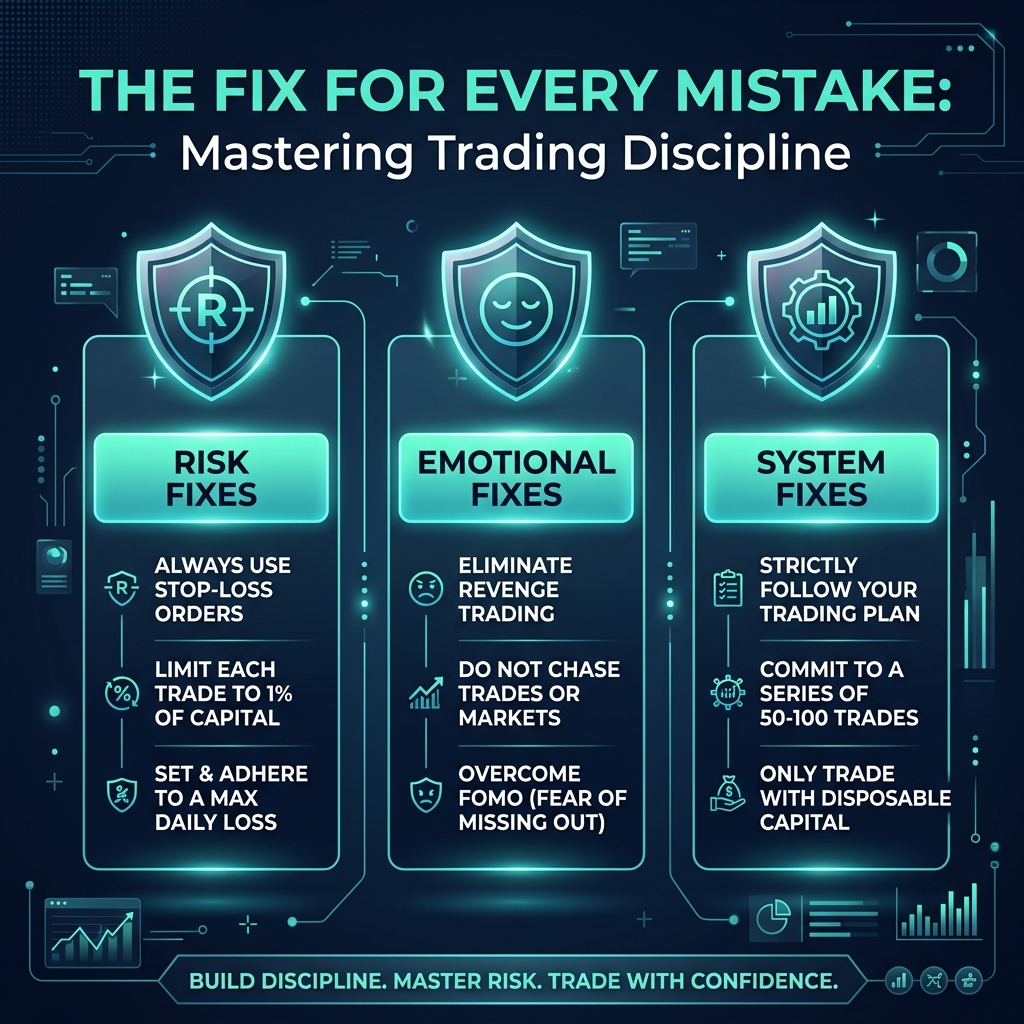
Quick Recap
- The same 10 mistakes destroy beginner accounts year after year — learn them from a lesson, not from your balance
- #1 killer: No stop loss. Always use one. No exceptions.
- #2 killer: Risking too much. 1% per trade is the rule.
- Emotional mistakes (revenge trading, FOMO, chasing) are solved by having and following a written plan
- Strategy hopping prevents you from ever learning what works — commit to 50-100 trades
- Scared money destroys decision-making — only trade truly disposable capital
🎯 Your Action Step
Rank these 10 mistakes from "I'm most likely to do this" to "I'd never do this." Be honest. Your top 3 are the ones you need to guard against most aggressively. Write your top 3 on a card and tape it to your monitor. When you catch yourself doing any of them — stop trading for the day. The awareness alone will save you thousands of dollars.