Knowing When to Close Is Half the Battle
Most trading education focuses on entries — when to buy, when to sell. But ask any experienced trader and they'll tell you: exits are where the money is made.
How many times have you seen a profitable trade turn into a loss because you didn't close it? Or closed too early, only to watch price continue 100 pips in your direction?
A solid take profit strategy removes the guesswork from your exits — and protects you from your own greed and fear.
3 Take Profit Strategies
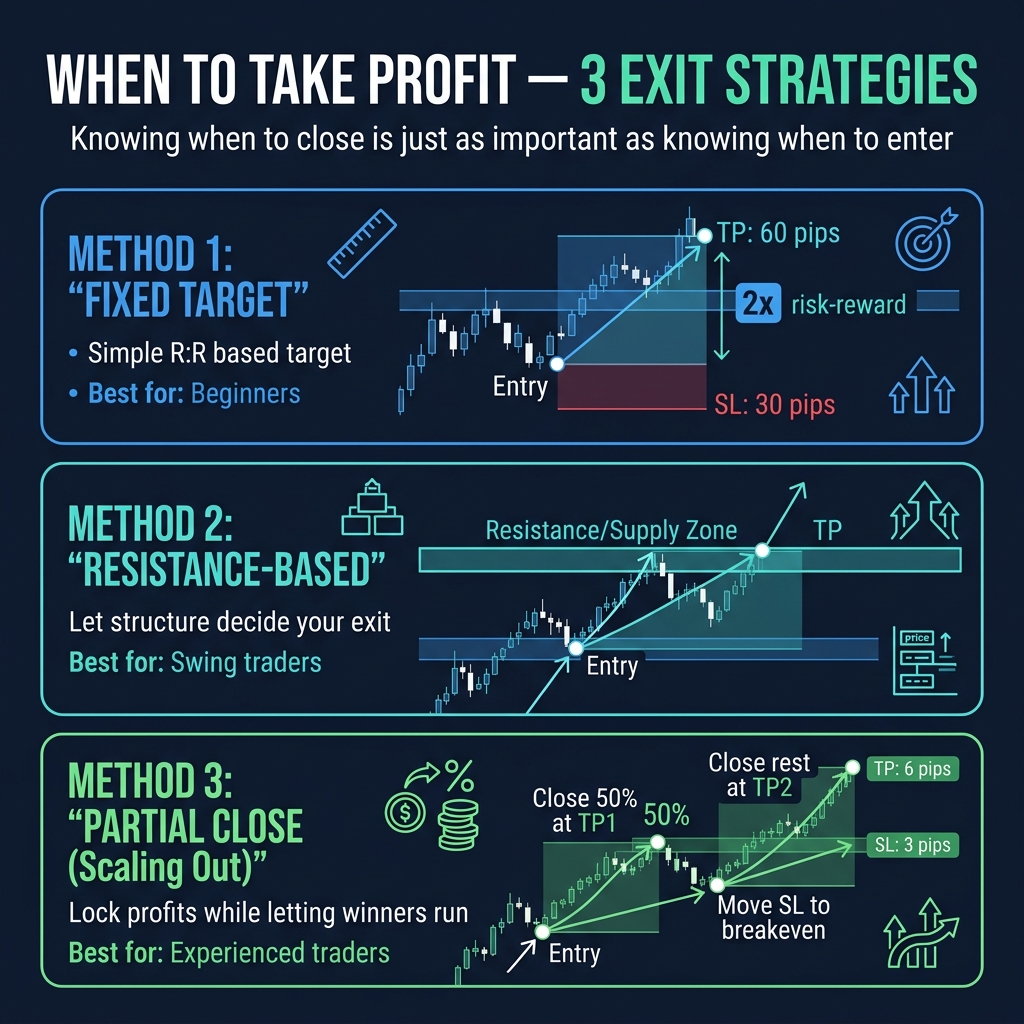
Strategy 1: Fixed Risk-Reward Target
The simplest approach: if your stop loss is 30 pips, your take profit is 60 pips (1:2 ratio). You don't care about chart structure — you set it and walk away.
| Stop Loss | 1:1 TP | 1:2 TP | 1:3 TP |
|---|---|---|---|
| 20 pips | 20 pips | 40 pips | 60 pips |
| 30 pips | 30 pips | 60 pips | 90 pips |
| 50 pips | 50 pips | 100 pips | 150 pips |
Best for: Beginners who need consistency. Start with 1:2 minimum.
Strategy 2: Structure-Based (Support/Resistance)
Place your take profit at the next significant support or resistance level. This is more intelligent because the market is likely to react at these levels.
💡 Example: You buy EUR/USD at 1.1050. The next resistance is at 1.1120 (+70 pips). Your stop loss is at 1.1025 (-25 pips). That's a 1:2.8 risk-reward ratio — excellent!
Best for: Swing traders who analyze chart structure.
Strategy 3: Scaling Out (Partial Close)
This is the professional's approach. Instead of closing 100% at one price, you split your exit:
- Close 50% at TP1 (e.g., +30 pips) → Lock in profit
- Move stop loss to breakeven → Zero risk on the rest
- Close remaining 50% at TP2 (e.g., +60 pips) → Let winners run
Scaling Out — The Best of Both Worlds
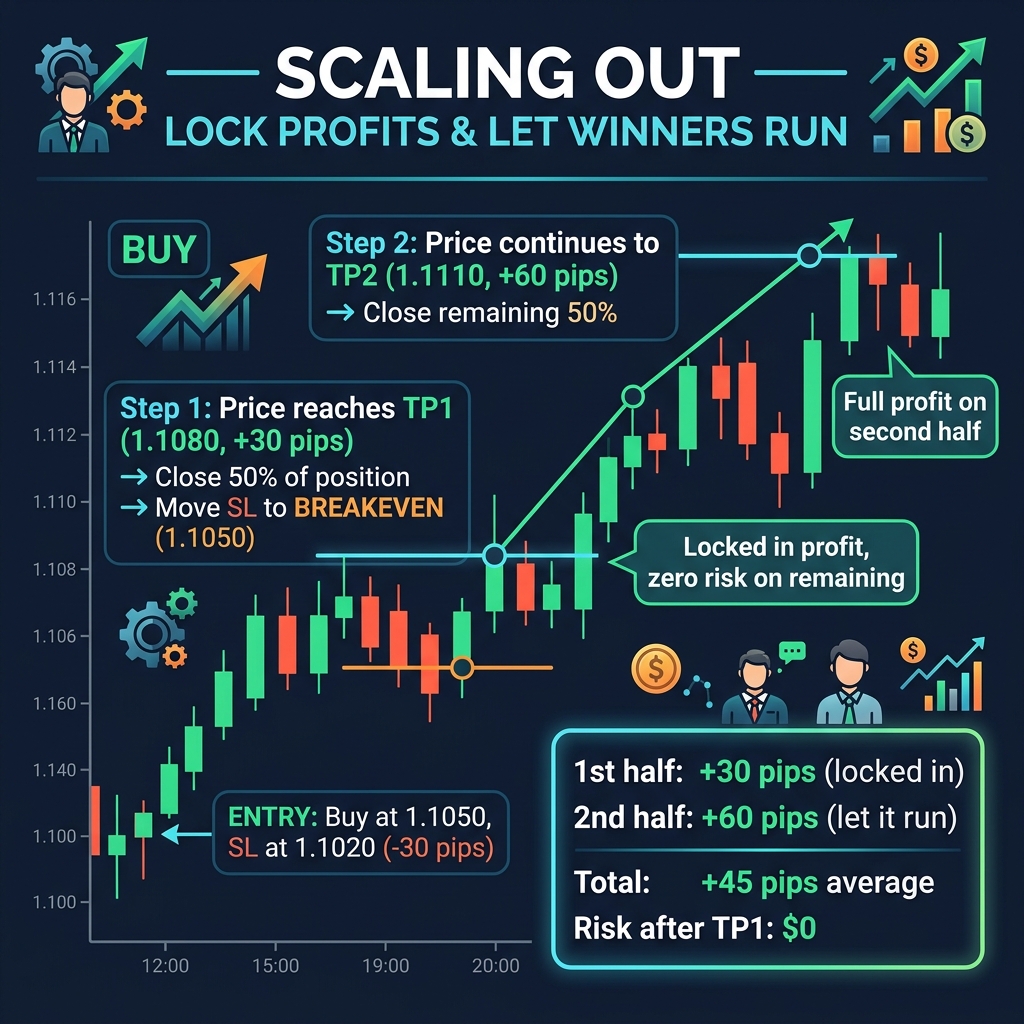
Why do professionals love scaling out?
- Psychological relief — You've banked profit. Pressure drops.
- Zero risk — After moving SL to breakeven, the remaining position is "free"
- Bigger average wins — The second half can run much further
- Handles uncertainty — You don't need to predict the exact top/bottom
Common Take Profit Mistakes
- Closing too early — Fear takes over at +10 pips and you grab $1 instead of waiting for +40 pips ($4). Stick to your plan.
- No take profit at all — "I'll just hold and see what happens." What happens is the trade reverses and you lose everything.
- Moving TP further away — Greed says "just 20 more pips!" Price reverses. Don't chase.
- Always using 1:1 — You need at least 1:2 to be sustainably profitable. 1:1 requires a >50% win rate just to break even.
Quick Recap
- ✅ Always set a take profit before entering the trade
- ✅ Minimum ratio: 1:2 risk-reward
- ✅ Structure-based TP (at support/resistance) is smarter than fixed pips
- ✅ Scaling out = lock profits + let winners run
- ✅ Don't move TP further away out of greed