The One Rule That Keeps You in the Game
Ask any professional trader their #1 rule and they'll say the same thing: "Always use a stop loss." It's not optional. It's not negotiable. It's your insurance policy against catastrophic losses.
A stop loss is a pre-set order that automatically closes your trade when price reaches a certain level. It limits your loss to a known, acceptable amount — before the trade even starts.
Without one, a single bad trade can wipe out weeks of profits. With one, you know your absolute maximum loss before you click "Buy."
Where to Place Your Stop Loss
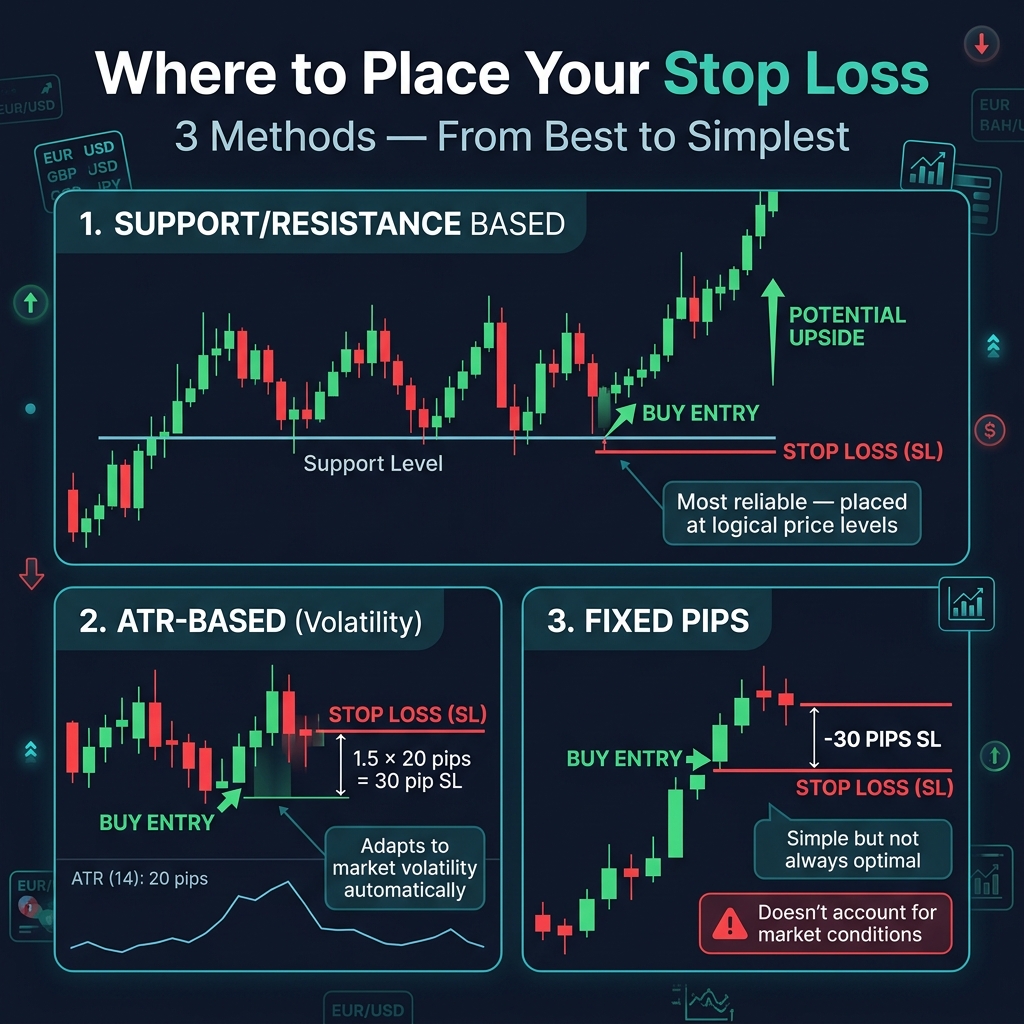
Method 1: Support/Resistance Based (Best)
Place your stop loss just below support (for buy trades) or above resistance (for sell trades). This is the most logical placement because if price breaks through these levels, your trade thesis is invalidated anyway.
💡 Example: You buy EUR/USD at 1.1050. Support is at 1.1030. Your stop loss goes at 1.1025 — 5 pips below support. If support breaks, your idea was wrong, and you exit with a small, planned loss.
Method 2: ATR-Based (Volatility Adaptive)
The Average True Range (ATR) measures how much a pair typically moves in a period. Set your stop loss at 1.5× to 2× ATR distance from your entry. This automatically adjusts for volatility — wider in choppy markets, tighter in calm ones.
Method 3: Fixed Pips (Simplest)
Set the same pip distance on every trade (e.g., 20 pips, 30 pips). Simple but not ideal — it doesn't account for market structure or volatility. Use this only as a starting point if you're brand new.
The 5 Stop Loss Mistakes That Blow Accounts
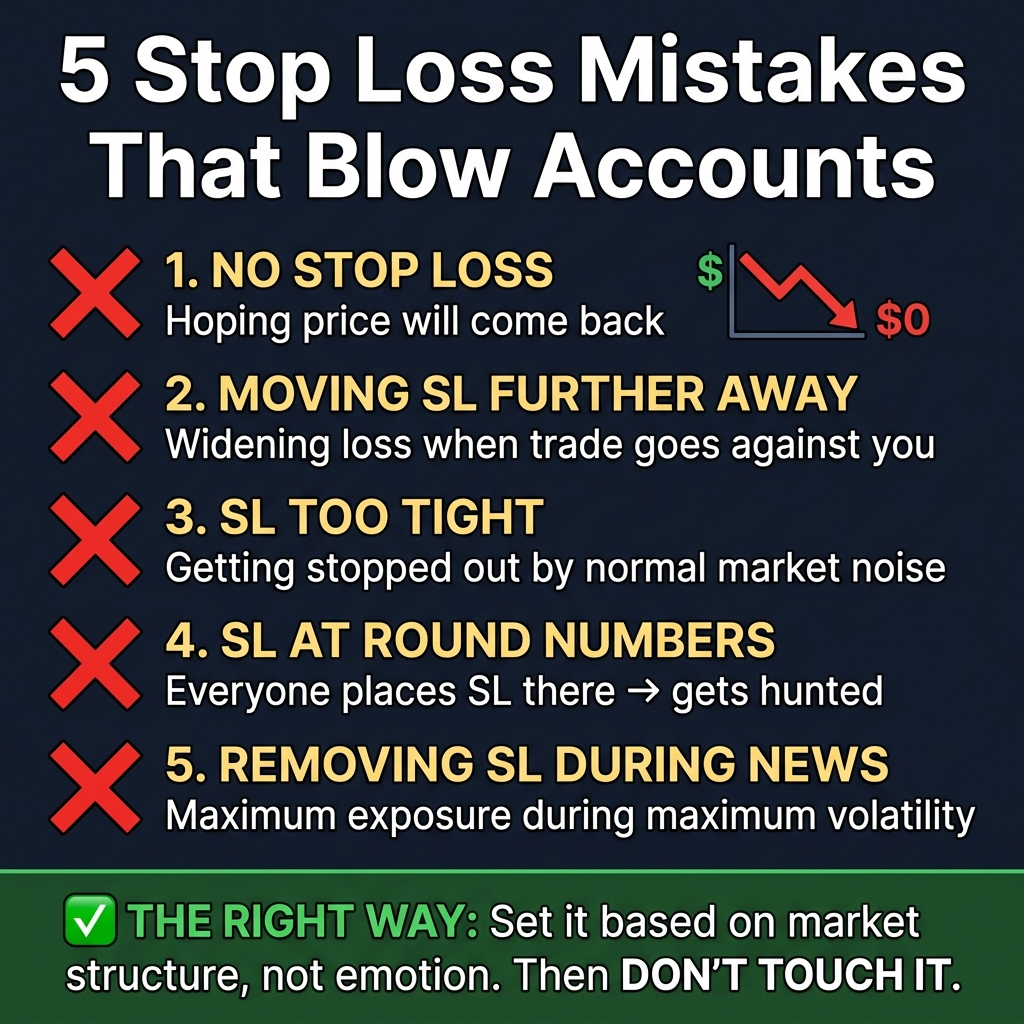
Mistake #1: No Stop Loss At All
"I'll just watch the trade and close it manually." No, you won't. You'll hope. You'll wait. You'll tell yourself "it's coming back." Then it doesn't, and you've lost 30% of your account on one trade.
Mistake #2: Moving Your Stop Loss Further Away
This is the most dangerous habit. Price hits -20 pips, you move SL from -30 to -50 to -80 to... account blown. Once your SL is set, do NOT move it further from your entry.
Mistake #3: Stop Loss Too Tight
A 5-pip stop loss on a pair that moves 15 pips per candle = getting stopped out by normal noise. Your SL needs breathing room. Use ATR or support/resistance to find the right distance.
Mistake #4: Placing SL at Round Numbers
Everyone puts their stop at 1.1000, 1.0900, etc. Market makers know this and will "hunt" these clusters. Place your SL a few pips beyond the obvious level.
Mistake #5: Removing SL During News
NFP just dropped. You remove your stop loss "to avoid getting stopped out." Price moves 100 pips against you in 10 seconds. Keep your SL on at all times, especially during news.
The Right Mindset About Losses
A stop loss hit is not failure — it's your insurance paying out. Professional traders expect to lose 40-50% of their trades. What matters is that winners are bigger than losers.
🎯 Think of it this way: A stop loss is the price you pay to find out if your trade idea was right. It's a business expense, not a personal defeat.
Quick Recap
- ✅ Always use a stop loss — on every trade, without exception
- ✅ Best placement: below support or above resistance
- ✅ Never move your SL further away from entry
- ✅ Give your SL enough room to avoid getting stopped by noise
- ✅ A stop loss hit is a business expense, not a failure