The Market Everyone Ignores — Until It Crashes Their Forex Trade
Most forex traders never look at the stock market. That's a mistake. The S&P 500, Nasdaq, and Nikkei don't just move stocks — they move currencies, gold, and bonds simultaneously. Understanding the connection between stocks and forex gives you a macro edge that pure chart traders will never have.
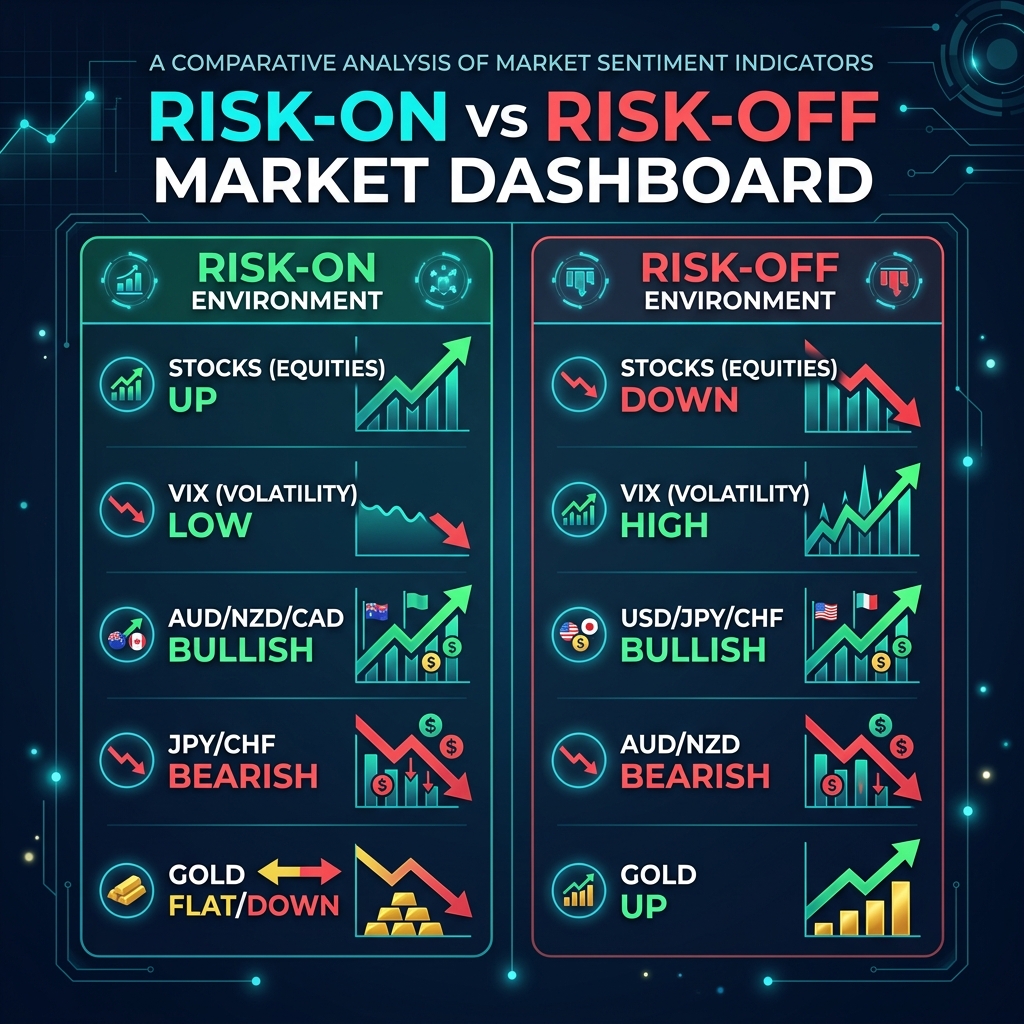
This lesson reveals the hidden link: risk sentiment. When stock markets rally, certain currencies rise. When stocks crash, different currencies surge. Learn to read this, and you'll always know which side of the trade to be on.
Risk-On vs Risk-Off — The Market's Mood Switch
Global financial markets operate on a spectrum between two emotional extremes:
| Environment | What's Happening | Stocks | Currencies That Rise | Currencies That Fall |
|---|---|---|---|---|
| Risk-On | Optimism, growth, investment appetite | Rising ↑ | AUD, NZD, CAD, GBP | USD, JPY, CHF |
| Risk-Off | Fear, uncertainty, flight to safety | Falling ↓ | USD, JPY, CHF | AUD, NZD, CAD, GBP |
Why This Happens
- Risk-On: Investors seek higher yields → buy stocks, commodities, and high-yield currencies (AUD, NZD) → sell safe havens
- Risk-Off: Investors flee to safety → sell stocks and risky assets → buy government bonds, USD, JPY, CHF, and gold
The S&P 500 and Forex — Key Correlations
| Currency Pair | Correlation with S&P 500 | What It Means |
|---|---|---|
| AUD/USD | Strong positive | When stocks rise, AUD/USD tends to rise (both are risk-on) |
| USD/JPY | Positive (usually) | Stocks up → risk-on → JPY weakens → USD/JPY rises |
| EUR/USD | Variable | Depends on relative risk perception between US and Europe |
| USD/CHF | Negative | Stocks down → CHF strengthens → USD/CHF falls |
| NZD/USD | Strong positive | Similar to AUD — commodity/growth currency that follows risk appetite |
Trading tip: If S&P 500 futures are dropping hard pre-market, look for short opportunities on AUD/USD and NZD/USD, and long setups on USD/JPY or gold.
How to Use Stock Markets in Your Forex Trading
1. Pre-Market Sentiment Check
Before your forex session, check S&P 500 futures and Asian stock indices (Nikkei 225). If futures are significantly up or down, you already know the risk sentiment for the day.
2. Confirmation Filter
If your forex system signals long AUD/USD, but the S&P 500 is crashing — that's a conflicting signal. The stock market is telling you risk is OFF. Consider skipping the trade or reducing size.
3. Early Warning System
Stock markets often move BEFORE forex reacts. A sudden drop in futures during late Asian session can warn you of incoming USD strength 30-60 minutes before it shows on currency charts.
The VIX — Your Fear Gauge
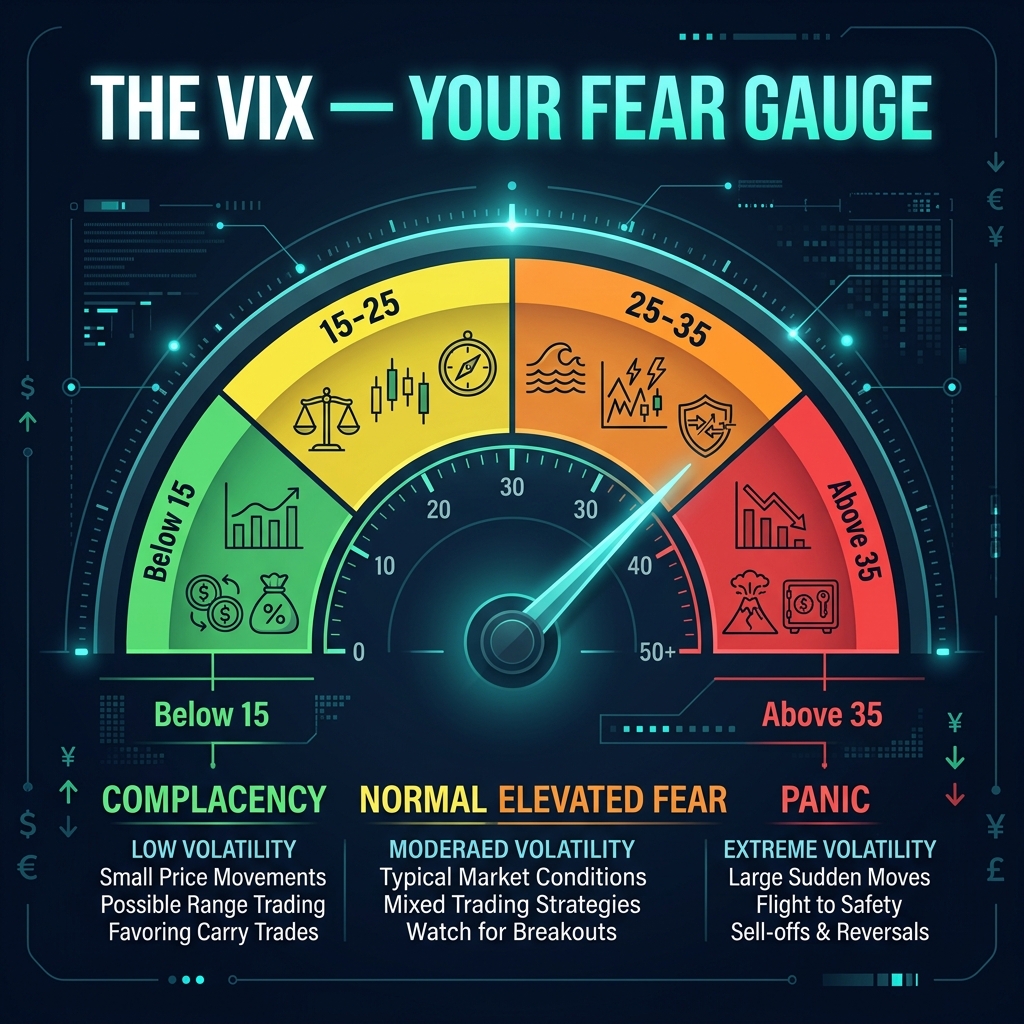
The VIX (CBOE Volatility Index) measures expected volatility in the S&P 500. Traders call it the "fear gauge."
| VIX Level | Market Mood | Forex Implications |
|---|---|---|
| Below 15 | Complacency — low fear | Risk-on environment, AUD/NZD favored, carry trades work well |
| 15-25 | Normal — moderate uncertainty | Mixed conditions, trade your technical system normally |
| 25-35 | Elevated fear | Risk-off building, JPY/CHF strengthening, widen stops |
| Above 35 | Panic | Strong risk-off, massive USD/JPY/CHF demand, reduce position sizes |
Quick Recap
- Stock markets and forex are connected through risk sentiment
- Risk-on = stocks up + AUD/NZD/CAD strong + JPY/CHF weak
- Risk-off = stocks down + USD/JPY/CHF strong + AUD/NZD weak
- Check S&P 500 futures before your forex session as a sentiment filter
- Use the VIX as your fear gauge — above 25 means reduce risk exposure
- Stocks often move BEFORE forex reacts — use them as an early warning system
🎯 Your Action Step
Add an S&P 500 chart and the VIX to your TradingView layout alongside your forex charts. For the next 2 weeks, note the VIX level at the start of your session and whether the S&P 500 is up or down. Then observe which currency pairs move in the direction you'd expect based on risk sentiment. This builds your cross-market awareness muscle.