The Fastest Way to Blow Up Your Account
A scalper takes 20 trades per day. A swing trader takes 2 per week. That means in one week, the scalper makes 100 decisions while the swing trader makes 2. If even 10% of those decisions are emotionally driven — moving stops, revenge trading, doubling down — the scalper has 10 mistakes per week versus the swing trader's zero.
Speed amplifies everything: profits, losses, and mistakes. Scalping without strict risk management isn't trading — it's gambling at 10x speed. This lesson gives you the exact rules to keep speed from killing your account.
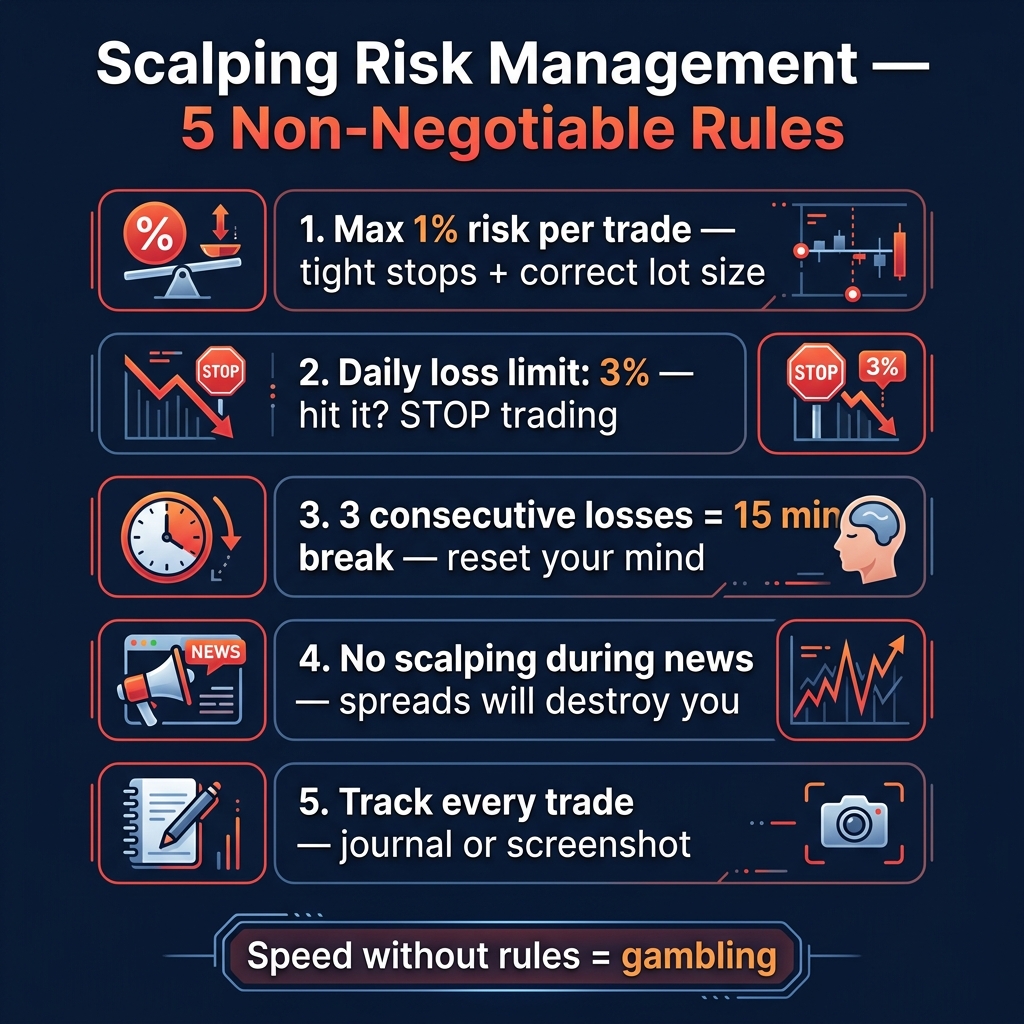
Rule 1: Max 1% Risk Per Trade — Calculate Before You Click
With tight stops (5-10 pips), your position size must be calculated precisely. The formula:
Lot size = (Account × Risk%) ÷ (SL pips × Pip value)
Example:
- Account: $5,000
- Risk: 1% = $50
- Stop loss: 8 pips
- Pip value (EUR/USD standard lot): $10
- Lot size: $50 ÷ (8 × $10) = $50 ÷ $80 = 0.62 lots
With a 5-pip stop, the same calculation gives 1.0 lot. With a 15-pip stop, it gives 0.33 lots. The lot size changes every time because the stop distance changes. Never use a fixed lot size for scalping.
Rule 2: Daily Loss Limit — 3% and You're Done
On a $5,000 account, your daily loss limit is $150 (3%). If you hit that number, close your platform. No exceptions. No "one more trade to make it back."
Why 3%? Because losing 3% in a day is recoverable with 2-3 good days. Losing 10% in a day takes a week to recover — and the emotional damage takes even longer.
| Daily Loss | Days to Recover (at 1.5% avg daily profit) | Emotional Impact |
|---|---|---|
| -1% | < 1 day | Minor — normal variance |
| -3% | 2 days | Moderate — need discipline to stop |
| -5% | 3-4 days | Significant — likely tilted |
| -10% | 7+ days | Severe — revenge trading probable |
Rule 3: The 3-Loss Circuit Breaker
After 3 consecutive losing trades, stop trading for at least 15 minutes. Stand up. Walk away from the screen. Breathe.
Three losses in a row usually means one of two things:
- Your strategy doesn't fit today's market conditions (ranging when you need trending)
- You're emotionally compromised and starting to force trades
Either way, the answer is the same: stop. When you return, re-analyze the market from scratch. Is the trend still valid? Are the sessions overlapping? Has volatility changed?
Rule 4: No Scalping During High-Impact News
NFP, CPI, FOMC rate decisions — these events cause spreads to widen from 0.5 pips to 5-10 pips in seconds. Your 8-pip stop loss gets filled at 15 pips slippage. Your 10-pip target becomes impossible when the spread alone is 8 pips.
The rule:
- Stop scalping 15 minutes before any high-impact news event
- Don't resume until 15 minutes after the release
- Check the economic calendar before every session
Rule 5: Track Every Single Trade
Because scalpers take so many trades, it's tempting to skip journaling. Don't. Every trade should be recorded with at least:
- Entry price, exit price, stop loss, target
- Win or loss (+ pips, + dollars)
- Screenshot of the setup
- Emotional state score (1-5)
After every session, review your trades. Look for patterns:
- Are you losing more in the first 30 minutes? Maybe you're entering before the trend establishes.
- Are losses clustered after noon? Maybe you're fatigued.
- Are your wins smaller than your losses? Your targets might be too tight or you're cutting winners early.
The Scalper's Risk Dashboard
Before every session, fill in this quick dashboard:
| Metric | My Value | Rule |
|---|---|---|
| Account balance | $____ | Starting point |
| Max risk per trade | $____ | 1% of balance |
| Daily loss limit | $____ | 3% of balance |
| Max consecutive losses | 3 | Then 15 min break |
| News events today | ____ | Avoid 15 min before/after |
| Planned session | ____ | London or London/NY only |
Spread Impact — The Hidden Cost
Spreads matter more in scalping than any other style. Here's the math:
| Target Size | Spread (0.5 pip) | Spread Cost % | Spread (2 pips) | Spread Cost % |
|---|---|---|---|---|
| 5 pips | 0.5 | 10% | 2 | 40% |
| 10 pips | 0.5 | 5% | 2 | 20% |
| 20 pips | 0.5 | 2.5% | 2 | 10% |
At a 2-pip spread with a 5-pip target, you're paying 40% of your profit in spread costs. That's why ECN accounts with raw spreads are essential for scalping. If your broker charges 2-pip spreads, scalping is mathematically stacked against you.
Quick Recap
- 1% max risk per trade — calculate lot size every time
- 3% daily loss limit — hit it and walk away, no exceptions
- 3-loss circuit breaker — pause 15 minutes after 3 consecutive losses
- No scalping during news — spreads widen and destroy your risk-reward
- Track every trade — your journal reveals patterns your emotions hide
- Spread impact is massive — use ECN accounts with raw spreads
🎯 Your Action Step
Create your personal Scalping Risk Dashboard right now. Calculate your exact max risk per trade, daily loss limit, and fill in the template above with YOUR numbers. Print it out or keep it on a sticky note next to your monitor. Before your next scalping session, check every box on the dashboard. This 60-second ritual prevents the 60-minute emotional spiral that blows accounts.